


Saif ur Rahman Compares K2 and K3 EDTA: Key Differences Explained
Saif ur Rahman, Trainee Medical laboratory technologist at Shaukat Khanum Memorial Cancer Hospital and Research Centre, shared on LinkedIn:
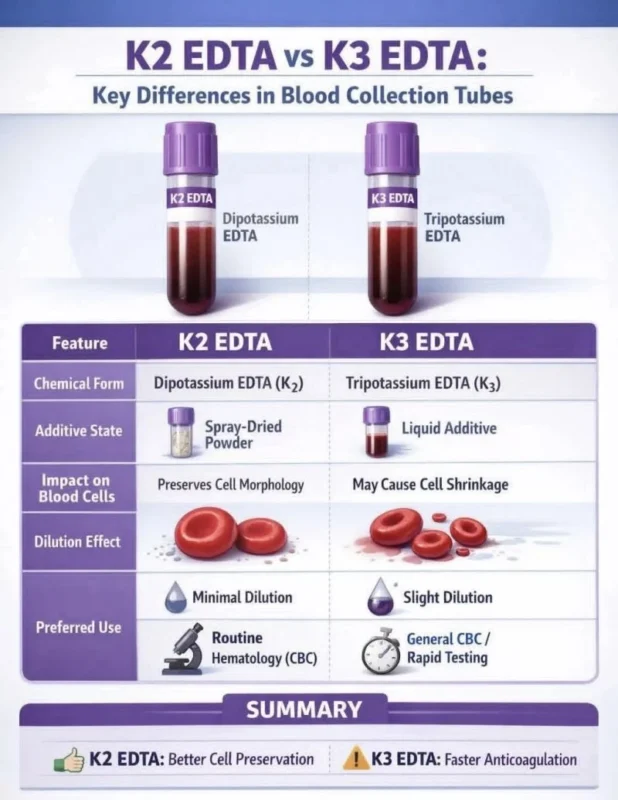
”K2 EDTA vs K3 EDTA – Key Differences Explained
Choosing the correct EDTA tube is critical for accurate hematology results.
Here’s a simple breakdown every lab professional should know
1. Chemical Composition
K2 EDTA → Dipotassium EDTA
K3 EDTA → Tripotassium EDTA
Both act as anticoagulants by binding calcium, preventing clot formation.
2. Additive Form
K2 EDTA → Spray-dried powder
K3 EDTA → Liquid additive
Liquid K3 EDTA can slightly dilute the blood sample.
3. Effect on Blood Cells
K2 EDTA
• Better preservation of cell morphology
• Accurate RBC, WBC and platelet counts
K3 EDTA
• May cause cell shrinkage
• Can affect MCV and hematocrit values
4. Dilution Effect
K2 EDTA → Minimal dilution
K3 EDTA → Slight dilution (due to liquid form)
5. Preferred Laboratory Use
K2 EDTA Gold standard for Routine CBC and Hematology
K3 EDTA
Used for general CBC / rapid testing
Summary
K2 EDTA → Better cell preservation and reliable CBC results
K3 EDTA → Faster anticoagulation but minor dilution effects
Most modern laboratories prefer K2 EDTA for routine hematology.
Lab Tip
Correct tube selection equals accurate results plus better patient care”
Stay updated with Hemostasis Today.
-
Sep 30, 2026, 01:52Javed Anees: DADA2 – When a Young Stroke Is More Than a Stroke
-
Sep 30, 2026, 01:51How a Venous Thrombus Becomes Revascularized – ISTH
-
Sep 29, 2026, 22:45Victor Agunyego: Paracetamol – The Most Common Drug We Underestimate
-
Sep 29, 2026, 22:42Nova Sinclair: Advancing the Future of Hematology – Meet Our 2027 Organizing Committee
-
Sep 29, 2026, 22:41Lorenz Räber: Intracoronary Imaging in PCI – Why, When, How, and Which Modality?
-
Sep 29, 2026, 22:31Selma Turkovic: Pleased to Deliver the Opening Presentation at Kingston Hospital
-
Sep 29, 2026, 22:31Miguel Teran: Ultrasound and Simulation in Arterial Blood Sampling
-
Sep 29, 2026, 22:28Mohammad Refaei: Navigating Your Career in Hematology From Training to Practice
-
Sep 29, 2026, 22:27Matteo Foschi: 10 Clinical Pearls for Antithrombotic Therapy in Secondary Stroke Prevention