

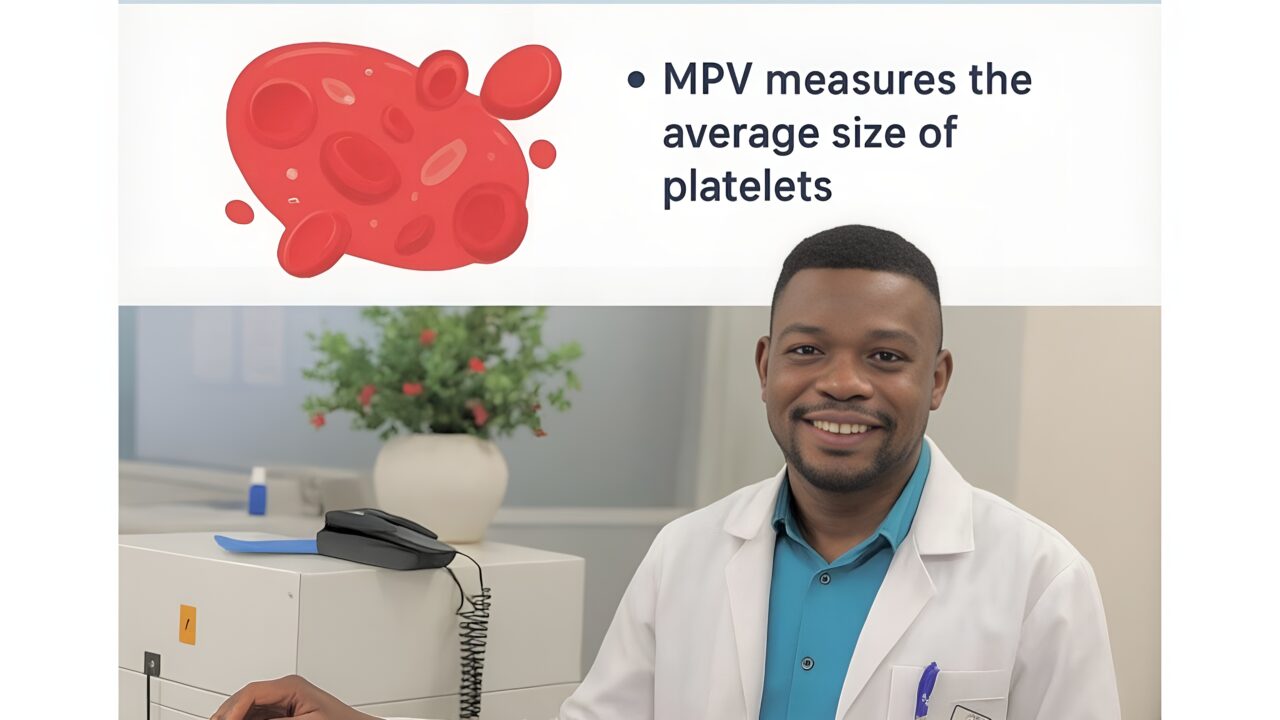
Samuel Nweke on Significance of MPV in a CBC in Diagnosis
Samuel Nweke, Deputy Lab Manager and Chairman of Quality Management Team at Malens Diagnostics, shared on LinkedIn:
”Significance of Mean Platelet Volume (MPV) in a Complete Blood Count (CBC) in Diagnosis
MPV:
Mean Platelet Volume (MPV) measures the average size of platelets in the blood.
It is automatically calculated by modern hematology analyzers.
Unit: femtoliters (fL)
Typical range: 7.5 – 11.5 fL
Platelet size reflects how active the bone marrow is in producing them.
Large platelets = younger, more reactive
Small platelets = older, less reactive
Interpretation of MPV Values:
Platelets circulate for about 8–10 days.
High MPV:
When platelet destruction increases (e.g., immune causes, inflammation, ITP), the bone marrow compensates by releasing larger, younger platelets — leading to a high MPV.
Low MPV:
When marrow production is suppressed or reduced (e.g., aplastic anemia, chemotherapy), the circulating platelets are smaller and fewer, resulting in a low MPV.
MPV and Platelet Count Relationship:
Low Platelet count + high MPV = Increased platelet destruction, marrow compensating (e.g., ITP)
Low Platelet count + low MPV = Decreased platelet production (e.g., marrow failure like aplastic anemia, leukemia, chemotherapy)
Low Platelet count + Normal MPV = Dilutional thrombocytopenia (e.g., massive transfusion) or splenic pooling
High Platelet count + high MPV = Myeloproliferative or inflammatory state
Normal platelet count + high MPV = Early platelet activation, inflammation, or cardiovascular risk marker
Calculation:
MPV = (PCT × 10⁴) ÷ PLT count
Where:
PCT: Plateletcrit, expressed as %
PLT: Platelet count in ×10⁹/L
Other Platelet Parameters:
P-LCR (Platelet Large Cell Ratio):
Percentage of large (young, newly released) platelets among total platelets.
P-LCC (Platelet Large Cell Count):
Absolute count of large platelets (volume >12 fL), expressed in ×10⁹/L.
PDW-SD (Platelet Distribution Width – Standard Deviation):
Reflects variability in platelet size, used to assess morphology and production.
PDW-CV (Platelet Distribution Width – Coefficient of Variation):
Quantifies degree of platelet anisocytosis (variation in size).
PCT (Plateletcrit):
Volume percentage (%) of platelets in whole blood. Similar to hematocrit (HCT) for red cells.
Understanding platelets will enable you to give a proper report on them.”
Stay updated with Hemostasis Today.
-
Oct 16, 2026, 10:07Habib Bennaceur: Building a Stronger Care Pathway for Sickle Cell Disease in India
-
Oct 16, 2026, 09:59Tareq Abadl: A Simple Guide to Blood Collection Tubes
-
Oct 16, 2026, 09:50Mona Alfaraj: Distinguishing HCL from SMZL in Bone Marrow
-
Oct 16, 2026, 09:44New International Consensus on Covert Brain Infarction – International Journal of Stroke
-
Oct 16, 2026, 06:17Neha Rastogi Panda: Precision Diagnosis and Organ Preservation in Splenic Abscess
-
Oct 16, 2026, 05:53Alejandro González Veliz: Looking Beyond Coronary Anatomy to Understand Ischemia
-
Oct 16, 2026, 04:16Asmaa M. Gouda: Advancing Blood Bank Leadership at Alexandria University Hospitals
-
Oct 16, 2026, 03:52Saja Al-Zamili: Minimally Invasive Hematoma Evacuation in Intracerebral Hemorrhage
-
Oct 16, 2026, 03:13Bhumika Satija: Beyond the Diploma A Growing Passion for Blood Banking and Transfusion Medicine