

Soroush Sohrabi: The Hidden Biology of Sclerotherapy and Mechanisms Beyond Endothelial Injury
Soroush Sohrabi, Consultant vascular and ednovascular surgeon at NMC Healthcare, shared a post on LinkedIn:
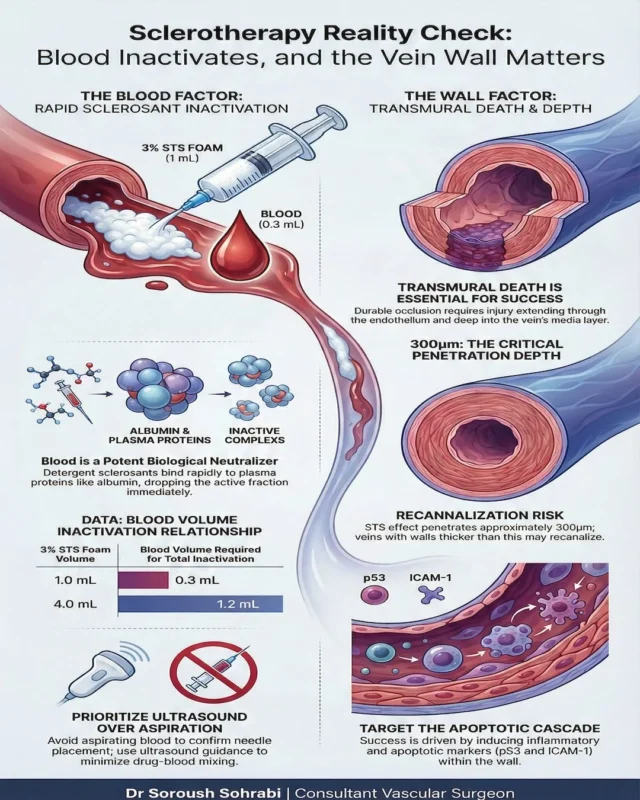
“Sclerotherapy Reality Check: Blood Inactivates — and the Vein Wall Matters
We often describe sclerotherapy in simple terms: inject the sclerosant, damage the endothelium, the vein closes.
The biology is more complex.
Two important experimental studies help clarify what is really happening:
‘Implication of foam sclerosant inactivation by human whole blood in a laboratory setting’
and
‘Media Damage Following Detergent Sclerotherapy Appears to be Secondary to the Induction of Inflammation and Apoptosis: An Immunohistochemical Study Elucidating Previous Histological Observations.’
These papers demonstrate two critical realities.
- First, blood is not passive. It actively reduces sclerosant activity. Detergent agents rapidly bind to plasma proteins such as albumin, forming inactive complexes. Even small volumes of blood can significantly decrease the active fraction available to act on the vein wall.
- Second, durable vein closure depends on more than superficial endothelial injury. Successful treatment requires deeper medial damage driven by inflammatory and apoptotic pathways. If injury remains too superficial relative to wall thickness, recanalisation becomes more likely.
In simple terms:
- Blood reduces effective drug activity
- The vein wall response determines durability
- Endothelial irritation alone is not enough
Why this matters clinically ?
These mechanistic insights help explain why outcomes vary:
- Larger veins behave differently from smaller veins
- Technique influences drug–wall contact time
- Mixing with blood reduces effective concentration
- Wall thickness influences long-term closure
- Sclerotherapy is not just a chemical injection. It is a biological interaction between sclerosant, blood, and vessel wall.
Understanding that interaction helps us refine technique, counsel patients more accurately, and improve durability of results.
What changes, if any, have these mechanisms prompted in your own approach to sclerotherapy?”
Stay updated with Hemostasis Today.
-
Sep 30, 2026, 15:39Ifeanyichukwu Ifechidere: The Molecular Orchestra of Primary Hemostasis
-
Sep 30, 2026, 15:28Reassessing the Benefit–Risk Balance of Extended Anticoagulation in Cancer Patients – ESC Working Group on Cardiovascular Pharmacotherapy
-
Sep 30, 2026, 15:07Chiranjeev Sharma: Targeting Factor XIa with the Synthetic Inhibitor SB-01
-
Sep 30, 2026, 14:41Bruna Gigante: Balancing Thrombosis and Bleeding in Cardiovascular Care
-
Sep 30, 2026, 14:13Ashok Choudhury: Portal Vein Thrombosis and Outcomes in Cirrhosis
-
Sep 30, 2026, 13:57Leslye Conde Bazán: When Conventional Imaging Is Not Enough – The Role of IVUS
-
Sep 30, 2026, 13:41Huda Salah Eldin: The Challenge of Balancing Antithrombotic Therapy After PCI
-
Sep 30, 2026, 13:29Abdus Salam: What Can CT Venography Reveal About the Veins?
-
Sep 30, 2026, 13:03Amira Mohy: Diagnostic Flow Cytometry Panels for Hematological Malignancies