


Joseph Raffaele: How Gut Aging Drives Cardiovascular Risk
Joseph Raffaele, Physician-Scientist in Longevity Medicine, CEO of PhysioAge LLC, posted on LinkedIn:
“The heart is one of the most sensitive organs to aging.
And now we’re learning it can respond to early degenerative signals coming from the gut.
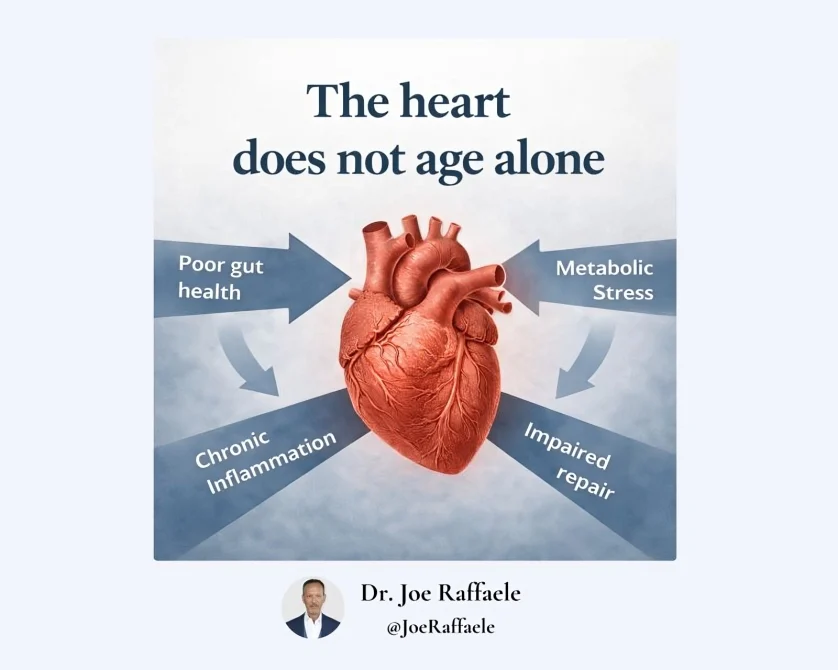
Cardiovascular aging is not an isolated process, as the heart sits downstream of metabolic, inflammatory, and immune signaling that comes from other organ systems.
A January 2026 study highlights one of those upstream drivers.
Researchers identified a hidden aging program in the gut, where intestinal stem cells accumulate predictable epigenetic changes over time. These changes weaken tissue repair, increase inflammatory signaling, and closely overlap with patterns seen in colon cancer.
Here’s why this matters for the heart:
Chronic gut inflammation increases systemic inflammatory load.
Systemic inflammation accelerates vascular stiffness, endothelial dysfunction, and atherosclerotic risk.
Over time, the cardiovascular system becomes the organ that reveals the cost.
Aging in the gut follows a structured, modifiable pattern. In lab models, restoring iron balance and key cellular signaling partially reversed epigenetic drift and improved cellular function.
This study also gives us a key reframe: the heart reflects the biology it is exposed to.
When inflammation, metabolic stress, and impaired repair accumulate, the cardiovascular system ages faster.
Protecting your heart includes protecting the systems that feed it.
Eating fiber-rich, plant-forward diets.
Reducing ultra-processed foods.
Managing chronic inflammation early, not waiting for disease to appear.
Cardiovascular aging assessment benefits from a wider biological lens. Inflammatory markers, metabolic health, and gut-related risk factors help explain vascular aging with greater prediction and precision than we have historically had access to.
If you want more grounded breakdowns like this, connecting organ systems, biology, and real-world risk, follow me here for ongoing insights.”
Title: Gut Microbiota, Probiotics, and Aging: Molecular Mechanisms and Implications for Healthy Aging
Author: Joo-Yun Kim
Read the Full Article on JMB

Stay updated with Hemostasis Today.
-
Sep 30, 2026, 01:52Javed Anees: DADA2 – When a Young Stroke Is More Than a Stroke
-
Sep 30, 2026, 01:51How a Venous Thrombus Becomes Revascularized – ISTH
-
Sep 29, 2026, 22:45Victor Agunyego: Paracetamol – The Most Common Drug We Underestimate
-
Sep 29, 2026, 22:42Nova Sinclair: Advancing the Future of Hematology – Meet Our 2027 Organizing Committee
-
Sep 29, 2026, 22:41Lorenz Räber: Intracoronary Imaging in PCI – Why, When, How, and Which Modality?
-
Sep 29, 2026, 22:31Selma Turkovic: Pleased to Deliver the Opening Presentation at Kingston Hospital
-
Sep 29, 2026, 22:31Miguel Teran: Ultrasound and Simulation in Arterial Blood Sampling
-
Sep 29, 2026, 22:28Mohammad Refaei: Navigating Your Career in Hematology From Training to Practice
-
Sep 29, 2026, 22:27Matteo Foschi: 10 Clinical Pearls for Antithrombotic Therapy in Secondary Stroke Prevention