

Abdul Mannan: The Dual Biology of the Sickle Cell Mutation
Abdul Mannan, Consultant Haematologist at Betsi Cadwaladr University Health Board, shared a post on LinkedIn about an article by Gavin Band et al. published in Nature, adding:
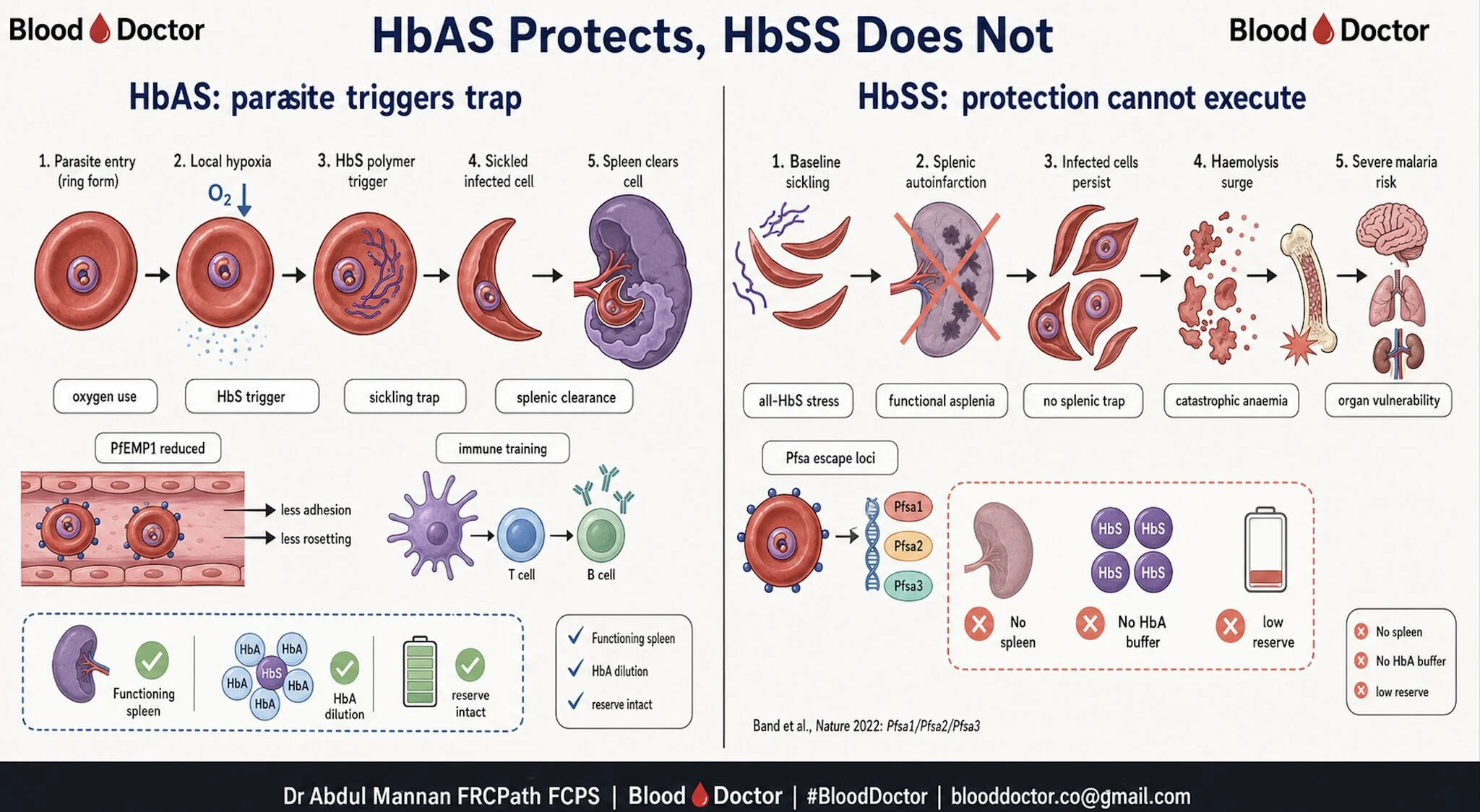
“The sickle mutation is not simply ‘protective’.
It depends on whether you inherit one copy or two.
That is the whole paradox.
Here’s the simple version:
- HbAS protects because the parasite creates local hypoxia inside the red cell
- That triggers limited HbS polymerisation
- The infected red cell sickles
- A working spleen clears it, parasite included
- Less PfEMP1 reaches the cell surface, so there is less adhesion and rosetting
But HbSS is different:
- The spleen is often lost early through repeated infarction
- Red cells are already under sickling stress
- There is no HbA buffer
- Baseline anaemia leaves little reserve
- Malaria then adds haemolysis on top of haemolysis
So the same mutation can act like a trap in HbAS, but becomes a liability in HbSS.
A 2022 Nature paper by Band et al. added another layer: HbS protection also depends on parasite genotype, with Pfsa1, Pfsa2 and Pfsa3 loci linked to parasites that can cause severe malaria despite HbS.
For trainees, this is a beautiful teaching point:
Genetics is never isolated from environment.
And malaria wrote part of the sickle cell story.
What is your favourite example of evolution shaping haematology?”
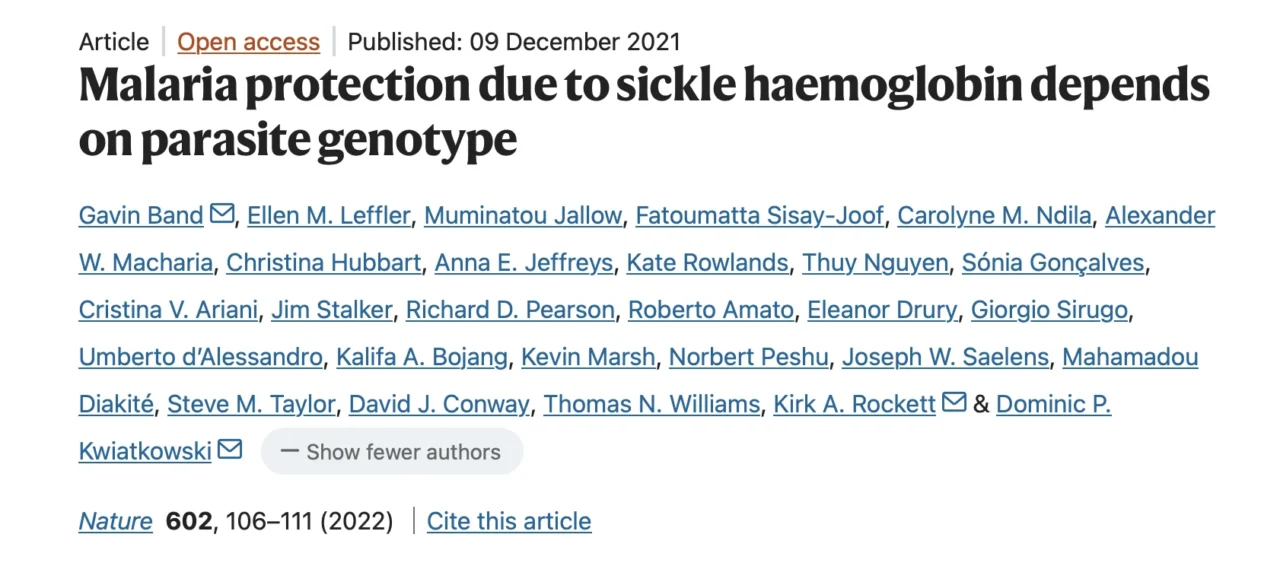
Title: Malaria protection due to sickle haemoglobin depends on parasite genotype
Authors: Gavin Band, Ellen M. Leffler, Muminatou Jallow, Fatoumatta Sisay-Joof, Carolyne M. Ndila, Alexander W. Macharia, Christina Hubbart, Anna E. Jeffreys, Kate Rowlands, Thuy Nguyen, Sónia Gonçalves, Cristina V. Ariani, Jim Stalker, Richard D. Pearson, Roberto Amato, Eleanor Drury, Giorgio Sirugo, Umberto d’Alessandro, Kalifa A. Bojang, Kevin Marsh, Norbert Peshu, Joseph W. Saelens, Mahamadou Diakité, Steve M. Taylor, David J. Conway, Thomas N. Williams, Kirk A. Rockett, Dominic P. Kwiatkowski
Other posts featuring Abdul Mannan on Hemostasis Today.
-
Sep 28, 2026, 19:14Aditya Sharma: An Outstanding Start to the Final Day of VSS 2026!
-
Sep 28, 2026, 19:07Dhargam Aljebouri: AIHA Subclassification Research Presented at the 14th Iraqi Society of Hematology Conference
-
Sep 28, 2026, 19:02William Wallace: Your Cholesterol Test is Missing a Particle that May Matter More than the One it Measures
-
Sep 28, 2026, 18:57Indu Thakur: Honoring Sickle Warriors and Advancing Diverse Blood Donation at Sickle Ball 2026
-
Sep 28, 2026, 18:48Orly Leiva: Rethinking JAK Inhibitor Cardiovascular Safety in MPNs
-
Sep 28, 2026, 18:42Wael Saad: Honored to Be Part of Portal and Mesenteric Vein Thrombosis Session at CIRSE 2026
-
Sep 28, 2026, 18:35Alejandro González Veliz: The Unbroken Connection Between Heart and Brain
-
Sep 28, 2026, 16:43Scott Sutton: Community and Connection in Immune Thrombocytopenia
-
Sep 28, 2026, 16:24Pankti Solanki: ISBT Recognized JAMA as the 49th Human Blood Group System