


Aloke Finn: Silent Plaque Rupture and Healing in Coronary Artery Disease
Aloke Finn, President and Chief Scientific Officer at CVPath Institute, Inc., Clinical Professor at University of Maryland School of Medicine, shared on LinkedIn about a recent article he and his colleagues co-authored, adding:
”Plaque rupture is often thought of as a terminal event leading to occlusive thrombus formation and the development of acute myocardial infarction.
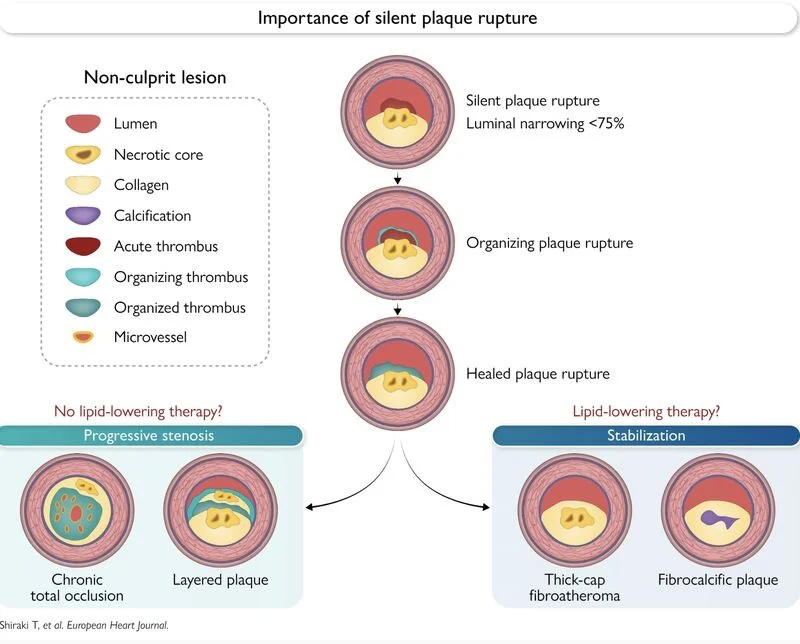
However, pathological studies have shown that high-grade stenoses often contain sites of multiple prior plaque ruptures, even in patients without a history of a coronary event, suggesting that silent plaque rupture may occur and be a driver of disease progression.
Here we comment on a novel study by Kakizaki et al. and Lorenz Räber published in the European Heart Journal using pooled data from the IBIS-4 and PACMAN-AMI trials which examined 783 non-culprit lesions in 336 patients with acute myocardial infarction who underwent serial multimodality intracoronary imaging at baseline and 52 weeks.
Silent plaque rupture was identified in 41 non-culprit lesions (5.2%), with visible thrombus present in only 10 of these lesions (1.3%). Among the 41 non-culprit lesions with plaque rupture at baseline, serial OCT at 52 weeks revealed that 21 (51.2%) had healed, with the healed lesions showing fibrous plaque (61.9%), layered plaque (28.6%), and thick-cap fibroatheroma (9.5%).
Their findings reinforce the concept that coronary artery disease progression is driven not only by de novo plaque growth but also by repetitive cycles of subclinical rupture and healing.
Future studies with larger sample sizes, longer follow-up periods, and systematic evaluation of the pharmacological interruption of this cycle are needed to fully elucidate the clinical implications of silent plaque rupture and to identify patients who may benefit from intensified preventive strategies before further disease progression occurs.
Nice work by our star fellow Tatsuya Shiraki!”
Title: The silent culprit: why ‘hidden’ plaque ruptures matter Get access Arrow
Authors: Tatsuya Shiraki , Aloke V Finn , Renu Virmani
Read the Full Article on European Heart Journal

Stay updated on all scientific advances with Hemostasis Today.
-
Sep 18, 2026, 14:33Heghine Khachatryan: The discussion of Thrombophilia, APS and Coagulation Testing
-
Sep 18, 2026, 14:27Maria Cherska: Are We Overlooking the Spleen in Cardiometabolic Research?
-
Sep 18, 2026, 14:05Wolfram Ruf: Managing Thrombotic Risk in Pregnancy
-
Sep 18, 2026, 13:38Sam Tsimikas: Uncovering a Modifiable Lp(a) Phenotype in Hypertriglyceridemia
-
Sep 18, 2026, 13:22Christine Rabinak: Predictive Modeling for Individualized Unfractionated Heparin Dosing
-
Sep 18, 2026, 13:07Bastu Odoka: Principles of Pediatric Transfusion Dosing
-
Sep 18, 2026, 12:54David McIntosh: Plasma Therapies and the Unfinished Global Access Mission
-
Sep 18, 2026, 11:10R. Stephani Hellwege: Beyond LVEF Echocardiographic Assessment of Undifferentiated Shock
-
Sep 18, 2026, 06:48Gopal Patidar: Honoured to Contribute to the ASFA 2026 Guidelines for Therapeutic Apheresis