


From Risk Visualization to Plaque Change: Babak Alex Vakili on CAC and CCTA Insights
Babak Alex Vakili, President and CEO at Heart Vein and Vascular Clinic, shared on LinkedIn:
”When I first opened this JAMA paper, I was drawn in by a simple, practical question: if we use coronary artery calcium (CAC) scoring to “show the risk” and then treat aggressively, do we actually change plaque progression on coronary CT angiography (CCTA), not just LDL on a lab sheet?
The investigators enrolled adults with a family history of coronary disease and randomized them to 2 strategies. One group received a CAC score–informed prevention program with structured counseling and preventive therapy, including atorvastatin 40 mg daily.
The other group received usual care. Everyone underwent CCTA at baseline and again at 3 years, and the core outcome was quantitative plaque volume and plaque composition, not symptoms and not MACE.
What I liked is that they did not stop at “total plaque.” They separated plaque into calcified and noncalcified components, and they further broke down noncalcified plaque into subtypes that we associate with higher risk biology.
The headline result is straightforward. Total plaque volume increased in both groups over 3 years, but it increased less in the CAC score–informed treatment strategy.
In parallel, noncalcified plaque progression was meaningfully lower with the treatment strategy, and the higher risk components (fibrofatty plus necrotic core) were also lower with treatment.
LDL-C dropped substantially more in the treatment arm, which is exactly what you would expect when one group is systematically treated and followed while the other is not.
Now the part that people latch onto, and I think it is worth being explicit about it.
Calcified plaque volume increased in both groups and was numerically higher in the treatment group at follow-up. The change in calcified plaque volume was plus 10.1 mm³ with treatment versus plus 8.9 mm³ with usual care, and follow-up calcified plaque volume was 40.9 mm³ versus 35.3 mm³.
Importantly, this between-group difference was not statistically significant, so I would not interpret this as “statins cause harmful plaque progression.” If anything, paired with lower noncalcified and lower higher risk plaque, it is more consistent with a compositional shift toward calcification that may reflect stabilization biology.
My take : CAC guided prevention can change the kind of plaque that grows.
Total plaque grows more slowly, noncalcified plaque grows much more slowly, and the more concerning noncalcified components shrink or barely grow.
Meanwhile, calcified plaque can still increase, and may even look higher in the treated group, which is exactly why CAC progression alone can be a misleading endpoint when you are actively treating patients.”
Read the full article here.
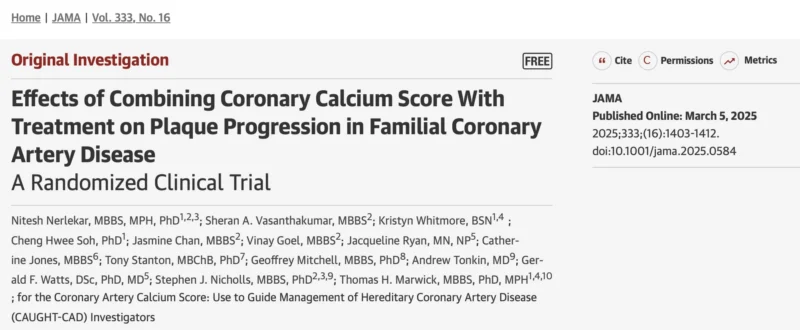
Article: Effects of Combining Coronary Calcium Score With Treatment on Plaque Progression in Familial Coronary Artery Disease: A Randomized Clinical Trial
Authors: Nitesh Nerlekar, Sheran A. Vasanthakumar, Kristyn Whitmore, Cheng Hwee Soh, Jasmine Chan, Vinay Goel, Jacqueline Ryan, Catherine Jones, Tony Stanton, Geoffrey Mitchell, Andrew Tonkin, Gerald F. Watts, Stephen J. Nicholls, Thomas H. Marwick for the Coronary Artery Calcium Score: Use to Guide Management of Hereditary Coronary Artery Disease (CAUGHT-CAD) Investigators
Stay updated on all scientific advances with Hemostasis Today.
-
Sep 11, 2026, 16:38Jim Kaveney: Class I, Level A – Lifestyle is Now the Official Standard in AFib Care
-
Sep 11, 2026, 16:31George Touma: Do We Really Need to Implant Metal in Every High-Bleeding-Risk Patient?
-
Sep 11, 2026, 16:24Yonah S. Tehrani: CDT vs Anticoagulation in Intermediate High Risk PE – The PRAGUE-26 Trial
-
Sep 11, 2026, 16:09Elad Anter։ A New Map of Atrial Fibrillation Initiation
-
Sep 11, 2026, 15:55Marwa Mostafa: The Paradox of Sideroblastic Anemia
-
Sep 11, 2026, 15:37Empowering Local Stakeholders to Advance Hemophilia Care in Côte d’Ivoire – World Federation of Hemophilia
-
Sep 11, 2026, 15:34Dhargam Aljebouri: A New Milestone for Transfusion Education in Iraq
-
Sep 11, 2026, 15:17Shadi Tabibian: Where Laboratory Precision Meets Clinical Care
-
Sep 11, 2026, 14:58Kevin Land: Connecting Donors to Patients Across the Spectrum of Care