


Chiara Novelli: Are We Validating Laboratory Algorithms as Rigorously as We Validate Laboratory Tests?
Chiara Novelli, Senior Biologist at Legnano Civil Hospital, shared a post on LinkedIn about a recent article she and her colleagues co-authored, published in International Journal of Laboratory Hematology, adding:
“Recently, our work on the implementation and validation of an automated Lupus Anticoagulant interpretation algorithm has been published in the ‘International Journal of Laboratory Hematology’.
The project was developed across a four-hospital laboratory network and focused not only on LA testing itself, but also on a broader question that many laboratories are increasingly facing:
How should we properly validate rule-based algorithms implemented in middleware and LIS environments?
As laboratory diagnostics become more complex, middleware systems are evolving from simple technical tools into true decision-support platforms.
However, while analytical validation is highly standardized, validation strategies for middleware algorithms often remain heterogeneous and poorly defined.
In our experience, key elements for a robust validation framework include:
- Hierarchical and traceable rule design
- Retrospective and prospective validation
- Discrepant-case analysis
- Management of analytical interferences and exceptions
- Continuous post-implementation monitoring
- Preservation of expert oversight for complex cases
Beyond standardization and turnaround time optimization, one of the most interesting aspects was observing how structured workflows can reduce inter-operator variability and support less experienced professionals without replacing clinical expertise.
I believe this topic goes far beyond coagulation testing and may become increasingly relevant for laboratory governance, accreditation processes, and AI-assisted diagnostics.
I would be very interested to hear how other laboratories are approaching these challenges:
- How do you validate middleware algorithms in your institution?
- Do you use retrospective datasets, prospective parallel testing, or both?
- How do you manage traceability and version control of rules?
- Where do you draw the line between autoverification and mandatory expert review?
- Are existing CLSI/ISTH recommendations sufficient for modern middleware ecosystems?”
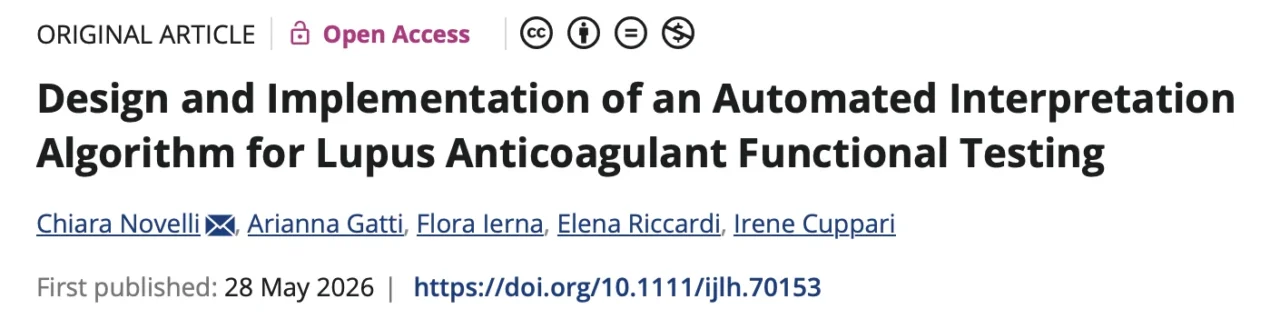
Title: Design and Implementation of an Automated Interpretation Algorithm for Lupus Anticoagulant Functional Testing
Authors: Chiara Novelli, Arianna Gatti, Flora Ierna, Elena Riccardi, Irene Cuppari
Stay updated on all scientific advances with Hemostasis Today.
-
Oct 20, 2026, 16:51Suzan Nakasendwa: A Growing Stroke Challenge in Uganda
-
Oct 20, 2026, 16:38Steve Moon: How Does Smoking Cessation Duration Affect Ischemic Stroke Risk
-
Oct 20, 2026, 16:25Cedrice Mentor: Reducing Platelet Wastage Through Cold Storage
-
Oct 20, 2026, 16:09Thirunavukkarasu Angappan: Can a Purified Fibrinogen Concentrate Replace Cryoprecipitate
-
Oct 20, 2026, 16:01Kalyan Roy: Platelet Conservation Through Evidence-Based Transfusion Practice
-
Oct 20, 2026, 15:28Stacy E. Croteau: 33 Countries, One Mission – Better Bleeding Disorder Care
-
Oct 20, 2026, 15:19Teresa Barnes: What Does a Pulmonary Embolism Mean for Jalen Hurts?
-
Oct 20, 2026, 15:04Laura S.: Could Speaking Up Prevent Maternal Deaths from Thrombosis?
-
Oct 20, 2026, 14:44Pete Stibbs: VTE in Professional Athletes – When Fitness Is Not Enough