


Damon Race: Transgene Biology and Durability in Hemophilia Gene Therapy
Damon Race, President and CEO of GeneVentiv Therapeutics, Inc., shared Paris Margaritis’s post on LinkedIn:
“What drives durability in hemophilia gene therapy?
This excellent paper raises an important question: does the biology of the transgene itself help determine durability?”
Paris Margaritis, Chief Scientific Officer at GeneVentiv Therapeutics, Inc, shared on LinkedIn about a recent article by Roland W. Herzog et al, published in Molecular Therapy, adding:
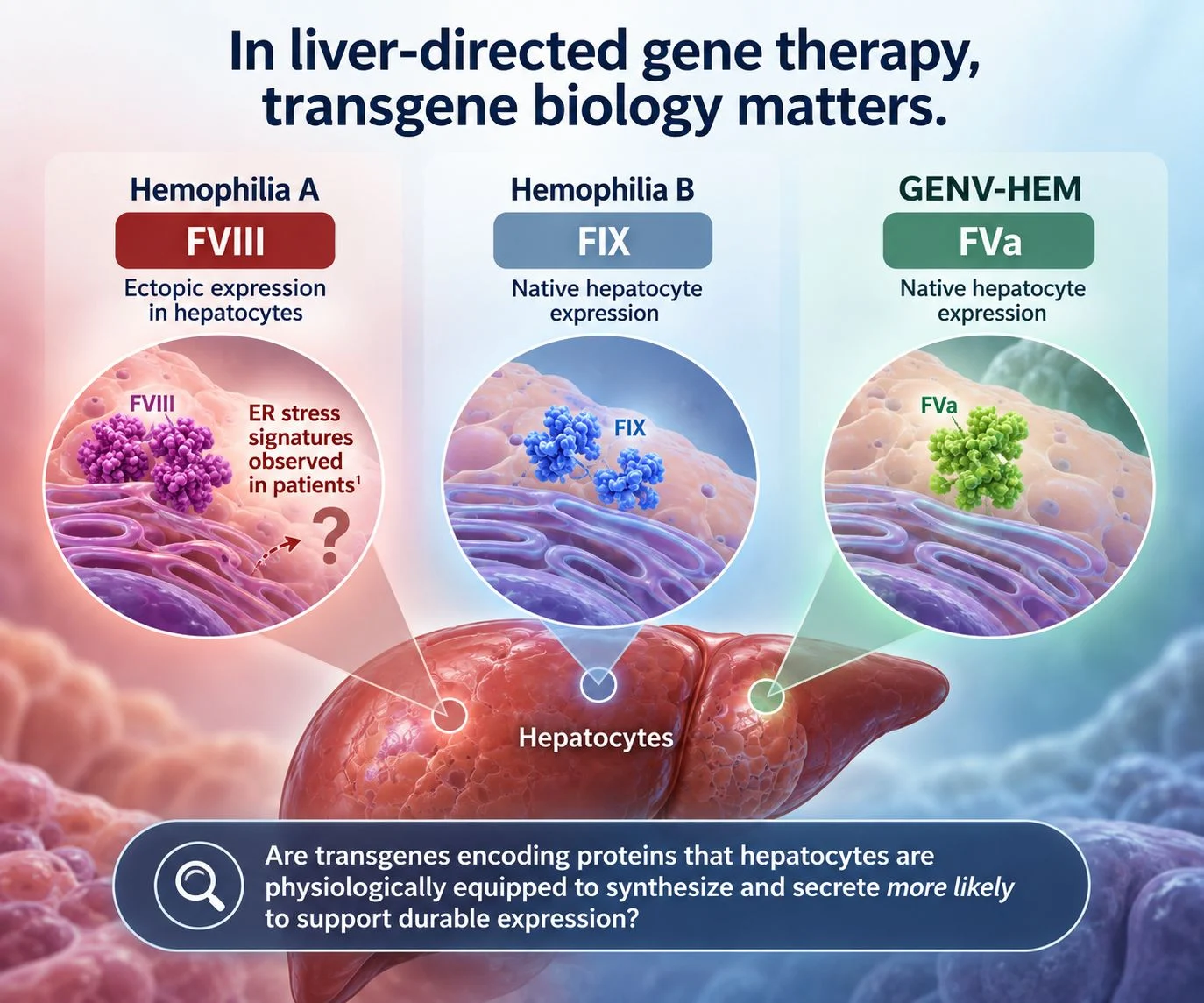
“In liver directed gene therapy, transgene biology matters.
ER stress and the unfolded protein response (UPR) have long been proposed as contributors to declining FVIII expression following liver directed AAV gene transfer, but much of the evidence has been preclinical.
Enter a recent Molecular Therapy article discussing new clinical observations following valoctocogene roxaparvovec (ROCTAVIAN) treatment that provide evidence of ER stress in the setting of hepatic FVIII expression.
Together with prior preclinical work, the authors suggest that cellular stress and immune responses may be interconnected and contribute to loss or silencing of FVIII expression.
An important biological point is that FVIII expression in hepatocytes is ectopic.
FVIII is normally produced by liver sinusoidal endothelial cells, whereas liver directed AAV based hemophilia A gene therapy asks hepatocytes to produce substantial amounts of FVIII.
At the same time, the contrast with hemophilia B gene therapy is very interesting.
With AAV5 FIX, liver toxicity and durability have been less problematic, with most patients achieving stable FIX expression.
Unlike FVIII, FIX is physiologically produced by hepatocytes.
We would all agree that these observations do not establish causality, but they raise an important question:
Are transgenes encoding proteins that hepatocytes are physiologically equipped to synthesize and secrete more likely to support durable expression?
This question is relevant to our work with GENV HEM at GeneVentiv Therapeutics, Inc., which is designed for liver directed expression of activated Factor V rather than FVIII.
Factor V is natively expressed in hepatocytes, providing a different biological context for hemophilia gene therapy.
In sum, the emerging clinical data, as discussed in the article, add an interesting piece of evidence to a mechanism that has been discussed for some time and reinforce the importance of considering not only the vector and target cell, but the biology of the transgene itself.
Congratulations to Roland W Herzog and Radoslaw (Radek) Kaczmarek for this thoughtful perspective.”
Title: Hepatotoxicity in clinical gene therapy for hemophilia A: Cellular stress and the immune system
Authors: Roland W. Herzog, Radoslaw Kaczmarek
Stay updated on all scientific advances with Hemostasis Today.
-
Sep 26, 2026, 14:01Chandra Viswanathan: Building a Stronger Blood and Plasma Ecosystem for India
-
Sep 26, 2026, 13:42Dhamirah Nazihah Mohd Nasiruddin: Bridging Clinical Suspicion and Laboratory Diagnosis in TMA
-
Sep 26, 2026, 13:42Anna Dunn: Long-Term Anticoagulation After Pulmonary Embolism
-
Sep 26, 2026, 09:49Manuel Monreal: Acute VTE in Patients With Severe Renal Insufficiency
-
Sep 26, 2026, 09:38New TIF Guidelines for Emergency Care in Thalassaemia and SCD
-
Sep 26, 2026, 09:28Annette Bowyer: Rethinking Product Specific Calibrators in Haemophilia
-
Sep 26, 2026, 09:21Nisanth Menon: When Emergency Medicine Meets Transfusion Medicine
-
Sep 26, 2026, 07:50Giuseppe Andò: P2Y12 Inhibition in Diabetes – A Personalized Approach
-
Sep 26, 2026, 07:36Tiffany Hall: Honored to Be Recognized for Advancing Blood Health