


Edward Lee Carter: Why Periprocedural DOAC Guidance Needs a Common Output Standard
Edward Lee Carter, Clinical Pharmacist Practitioner at U.S. Department of Veterans Affairs, shared on LinkedIn about his recent article published in Annals of Pharmacotherapy, adding:
“Five tools. One patient. Same plan before surgery. Different answers after.
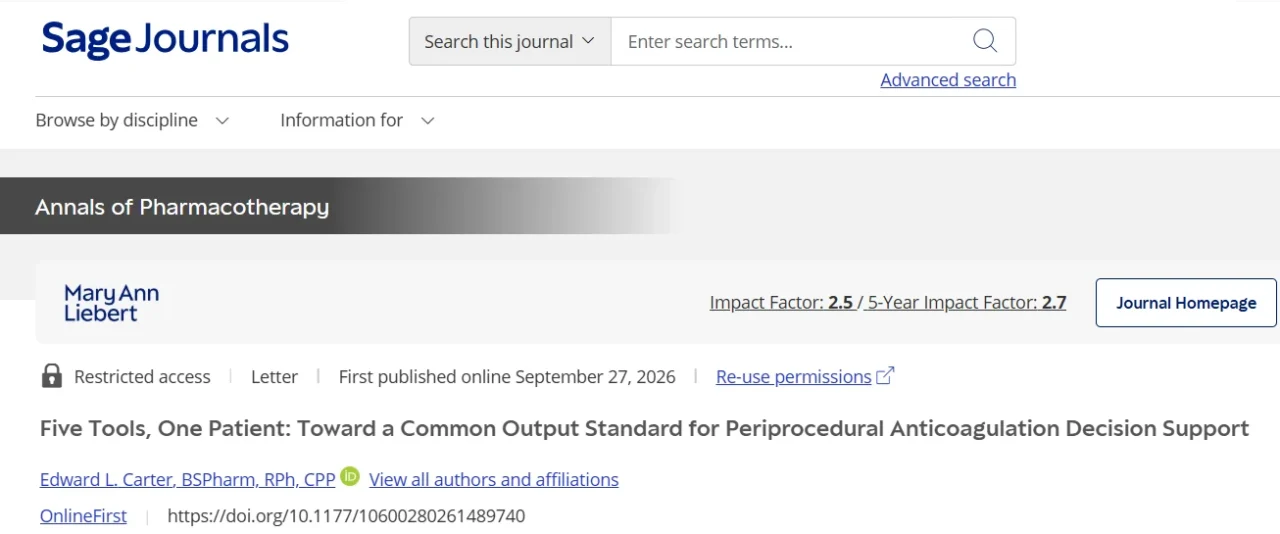
My Letter to the Editor is now published in Annals of Pharmacotherapy.
Periprocedural DOAC management is usually framed as a pharmacokinetic problem.
In practice, it’s also a translation problem. ‘Hold 2 days,’ ‘skip 4 doses,’ and ‘stop at least 48 hours’ all have to become one unambiguous medication calendar, at the exact moment when both clot and bleeding risk are elevated.
I ran one hypothetical patient through 5 publicly available resources: IPRO MAPPP, ACC ManageAnticoag, Thrombosis Canada, Anticoagulation Forum guidance, and the MAQI2 Toolkit.
The patient: 79 years old, nonvalvular AF, apixaban 5 mg twice daily, CrCl 55, CHA2DS2-VASc 7, scheduled for total knee arthroplasty.
Before surgery, all 5 tools agreed:
- Last dose on day -3
- Hold on days -2 and -1, and on the day of surgery
- No therapeutic heparin bridging
- Resume at 48 to 72 hours if hemostasis is adequate
After surgery, they diverged.
Some surfaced reduced-dose DOAC or prophylactic LMWH before therapeutic resumption.
Others went straight to therapeutic apixaban at 48 to 72 hours.
That matters because:
- VTE prophylaxis is not therapeutic AF anticoagulation.
- CHA2DS2-VASc does not estimate postoperative VTE risk.
The letter proposes a minimum common output standard.
It doesn’t require identical algorithms, only explicit outputs: the indication, the final dose with date and time, every omitted dose, whether parenteral therapy is bridging or prophylaxis, the conditional restart window, the hemostatic checkpoint, the accountable clinician, and the evidence source, version, and review date.
Decision support should standardize the workflow, not merely shorten the recommendation.”
Title: Five Tools, One Patient: Toward a Common Output Standard for Periprocedural Anticoagulation Decision Support
Authors: Edward L. Carter
Stay updated on all scientific advances with Hemostasis Today.
-
Sep 29, 2026, 16:07Yasmine Laraba: Deep Vein Thrombosis Causes, Signs and Management
-
Sep 29, 2026, 16:01Stephen Cornelissen: How Joining the Stem Cell Registry Can Save Patients with Blood Cancers
-
Sep 29, 2026, 15:45Alan Nurden: Could Mast Cell aIIb Integrin Play a Key Role in Septic Thrombus Stability?
-
Sep 29, 2026, 15:43Priyadarshani Sharma: Advocacy and Patient Rights Transform Indian Haemoglobinopathies Care
-
Sep 29, 2026, 15:21Kanchan K Banerjee: Rusfertide Earns NCCN Category 1 Recommendation for Polycythemia Vera
-
Sep 29, 2026, 15:06Faizan Khan։ The Worldwide Burden of Venous Thromboembolism
-
Sep 29, 2026, 14:59Global Von Willebrand Disease Diversity Webinar Now Available on EHC YouTube – EHC
-
Sep 29, 2026, 14:43Mary Cushman: Apply to Shape Scientific Publishing as ISTH Associate Editor
-
Sep 29, 2026, 14:32Honoring Women Leaders Advancing Research, Care, and Innovation in Thrombosis and Hemostasis – Seminars in Thrombosis and Hemostasis