


Francisco Chacón-Lozsán: Thromboinflammation and Coagulation Dysfunction in Cirrhosis
Francisco Chacón-Lozsán, Fellow at World Extreme Medicine, Member of European Society of Intensive Care Medicine (ESICM) and American College of Cardiology, shared a post on LinkedIn about a recent article by Shari Rogal et al. published in Annals of Internal Medicine, adding:
“Cirrhosis is no longer just a ‘liver disease.’
This review summarizes how inpatient cirrhosis management has fundamentally evolved from static ‘end stage liver disease care’ into dynamic risk stratification and organ support.
One of the most important modern concepts highlighted:
‘Cirrhosis’ is increasingly being replaced by the concept of compensated advanced chronic liver disease (cACLD).
A particularly important ICU and ward management point:
Variceal bleeding management has changed.
Modern evidence supports:
- Restrictive transfusion strategy
- Early vasoactive therapy
- Early antibiotics
- Rapid endoscopy
- Selective early TIPS in high risk patients
One major physiological misconception continues to harm patients:
Elevated INR in cirrhosis does NOT equal auto anticoagulation.
Cirrhosis creates a ‘rebalanced’ coagulation state where patients can simultaneously:
- Bleed
And
- Thrombosis
This explains why routine FFP correction before paracentesis is no longer recommended and why portal vein thrombosis remains common.
Another critical update:
Ascites management is not simply ‘give diuretics.’
The review reinforces that:
- Sodium restriction is foundational
- Albumin remains physiologically crucial
- Aggressive fluid shifts can precipitate renal collapse
- Diagnostic paracentesis should be routine in hospitalized patients with ascites, even without symptoms
Perhaps one of the most important modern concepts:
Hepatic encephalopathy is not merely ‘high ammonia.’
The article emphasizes:
- Systemic inflammation
- Infection triggers
- Electrolyte disturbances
- Medications
- Renal dysfunction
- Gut microbiome interactions as central drivers of encephalopathy.
And importantly:
Protein restriction is now contraindicated.
This is a major paradigm shift from older teaching.
Patients with cirrhosis require:
- Aggressive nutritional support
- High protein intake
- Sarcopenia prevention
- Late night protein supplementation
One of the strongest messages of the paper:
Every hospitalization for decompensated cirrhosis should trigger transplant thinking.
Not ‘end stage management.’
Not passive stabilization.
But active reassessment of:
- Prognosis
- Reversibility
- Candidacy
- Goals of care
- Frailty
- Transplant referral timing
For intensivists and hospitalists, cirrhosis management is increasingly becoming a discipline of:
- Hemodynamic physiology
- Renal protection
- Inflammation control
- Nutritional optimization
- Procedural timing
- Multidisciplinary coordination
Rather than isolated hepatology alone.”
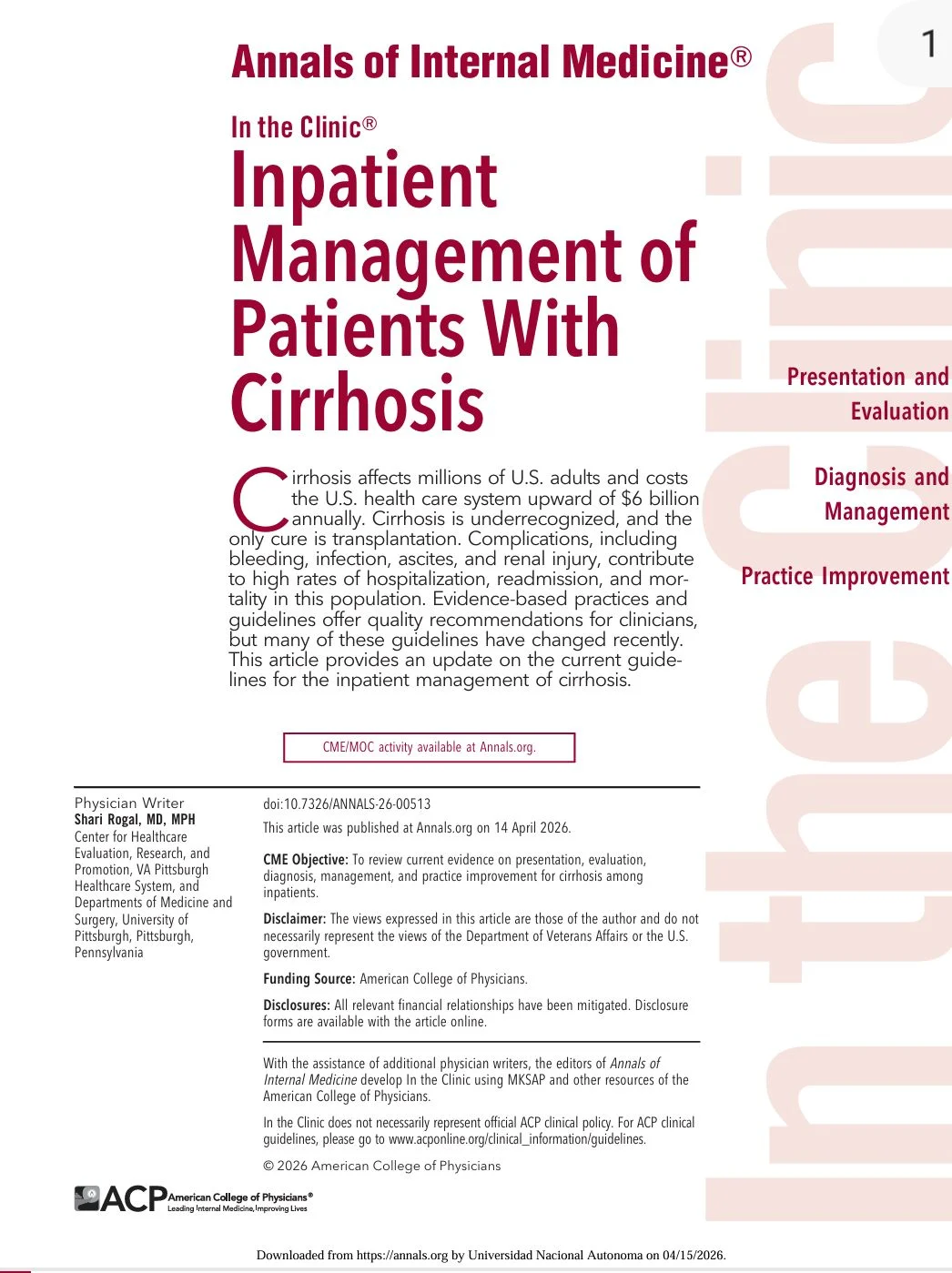
Title: Inpatient Management of Patients With Cirrhosis
Author: Shari Rogal
Stay updated on all scientific advances with Hemostasis Today.
-
Sep 29, 2026, 22:45Victor Agunyego: Paracetamol – The Most Common Drug We Underestimate
-
Sep 29, 2026, 22:42Nova Sinclair: Advancing the Future of Hematology – Meet Our 2027 Organizing Committee
-
Sep 29, 2026, 22:41Lorenz Räber: Intracoronary Imaging in PCI – Why, When, How, and Which Modality?
-
Sep 29, 2026, 22:31Selma Turkovic: Pleased to Deliver the Opening Presentation at Kingston Hospital
-
Sep 29, 2026, 22:31Miguel Teran: Ultrasound and Simulation in Arterial Blood Sampling
-
Sep 29, 2026, 21:47Javed Anees: DADA2 – When a Young Stroke Is More Than a Stroke
-
Sep 29, 2026, 22:28Mohammad Refaei: Navigating Your Career in Hematology From Training to Practice
-
Sep 29, 2026, 22:27Matteo Foschi: 10 Clinical Pearls for Antithrombotic Therapy in Secondary Stroke Prevention
-
Sep 29, 2026, 22:26A Global Call for Action on Cardiovascular Health on World Heart Day – ISTH