


Francisco Chacón-Lozsán։ Why the Endothelial Glycocalyx Matters at the Bedside
Francisco Chacón-Lozsán, Fellow at World Extreme Medicine, Member of European Society of Intensive Care Medicine (ESICM) and American College of Cardiology, shared a post on LinkedIn about a recent article by Marcela de Almeida Lopes et al, published in Journal of Critical Care, adding:
”The endothelial glycocalyx: why it matters at the bedside
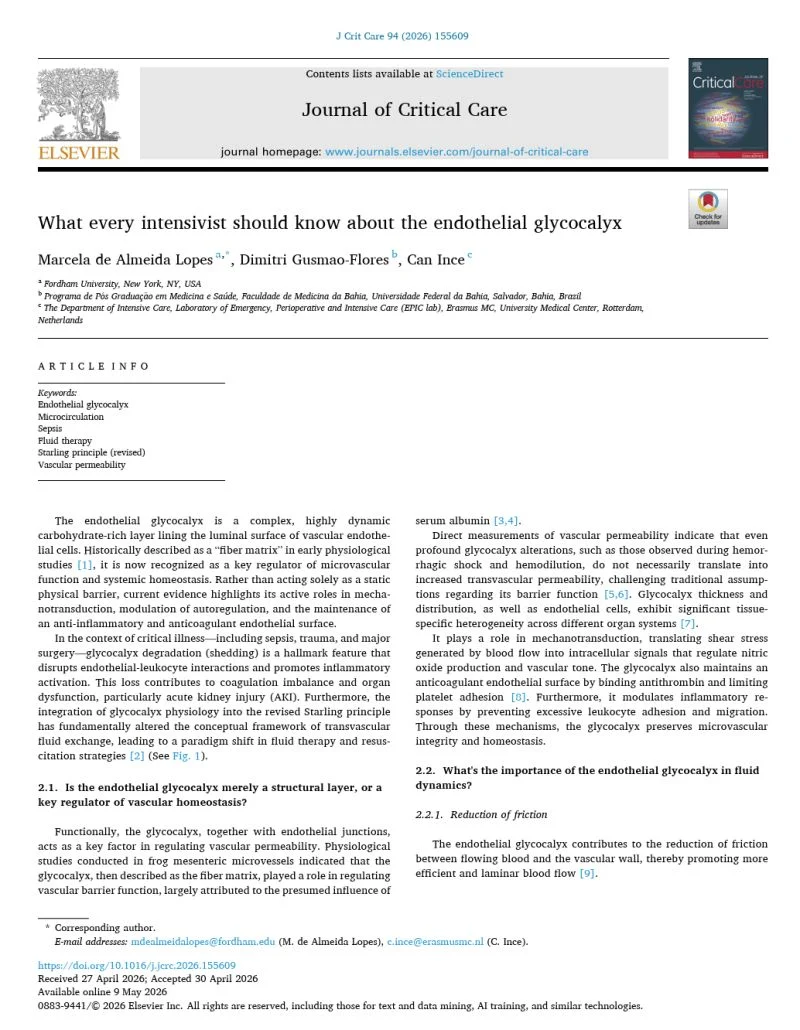
The endothelial glycocalyx is increasingly changing how we understand microcirculation, vascular permeability and fluid therapy in critically ill patients.
Rather than being simply a physical barrier covering the endothelium, the glycocalyx is a dynamic structure involved in mechanotransduction, vascular tone, anticoagulation and regulation of inflammatory cell adhesion.
This becomes particularly relevant during critical illness.
In sepsis, septic shock, trauma, burns, cardiac surgery and ARDS, inflammatory cytokines, oxidative stress, ischemia reperfusion, hyperglycemia and high catecholamine exposure can promote glycocalyx shedding. Importantly, excessive intravenous fluid administration may further contribute to this injury.
The consequence is not simply ‘capillary leak.’
Loss of glycocalyx integrity promotes interstitial edema, impaired oxygen diffusion, leukocyte and platelet adhesion, inflammation, microthrombosis and ultimately microcirculatory dysfunction.
One of the most clinically important concepts is its relationship with the revised Starling principle.
The effective oncotic pressure gradient is considered to exist primarily between plasma and the subglycocalyx space, rather than between plasma and the interstitium. Sustained venous end capillary reabsorption is minimal, with excess interstitial fluid predominantly returning through the lymphatic system.
This helps explain an everyday ICU observation:
Giving more fluid does not necessarily produce sustained intravascular volume expansion.
When the endothelial surface is already damaged, aggressive fluid administration may instead increase edema and potentially aggravate glycocalyx injury. This provides a physiological rationale for increasingly individualized and restrictive fluid strategies rather than indiscriminate liberal resuscitation.
Can we monitor the glycocalyx?
Syndecan 1, heparan sulfate, glycosaminoglycans and hyaluronan have been studied as circulating markers of shedding. Handheld vital microscopy can evaluate the microcirculation and estimate parameters associated with glycocalyx integrity, but these remain indirect measurements and are not yet standardized for routine clinical practice.
For now, perhaps the most clinically applicable strategy is prevention: avoid unnecessary fluid overload, control hyperglycemia, treat sepsis effectively and minimize ischemia reperfusion injury. No therapy has yet been conclusively demonstrated to regenerate the human glycocalyx.”
Title: What every intensivist should know about the endothelial glycocalyx
Authors: Marcela de Almeida Lopes, Dimitri Gusmao-Flores, Can Ince
Stay updated on all scientific advances with Hemostasis Today.
-
Oct 9, 2026, 16:23David Boone: Distinguishing Stroke Prevention from Rhythm Control in Atrial Fibrillation
-
Oct 9, 2026, 15:27Mohamed Hegazi: Geostatistical Modelling Maps Global β-Thalassaemia Carrier Prevalence
-
Oct 9, 2026, 15:15Maha Othman: Uncovering the Consensus on TXA in TBI – Call for Collaboration on a Landmark Umbrella Review
-
Oct 9, 2026, 15:07Daniel D. Han: How Inhalation Product Exposure Impairs Cardiac and Platelet Recovery After MI
-
Oct 9, 2026, 14:58William Toole: How Ultrasound-Guided PRP Therapy Relieves Joint and Tendon Pain
-
Oct 9, 2026, 14:50Shayan Mohammadmoradi: In Corpus Christi for the 20th Midwest Platelet Conference
-
Oct 9, 2026, 14:37Tariq Tramboo: High Platelet Concentrate for Osteoarthritis Knee – Recent Meta-Analyses
-
Oct 9, 2026, 14:26Yousma Khan: Hematology Series – Beyond RBCs, WBCs and Platelets
-
Oct 9, 2026, 14:13Jesus Ardila Novoa: Why the WHO’s Historic Essential Medicines List Decision Is Just the Beginning