


George Harston: How AI Is Supporting the Next Generation of Acute Stroke Care in AHA 2026 Guidelines
George Harston, Chief Medical and Innovation Officer at Brainomix, Consultant Physician in Stroke and Internal Medicine at Oxford University Hospitals, reposted from Brainomix on LinkedIn about a recent article by Shyam Prabhakaran et al, published in Stroke, adding:
”These guidelines provide a welcome, evidence-based update for providing care in acute ischemic stroke.
Hear more in this podcast episode.
At Brainomix, we design our AI-powered software around the unmet needs of the patient pathway to improve access to care.
Our latest improvements to CTP, world-leading automated e-ASPECTS, innovation pipeline, and network wide deployments are all addressing core components of guideline-based care outlined in this document.”
Quoting Brainomix‘s post:
”The latest American Heart Association-ASA Guidelines for Acute Ischemic Stroke mark an important step forward in improving stroke care and expanding patient access to treatment.
Brainomix Chief Medical and Innovation Officer, Dr George Harston, recently sat down with GlobalData Healthcare to discuss some of the key updates and what they mean for patients and healthcare systems worldwide.
- Greater focus on the pre-hospital phase
Highlighting the value of mobile stroke units and telemedicine, while reinforcing the importance of getting patients to the nearest stroke-capable hospital as quickly as possible. Time is Brain!
- Expanding access to life- and disability-saving treatments
The guidelines extend the time window for thrombolysis through an advanced imaging approach and recommend broader patient eligibility for thrombectomy using simple imaging methods
- Recognising the role of stroke AI
AI-powered tools are playing an increasingly important role in building coordinated stroke networks and supporting the delivery of high-quality stroke care.
These updates represent meaningful progress towards ensuring that more patients receive timely, effective treatment and achieve better outcomes.
Listen to George’s full interview with Global Data Healthcare.”
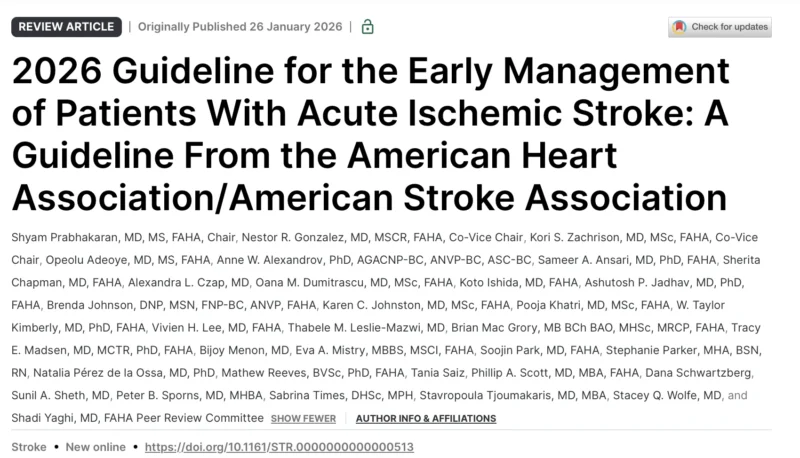
Title: 2026 Guideline for the Early Management of Patients With Acute Ischemic Stroke: A Guideline From the American Heart Association/American Stroke Association
Authors: Shyam Prabhakaran, Nestor R. Gonzalez, Kori S. Zachrison, Opeolu Adeoye, Anne W. Alexandrov, Sameer A. Ansari, Sherita Chapman, Alexandra L. Czap, Oana M. Dumitrascu, Koto Ishida, Ashutosh P. Jadhav, Brenda Johnson, Karen C. Johnston, Pooja Khatri, W. Taylor Kimberly, Vivien H. Lee, Thabele M. Leslie-Mazwi, Brian Mac Grory, Tracy E. Madsen, Bijoy Menon, Eva A. Mistry, Soojin Park, Stephanie Parker, Natalia Pérez de la Ossa, Mathew Reeves, Tania Saiz, Phillip A. Scott, Dana Schwartzberg, Sunil A. Sheth, Peter B. Sporns, Sabrina Times, Stavropoula Tjoumakaris, Stacey Q. Wolfe, Shadi Yaghi
Stay updated on all scientific advances with Hemostasis Today.
-
Nov 8, 2026, 19:31Anna Kajaste-Rudnitski: Presenting AAV-Induced p53 Signalling in Human CNS Cells at ESGCT 26
-
Nov 8, 2026, 19:29David McIntosh: Cybersecurity Matters, but Blood Availability Remains the Bigger Challenge
-
Nov 8, 2026, 19:26Wenxue Ma: An Integrative Framework for Macrophage-Mediated Therapeutic Resistance in Cancer
-
Nov 8, 2026, 19:25Yildiz Yigit: Presenting a Polycythemia Vera Case at the MPN Subcommittee Session
-
Nov 8, 2026, 18:56Denis Oduor: Strengthening the Regulation and Delivery of Blood Transfusion and Transplantation Services
-
Nov 8, 2026, 18:28Raghavendra Rao: A Narrative Review on Chronic Venous Disease during Pregnancy
-
Nov 8, 2026, 17:57Dhiren Patel: PLD1-Derived Phospholipids Regulate NAD Kinase and ROS Production in Neutrophils
-
Nov 8, 2026, 17:48Andra T.: What Causes Antiphospholipid Syndrome? – Four Steps, not One Cause
-
Nov 8, 2026, 17:38Nasrin Samadi: Can a Normal Clotting Test Be Misleading?