

FDA Expands Hympavzi Approval to Children and Patients With Hemophilia A or B With Inhibitor
The U.S. FDA has expanded the approved use of Hympavzi (marstacimab-hncq), broadening access to a once-weekly, subcutaneous non-factor therapy for routine bleeding prophylaxis in people with hemophilia A or B.
The June 2026 decision extends the indication to adults and children aged 6 years and older, including patients with factor VIII or factor IX inhibitors.
What is Hympavzi?
Hympavzi (marstacimab-hncq) is a non-factor replacement therapy for hemophilia.
It is a monoclonal antibody that targets tissue factor pathway inhibitor (TFPI), a natural anticoagulant protein involved in regulating thrombin generation.
By inhibiting TFPI, marstacimab increases tissue-factor–initiated thrombin generation and rebalances coagulation, helping prevent bleeding without replacing the missing factor VIII or factor IX.
Unlike conventional factor replacement, which is administered intravenously, Hympavzi is given as a subcutaneous injection once weekly.
This makes Hympavzi part of a broader shift in hemophilia treatment toward rebalancing hemostasis rather than replacing the deficient coagulation factor.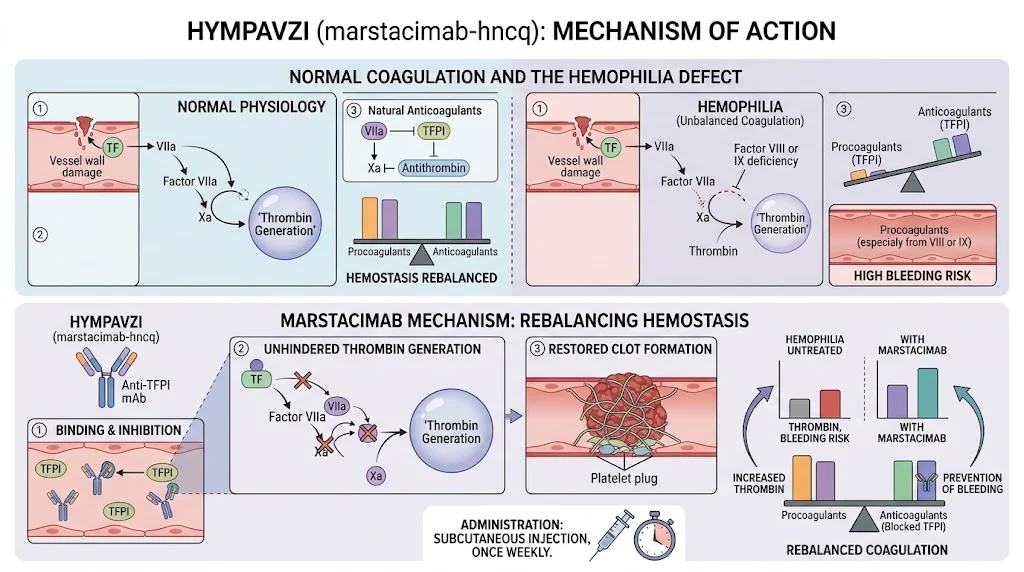
Expanded Eligibility
Hympavzi is now indicated for routine prophylaxis in adults and pediatric patients aged 6 years and older with:
- Hemophilia A, with or without factor VIII inhibitors
- Hemophilia B, with or without factor IX inhibitors
- The expansion is particularly important for children aged 6–11 years and for patients with inhibitors, two populations not covered by the original indication.
A Different Approach to Hemophilia Prophylaxis
Traditional hemophilia management relies on replacement of the deficient coagulation factor. Hympavzi takes a different approach.
Marstacimab is a monoclonal antibody that inhibits tissue factor pathway inhibitor (TFPI), an endogenous anticoagulant.
By reducing TFPI activity, marstacimab enhances tissue-factor–initiated thrombin generation and helps restore hemostatic balance despite the underlying factor deficiency.
This places Hympavzi among the expanding class of non-factor therapies, which aim to rebalance coagulation rather than directly replace factor VIII or IX.
A Significant Pediatric Expansion
The inclusion of children aged 6 years and older represents an important development in pediatric hemophilia care.
Younger children with hemophilia may otherwise require regular intravenous factor replacement, which can create substantial challenges for families, particularly when venous access is difficult.
A once-weekly subcutaneous prophylactic option may offer a more practical approach to long-term treatment and home administration.
The pediatric program included children with both hemophilia A and hemophilia B, with and without inhibitors.
Extending Treatment to Patients With Inhibitors
The expanded indication also includes patients with factor VIII or factor IX inhibitors.
Inhibitors can significantly complicate conventional factor replacement by reducing the effectiveness of administered factor concentrates.
The availability of a non-factor prophylactic strategy therefore adds another option for individualized treatment.
However, inhibitor management remains complex and breakthrough bleeding requires a specific treatment plan based on the patient’s clinical circumstances and the hemostatic agents available.
Once-Weekly Subcutaneous Administration
Hympavzi is administered by subcutaneous injection once weekly.
For children aged 6 to less than 12 years, the approved regimen begins with a 150 mg loading dose, followed by weekly maintenance dosing. For patients aged 12 years and older, the regimen begins with a 300 mg loading dose, followed by weekly maintenance treatment.
The dosing regimen can subsequently be adjusted according to the approved prescribing information.
Management of Bleeding During Prophylaxis
Hympavzi is intended for routine prophylaxis and is not a treatment for acute bleeding.
Breakthrough bleeding may require factor VIII or IX replacement or bypassing agents, depending on the patient’s hemophilia type, inhibitor status, and clinical situation.
Importantly, additional Hympavzi should not be administered to treat an acute bleeding episode. The prescribing information emphasizes using the lowest effective dose of concomitant hemostatic agents.
This makes education and an individualized bleeding-management plan essential for patients and families receiving non-factor prophylaxis.
Perioperative Management Remains Important
Non-factor prophylaxis does not eliminate the complexity of surgical management.
Patients undergoing major surgery require individualized planning with their hemophilia treatment team. The prescribing information recommends temporarily discontinuing Hympavzi at least 7 days before major surgery.
Perioperative hemostatic support should then be determined according to the procedure, bleeding risk, inhibitor status, and the patient’s individual treatment plan.
Thrombotic Risk Remains a Key Consideration
The therapeutic concept behind TFPI inhibition also creates an important safety consideration.
By increasing thrombin generation, Hympavzi has the potential to contribute to thromboembolic complications, particularly in patients with additional thrombotic risk factors or when used with other hemostatic agents.
The current prescribing information reports thromboembolic events in clinical development and highlights increases in laboratory markers including D-dimer and prothrombin fragment 1.2.
The goal of non-factor therapy is therefore not simply to generate more thrombin, but to achieve an appropriate hemostatic balance.
An Expanding Non-Factor Landscape
Hympavzi is part of a rapidly expanding non-factor treatment landscape.
Concizumab (Alhemo) also targets TFPI, while fitusiran (Qfitlia) reduces antithrombin production through RNA interference.
Emicizumab (Hemlibra) uses a different mechanism, mimicking the cofactor function of activated factor VIII.
These therapies should not be considered interchangeable. Their mechanisms, dosing schedules, indications, safety profiles and approaches to breakthrough bleeding and surgery differ substantially.
What This Means for Hemophilia Care
The FDA’s expanded approval represents more than an extension of the age range.
It reflects the broader transformation of hemophilia treatment – from factor replacement toward rebalancing the coagulation system.
For children, particularly those for whom repeated intravenous access presents a challenge, once-weekly subcutaneous prophylaxis may offer an additional treatment option.
For patients with inhibitors, the expansion further diversifies the available prophylactic strategies.
At the same time, important questions remain regarding long-term safety, thrombotic risk, real-world bleeding outcomes, adherence, treatment access and how marstacimab should be positioned alongside other non-factor therapies.
The Future of Hemophilia Prophylaxis
The FDA’s expanded approval of Hympavzi marks an important step in the evolution of hemophilia prophylaxis.
By extending a once-weekly, subcutaneous non-factor therapy to children aged 6 years and older and to patients with inhibitors, the decision broadens the therapeutic options available to families and clinicians.
The next challenge will be determining how TFPI inhibition should be integrated into individualized care while maintaining effective bleeding control and minimizing thrombotic risk.
FAQ
1.How does TFPI inhibition restore hemostatic balance without replacing factor VIII or IX?
By neutralizing TFPI, marstacimab enhances tissue-factor–initiated thrombin generation, partially compensating for impaired coagulation.
2.Why does Hympavzi require caution with bypassing agents or factor concentrates?
Combining treatments that independently increase thrombin generation may produce excessive coagulation and elevate thromboembolic risk.
3.Why is Hympavzi unsuitable for treating acute breakthrough bleeding?
Its role is preventive prophylaxis; acute bleeding requires rapid, individualized treatment with factor replacement or bypassing agents.
4.How should Hympavzi be managed before major surgery?
It should generally be discontinued at least 7 days beforehand, with perioperative hemostatic support planned according to bleeding and thrombosis risks.
5.What pharmacodynamic markers may indicate enhanced coagulation?
Treatment may increase markers such as D-dimer and prothrombin fragment 1.2, reflecting increased coagulation-system activity.
Stay updated with Hemostasis Today.
-
Aug 27, 2026, 11:08Sunisha Arora: New EBMT Recommendations Transform the Approach to HSCT in Thalassemia
-
Aug 27, 2026, 10:51Seema Dawood: A Layered Approach to Identifying Thalassemia in the Laboratory
-
Aug 27, 2026, 10:44Ed Smith: Vitalant Expands Hemophilia Center Team With New Career Opportunities
-
Aug 27, 2026, 10:28Narat Srivali: Exploring the Link Between Perioperative Corticosteroids and VTE Risk
-
Aug 27, 2026, 10:19Vincent Poher: Clinical Validation of Rapid Whole-Blood Fibrinogen Measurement
-
Aug 27, 2026, 07:49Denis Oduor: Bringing Blood Closer – Strengthening Kenya’s Response to PPH
-
Aug 27, 2026, 07:19Luis Oliverio Ambriz Garcia: ASH 2026 Guidelines – What’s New in ITP?
-
Aug 27, 2026, 06:58Priyam Bordoloi: The Biological Advantage of Two X Chromosomes
-
Aug 27, 2026, 00:14Join EHA ReCon 2027 in Malta – Explore RNA Biology to Therapeutics