


Jensa Morris: Anticoagulation in Thrombocytopenia and Cancer-Associated Thrombosis
Jensa Morris, Director of Smilow Hospitalist Service at Yale New Haven Hospital, shared a post on LinkedIn about a recent article by Tzu–Fei Wang et al, published in RPTH, adding:
“Anticoagulation of Patients with Acute VTE and Thrombocytopenia
This is a dilemma we frequently encounter on the Oncololgy Hospitalist service.
The intersection of thrombocytopenia and a hypercoagulable state creates a complex clinical scenario.
Even mild thrombocytopenia in the setting of anticoagulation increases bleeding risk and yet is not protective against thrombosis.
Current management recommendations are guided by expert International Society on Thrombosis and Haemostasis (ISTH) consensus rather than robust clinical trial data:
- Platelet count 50K or higher means full-dose anticoagulation
- Platelet count below 50K and high risk (e.g., PE or acute symptomatic proximal DVT) means full-dose anticoagulation with platelet transfusion to target 40–50K
- Platelets 25–50K and lower risk (incidental PE, CRT, distal DVT) means half-dose LMWH
- Platelets below 25K means temporarily hold anticoagulation
To address this knowledge gap, the START (STrategies for Anticoagulation in patients with thRombocytopenia and cancer associated Thrombosis) pilot feasibility trial is now enrolling.
Looking forward to results to guide this frequent clinical problem.”
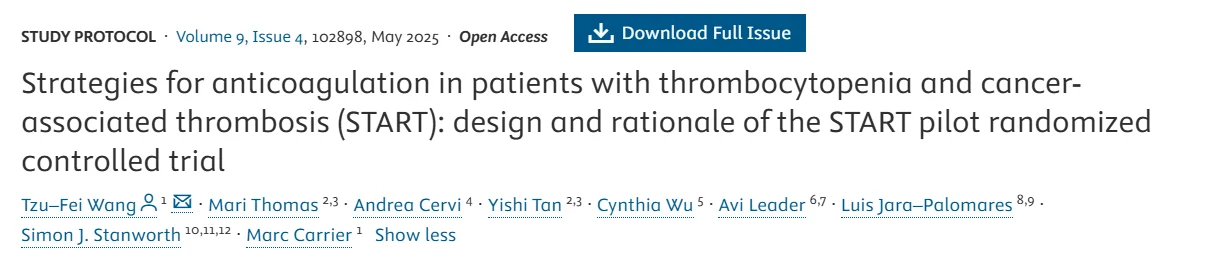
Title: Strategies for anticoagulation in patients with thrombocytopenia and cancer-associated thrombosis (START): design and rationale of the START pilot randomized controlled trial
Authors: Tzu–Fei Wang, Mari Thomas, Andrea Cervi, Yishi Tan, Cynthia Wu, Avi Leader, Luis Jara–Palomares, Simon J. Stanworth, Marc Carrier
Stay updated on all scientific advances with Hemostasis Today.
-
Sep 26, 2026, 02:37Alireza Arzhangzadeh: Antithrombotic Strategies in Coronary Artery Aneurysm, Ectasia, and Slow Flow
-
Sep 26, 2026, 02:15Sherif Mahmoud: Updated Guideline for Antithrombotic-Associated Intracranial Hemorrhage
-
Sep 25, 2026, 20:01Anand Gupta: Timing of DOAC Initiation in Newly Diagnosed Atrial Fibrillation
-
Sep 25, 2026, 19:56Steven Fein: A History of Blood Clots Doesn’t Mean a Healthy Pregnancy Is Out of Reach
-
Sep 25, 2026, 19:54Pedro Perez: “Provoked” VTE May Not Always Mean the Risk Disappears When the Provoking Event Does
-
Sep 25, 2026, 19:53Kemal Karaagac: Calcitriol May Reduce Thrombotic Risk in MASLD
-
Sep 25, 2026, 19:52The SINGLE-AF Trial Anticoagulation for Intermediate Stroke Risk – NEJM
-
Sep 25, 2026, 19:49Shinya Goto: DOAC vs Placebo in Intermediate Stroke Risk of AF in Single Country?
-
Sep 25, 2026, 19:47Bryan Cotton: DOACs Versus Nothing When Stroke Risk Is Not Zero