


Leonardo Cardoso: Mechanical Thrombectomy Improves Functional Independence, Outcomes and Reduces Mortality
Leonardo Cardoso, Medical Student at Federal University of Minas Gerais, shared on LinkedIn about a recent article he and his colleagues co-authored, adding:
”Mechanical thrombectomy (MT) is a well-established treatment for eligible patients with large-vessel occlusion acute ischemic stroke.
However, its safety and efficacy in elderly patients remain a matter of debate.
In our recently published study in The Neuroradiology Journal, we analyzed data from 15 randomized clinical trials including elderly patients (≥70 years) treated with MT versus standard medical management.
We also explored potential effect modifiers such as stroke severity, anterior versus posterior circulation, use of general anesthesia, time from onset to randomization, country socioeconomic status, infarct size, and imaging selection strategies.
Key findings:
- MT was associated with higher rates of functional independence and functional recovery at 90 days.
- Lower rates of severe disability were observed in the thrombectomy group.
- Mortality was reduced, particularly among patients over 80 years.
- Benefits were consistent across circulation territories and most subgroup analyses, including large infarcts.
We discuss how these findings integrate with the current literature and contemporary guideline recommendations, while also addressing remaining gaps and future research directions for this growing and clinically complex population.
I would like to sincerely thank my coauthors for this collaboration, Ahmet Günkan and Márcio Yuri Ferreira for their guidance, Professors Panagiotis Papanagiotou and Jean-Claude Baron for their supervision and insights, and Sávio B. for the original study idea.”
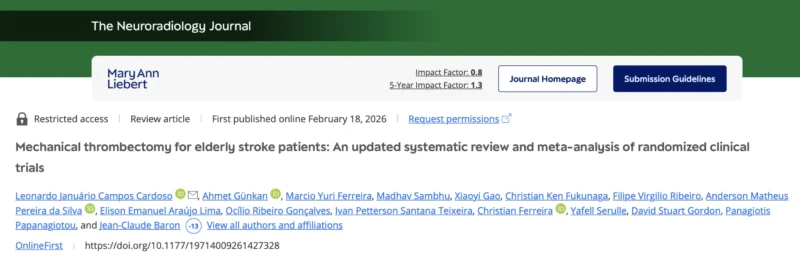
Title: Mechanical thrombectomy for elderly stroke patients: An updated systematic review and meta-analysis of randomized clinical trials
Authors: Leonardo Januário Campos Cardoso, Ahmet Günkan, Marcio Yuri Ferreira, Madhav Sambhu, Xiaoyi Gao, Christian Ken Fukunaga, Filipe Virgilio Ribeiro, Anderson Matheus Pereira da Silva, Elison Emanuel Araújo Lima, Ocílio Ribeiro Gonçalves, Ivan Petterson Santana Teixeira, Christian Ferreira, Yafell Serulle, David Stuart Gordon, Panagiotis Papanagiotou, Jean-Claude Baron
Read the Full Article on The Neuroradiology Journal
Stay updated on all scientific advances with Hemostasis Today.
-
Oct 10, 2026, 07:59Leila Caroline Souza Reis: Enoxaparin Dosing for VTE Prevention in Adults With Obesity
-
Oct 10, 2026, 07:41Adeeb Bazuhair: New Evidence for Catheter Directed Thrombolysis in Acute PE
-
Oct 10, 2026, 07:22Poppy Clarke: Turning Steps Into Support for Thrombosis Awareness
-
Oct 10, 2026, 07:12Hamzah Khan: The Role of Genuine Curiosity in Driving High-Impact Academic Research
-
Oct 10, 2026, 06:58Nita Radhakrishnan: Turning Evidence Into Action for Hemophilia Care in India
-
Oct 10, 2026, 06:48Nutan Kaushik: HemeNext 2.0 Brings Global Perspectives to Hematology
-
Oct 10, 2026, 06:43Suthesh Sivapalaratnam: Advancing Bleeding Disorder Care at EHC 2026
-
Oct 10, 2026, 02:38Brianne D.: Sex Differences in RIPK1 Signaling Following Intracerebral Hemorrhage
-
Oct 10, 2026, 02:17Dino Mehic: Managing Heavy Menstrual Bleeding in Patients with BDUC