


Lori Bryngelson Taylor: Expert Consensus Guidelines Flag Hypophosphatemia Risks With Injectafer
Lori Bryngelson Taylor, Graduate Student at Rutgers School of Health Professions, Clinical Dietitian – Expert Advisory Board at The Pernicious Anaemia Society, Clincial Dietitian, Speaker, Writer at Save Your Plate. shared a post on LinkedIn about a recent article by Layla Van Doren et al., published American Journal of Hematology, adding:
“Autoimmune gastritis/pernicious anemia patients require iron infusions throughout their life.
It causes prolonged levels of low phosphate that can damage bones and parathyroid function.
And the effect is compounded for those of us receiving repeated infusions.
I’ve been saying for years that injectafer (ferric carboxymaltose) is a dangerous drug after an iron infusion in 2018 caused me to have immediate and ongoing palpitations.
My doctors couldn’t figure out why at the time.
It took me two weeks to track down an article that referenced low phosphate (hypophosphatemia) as a possible cause.
I had a phosphorus test done and blood value was 1.8 mg/dl, considered severely low (the bottom of normal is 2.5 mg/dl).
If I had been in the hospital, I would have required an IV to keep heart and lungs working.
There was not then nor is there now a standard treatment for hypophosphatemia, which can last for weeks to 6 months.
I was on neutraphos 4x/day for over a month and we used serial phosphorus monitoring to determine when I could taper down.
For many, the course is much worse.
Injectafer causes an increase in phosphorus handling protein FGF23 which causes the kidney to release phosphorus, causing patients to ‘pee out’ their bones.
This process can last for weeks to months.
The low phosphorus then causes low vitamin D3, low blood calcium (hypocalcemia) and secondary hyperparathyroidism as well people as fracture or bone loss.
Low blood phosphorus is no joke – phosphorus is the P in ATP and deficiencies can affect both heart and lung function.
A comprehensive metabolic panel does not include measures of blood phosphorus and the biggest sign of a phosphorus deficiency is fatigue, which is attributed to the iron deficiency.
So this effect is often missed.
Researchers can say it better than me.
‘It is prudent to identify patients at risk for treatment-emergent hypophosphatemia since it can be prolonged and there is no standard management.
The group of persons at risk is broad but those at highest are patients with recurrent blood loss and malabsorptive causes where repeat infusions are required.
For these patients, FCM can be dangerous and should be avoided, as repeat infusions may lead to osteomalacia and fractures.
An alternative formulation to FCM should be considered, where available.'”
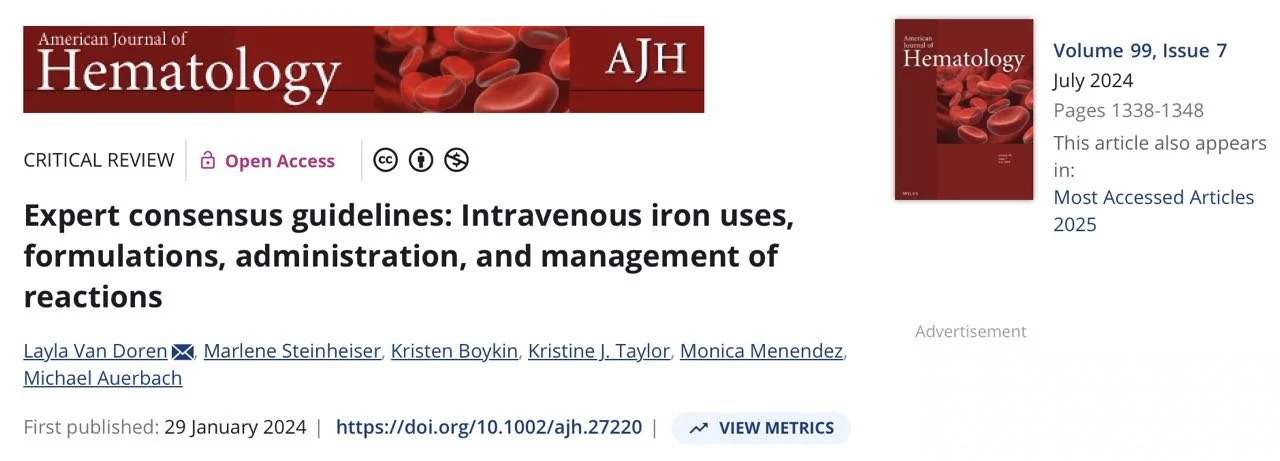
Title: Expert consensus guidelines: Intravenous iron uses, formulations, administration, and management of reactions
Authors: Layla Van Doren, Marlene Steinheiser, Kristen Boykin, Kristine J. Taylor, Monica Menendez, Michael Auerbach
Stay updated on all scientific advances with Hemostasis Today.
-
Oct 3, 2026, 06:40Aayush Bist: Study Reveals Distinct Social Patterns in Anemia, Excess Adiposity, and High Blood Pressure Among Women in Nepal
-
Oct 3, 2026, 06:39Ahmed Bennis: Understanding the Diagnosis, Risk, and Management of ARN
-
Oct 3, 2026, 06:11Ana Cespedes: Maternal Anemia in Pregnancy Linked to Differences in Infant Brain Structure
-
Oct 3, 2026, 05:52Kemal Karaagac: When Vitamin K Antagonists Remain Essential in Cardiac Care
-
Oct 3, 2026, 05:32Shiavax J. Rao: PERT 2026 Session Explores Long-Term Anticoagulation and DOAC Management
-
Oct 3, 2026, 05:13Parveen Yograj: Iron Deficiency and Anaemia – Diagnosis, Causes, and Treatment Guidelines
-
Oct 3, 2026, 00:25Antiplatelets May Be a Strong Option After Ischemic Stroke in Active Cancer – International Journal of Stroke
-
Oct 3, 2026, 00:24Mavis Agnes Kisakye: Honored to Join UNHLS Leadership in Advancing HIV Diagnostics in Uganda
-
Oct 3, 2026, 00:23Phil Spinella: Blood is for Bleeding, Salt Water is for Cooking pasta, Keeping it simple