


May Guo: Inhibiting Anti-PEG Antibody Binding With Randomized PEG
May Guo, Vice President of Business Development at Biomay AG, Founder and CEO of Novaribo Consulting, shared a post on LinkedIn about a recent article by Philip Dreier et al., published in Chemical Science, adding:
“This study presents the isomerization of PEG to randomized PEG (rPEG) as an efficient approach for inhibiting anti-PEG antibodies (APA) interaction while preserving the advantages of PEG.
rPEGs were obtained via living anionic ring-opening (co)polymerization (AROP) of ethylene oxide (EO) with glycidyl methyl ether (GME).
Chain-end functionalization of rPEGs with lipid anchor groups was conducted to obtain rPEG lipids with C14-chains (ditetradecylacetamide (DTAA), dimyristoyl-glycerol (DMG)).
It is demonstrated that rPEG lipids can prevent APA binding but nevertheless exhibit similar performance in LNPs as comparable PEG lipids.”
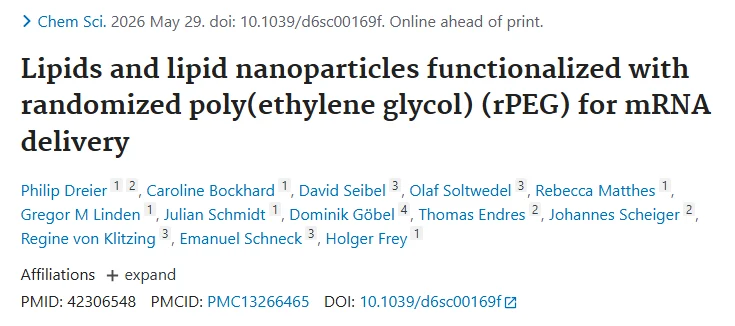
Title: Lipids and lipid nanoparticles functionalized with randomized poly(ethylene glycol) (rPEG) for mRNA delivery
Authors: Philip Dreier, Caroline Bockhard, David Seibel, Olaf Soltwedel, Rebecca Matthes, Gregor M Linden, Julian Schmidt, Dominik Göbel, Thomas Endres, Johannes Scheiger, Regine von Klitzing, Emanuel Schneck, Holger Frey
Stay updated on all scientific advances with Hemostasis Today.
-
Nov 16, 2026, 15:35Jim Hoffman: Could Blood Purification Change the Fight Against Cancer?
-
Nov 16, 2026, 15:16How Do Artificial Hearts Affect Platelet Function? – Platelets Journal
-
Nov 16, 2026, 15:10Assessing Coagulation Activation in DOAC – Treated Patients – JTH
-
Nov 16, 2026, 15:00Davide Antonio Mei: Should Anticoagulation Continue After AF Ablation?
-
Nov 16, 2026, 14:55Danielle Boyle: Beyond Platelet Counts – Why Patient Stories Matter
-
Nov 16, 2026, 14:28Jan Sloves: The Future of Vascular Ultrasound
-
Nov 16, 2026, 13:49Bahman Rasouli: A Rare Vascular Manifestation of Recurrent Papillary Thyroid Carcinoma
-
Nov 16, 2026, 13:28Muhammad Danyal: Platelet Patterns in Hepatitis B and C
-
Nov 16, 2026, 12:52Frank Nocken: Alzheimer’s Research Expands Beyond Amyloid-Based Treatments