


Nathan Connell: Transforming Surgical Care with Tranexamic Acid
Nathan Connell, Clinical Chief of Hematology at Brigham and Women’s Faulkner Hospital, shared a post on Linkedln about a recent article by Brett L. Houston et al, published in NEJM, adding:
”Sometimes the most important advances in medicine are not the newest, most expensive therapies.
A new trial published in the New England Journal of Medicine (NEJM Group) highlights the impact of tranexamic acid, or TXA, in major noncardiac surgery.
TXA is a low-cost medication that helps stabilize blood clots and reduce bleeding.
In more than 8,000 patients across 10 hospitals, a hospital-wide TXA policy reduced red blood cell transfusions from 9.8% to 7.4%, without an increased rate of venous thromboembolism at 90 days.
That matters, because it suggests that using TXA in this scenario is a practical, scalable intervention that leads to:
- Fewer transfusions
- Better stewardship of a limited blood supply
- Potential benefit in health systems with constrained resources
Blood transfusion is lifesaving, but blood is also precious. Interventions like TXA remind us that improving outcomes does not always require high-cost technology.
Sometimes it requires using simple, evidence-based tools consistently and thoughtfully.
For patients, clinicians, hospitals, and global health systems, this is exactly the kind of high-value care we should pay attention to.”
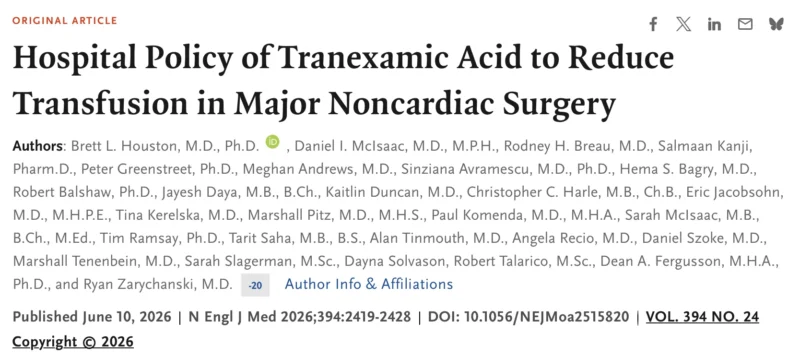
Title: Hospital Policy of Tranexamic Acid to Reduce Transfusion in Major Noncardiac Surgery
Authors: Brett L. Houston, Daniel I. McIsaac, Rodney H. Breau, Salmaan Kanji, Peter Greenstreet, Meghan Andrews, Sinziana Avramescu, Hema S. Bagry, Robert Balshaw, Jayesh Daya, Kaitlin Duncan, Christopher C. Harle, Eric Jacobsohn, Tina Kerelska, Marshall Pitz, Paul Komenda, Sarah McIsaac, Tim Ramsay, Tarit Saha, Alan Tinmouth, Angela Recio, Daniel Szoke, Marshall Tenenbein, Sarah Slagerman, Dayna Solvason, Robert Talarico, Dean A. Fergusson, Ryan Zarychanski
Stay updated on all scientific advances with Hemostasis Today.
-
Sep 26, 2026, 14:41Understanding Recovery After Pulmonary Embolism – ISTH
-
Sep 26, 2026, 14:36Biplab K Saha: Updating the Clinical Approach to IPH
-
Sep 26, 2026, 14:24Andre W. Bourgoyne: Patient Blood Management Before Transfusion
-
Sep 26, 2026, 14:21Damon Race: Transgene Biology and Durability in Hemophilia Gene Therapy
-
Sep 26, 2026, 14:01Chandra Viswanathan: Building a Stronger Blood and Plasma Ecosystem for India
-
Sep 26, 2026, 13:42Dhamirah Nazihah Mohd Nasiruddin: Bridging Clinical Suspicion and Laboratory Diagnosis in TMA
-
Sep 26, 2026, 13:42Anna Dunn: Long-Term Anticoagulation After Pulmonary Embolism
-
Sep 26, 2026, 09:49Manuel Monreal: Acute VTE in Patients With Severe Renal Insufficiency
-
Sep 26, 2026, 09:38New TIF Guidelines for Emergency Care in Thalassaemia and SCD