


Ney Carter Borges: The Optimal DAPT Duration in High Bleeding Risk PCI Patients
Ney Carter Borges, Member Cardiologist of Global Physician Association at Cleveland Clinic Florida, shared on LinkedIn about a recent article by Andrea Zito et al, published in JAMA, adding:
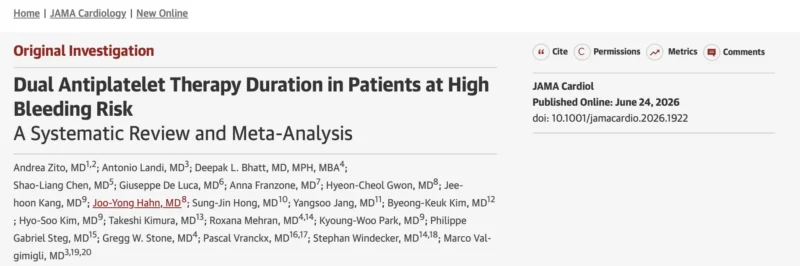
”Dual Antiplatelet Therapy Duration in Patients at High Bleeding Risk: Updated Evidence From a Systematic Review and Meta-analysis
This systematic review and meta-analysis evaluated the optimal duration of dual antiplatelet therapy (DAPT) in patients at high bleeding risk (HBR) undergoing percutaneous coronary intervention (PCI).
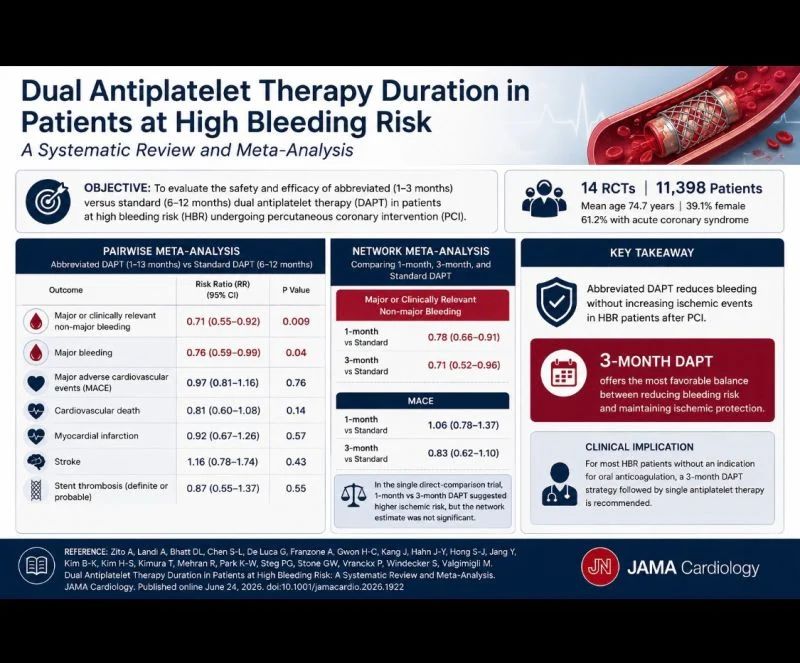
Fourteen randomized controlled trials involving 11,398 HBR patients (mean age 74.7 years; 39.1% women; 61.2% presenting with acute coronary syndrome) were included. The analysis compared abbreviated DAPT (1–3 months) with conventional DAPT (6–12 months), while excluding patients requiring chronic oral anticoagulation.
Abbreviated DAPT significantly reduced major or clinically relevant non-major bleeding by 29% (RR 0.71, 95% CI 0.55–0.92; P=0.009) and major bleeding by 24% (RR 0.76, 95% CI 0.59–0.99; P=0.04).
Importantly, these bleeding benefits were achieved without increasing ischemic complications, including major adverse cardiovascular events (MACE), myocardial infarction, stroke, cardiovascular death, or stent thrombosis.
Sensitivity analyses consistently confirmed the robustness of these findings.
Network meta-analysis demonstrated that both 1-month and 3-month DAPT regimens reduced bleeding compared with standard therapy.
However, although a single direct-comparison trial suggested a higher ischemic risk with 1-month versus 3-month DAPT, the overall network estimate was not statistically significant.
Collectively, the available evidence appears more reassuring for 3-month DAPT, which preserved ischemic protection while minimizing bleeding risk.
These findings reinforce contemporary individualized antithrombotic strategies, supporting shorter DAPT durations in carefully selected HBR patients after PCI.
For most HBR patients without an indication for oral anticoagulation, a 3-month DAPT strategy followed by single antiplatelet therapy provides the most favorable balance between bleeding reduction and ischemic safety, whereas routine 1-month DAPT warrants additional confirmation in future randomized trials.”
Title: Dual Antiplatelet Therapy Duration in Patients at High Bleeding Risk: A Systematic Review and Meta-Analysis
Authors: Andrea Zito, Antonio Landi, Deepak L. Bhatt, Shao-Liang Chen, Giuseppe De Luca, Anna Franzone, Hyeon-Cheol Gwon, Jeehoon Kang, Joo-Yong Hahn, Sung-Jin Hong, Yangsoo Jang, Byeong-Keuk Kim, Hyo-Soo Kim, Takeshi Kimura, Roxana Mehran, Kyoung-Woo Park, Philippe Gabriel Steg, Gregg W. Stone, Pascal Vranckx, Stephan Windecker, Marco Valgimigli
Stay updated on all scientific advances with Hemostasis Today.
-
Sep 24, 2026, 18:43Hugh Nguyen: Honored to Accept the Friend of Singapore Red Cross Award
-
Sep 24, 2026, 18:42Titilope Fasipe: Proud to Support American Society of Hematology’s SCD Initiative
-
Sep 24, 2026, 18:34Ifeanyichukwu Ifechidere: Why Coagulation Samples Can Be “Too Valuable to Throw Away”?
-
Sep 24, 2026, 18:33Aswin K. Mohan: When a Superpower Hears the Call for Blood
-
Sep 24, 2026, 18:31Mercy Lung’aho: Anemia Is Not Only An Iron Problem
-
Sep 24, 2026, 18:29Nick Hanson: Before a Dementia Diagnosis Check Vitamin B12
-
Sep 24, 2026, 18:28Rachel McBryan: Nearly One in Five Older Canadians Has Low Vitamin B12
-
Sep 24, 2026, 18:27Kemal Karaagac: Early DOAC Initiation After Acute Ischaemic Stroke in Atrial Fibrillation
-
Sep 24, 2026, 18:26Mohammed A. AlOmar: What Characterizes Young Stroke in the UAE?