


Ons Marsit: Impact of Electroanatomical Mapping on Pentaspline Pulsed Field Ablation
Ons Marsit, Field Clinical Specialist at Boston Scientific, shared a post on LinkedIn about a recent article by Ahmed S Yassin et al., published in EP Europace, adding:
”What does mapping add to Pentaspline PFA-PV isolation?
- New randomized data from MAP-PFA, recently published in Europace.
- 32 patients underwent pentaspline PFA with EAM visible vs blinded to the operator.
With mapping:
- More centered antral lesions: eccentricity index 0.91 vs 1.23 (p=0.039)
- No increase in procedure time: 59 vs 57 min
There were also numerical trends toward fewer incomplete PVIs (1 vs 4), fewer patients requiring touch-ups (1 vs 3), fewer off-target ablations (0 vs 2) and better flower-configuration spline overlap, although these secondary endpoints were not statistically significant.
Why does this matter?
NAVIGATE-PF Phase 2 reported 95 percent durable PV isolation at 60 days.
MAP-PFA may provide part of the mechanistic explanation behind this durability: more centered antral lesions and potentially better flower-configuration spline overlap — plausible prerequisites for durable isolation.
Whether these acute improvements translate into greater chronic durability and better clinical outcomes remains to be demonstrated.”
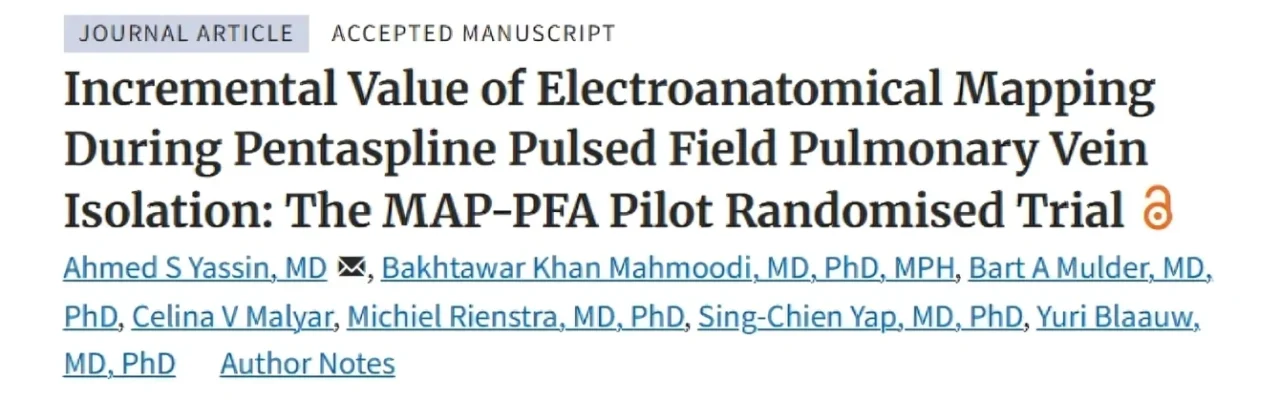
Title: Incremental Value of Electroanatomical Mapping During Pentaspline Pulsed Field Pulmonary Vein Isolation: The MAP-PFA Pilot Randomised Trial
Authors: Ahmed S Yassin, Bakhtawar Khan Mahmoodi, Bart A Mulder, Celina V Malyar, Michiel Rienstra, Sing-Chien Yap, Yuri Blaauw
Stay updated on all scientific advances with Hemostasis Today.
-
Oct 13, 2026, 02:01Nour Al-Mozain: Is It Really Anti-D? – Unraveling Auto-Anti-LW in the Transfusion Laboratory
-
Oct 13, 2026, 01:51Berenice Villegas: The Role of Morphologic Evaluation in Body Fluid Differential Analysis
-
Oct 13, 2026, 01:44Debadrita Ray: Evaluating vWF and VITRO Score for Detecting CSPH in cACLD Patients
-
Oct 13, 2026, 01:34Nagesh Ramesh: Donating Blood for International Plasma Awareness Week
-
Oct 12, 2026, 21:51Sam Botchey: Orthobiologics Are Advancing but the Evidence Must Keep Pace
-
Oct 12, 2026, 21:50Serum Vitamin D, Platelet Function, and Bleeding in Primary ITP – Platelets Journal
-
Oct 12, 2026, 21:30Nika Samadzadeh Tabrizi: Looking Forward to the PACeS Trial on Anticoagulation for POAF
-
Oct 12, 2026, 21:28Michael Megaly: Does Coronary Ectasia Affect Outcomes in Acute Coronary Syndromes?
-
Oct 12, 2026, 21:25Vitor Borin P. de Souza: Think Twice Before Anticoagulating an Isolated Subsegmental PE