

Blocking Histone-Induced Platelet-Erythrocyte Interactions With Polyanions – Platelets Journal
Platelets Journal shared a post on LinkedIn about a recent article by Vichari Sirimanne et al, adding:
“Recently published in Platelets.
‘Platelet-erythrocyte complex production is exacerbated by histones and protected by small polyanion histone neutralizing compounds’ by Vichari Sirimanne (2026).
Individual erythrocytes carrying bound, activated platelets (platelet-erythrocyte complexes) circulate at low levels in healthy whole blood (approx. 0.1-0.3 percent of erythrocytes in humans; approx. 0.5-2 percent in mice), and is suspected to be a mechanism of erythrocyte clearance.
However, excessive levels of circulating platelet-erythrocyte complexes are associated with thrombosis risk. Sirimanne and colleagues tested whether extracellular histones, released in large quantities during sepsis, can contribute to the formation of these complexes, and whether sulphated small polyanions (SPAs) can prevent complex formation.
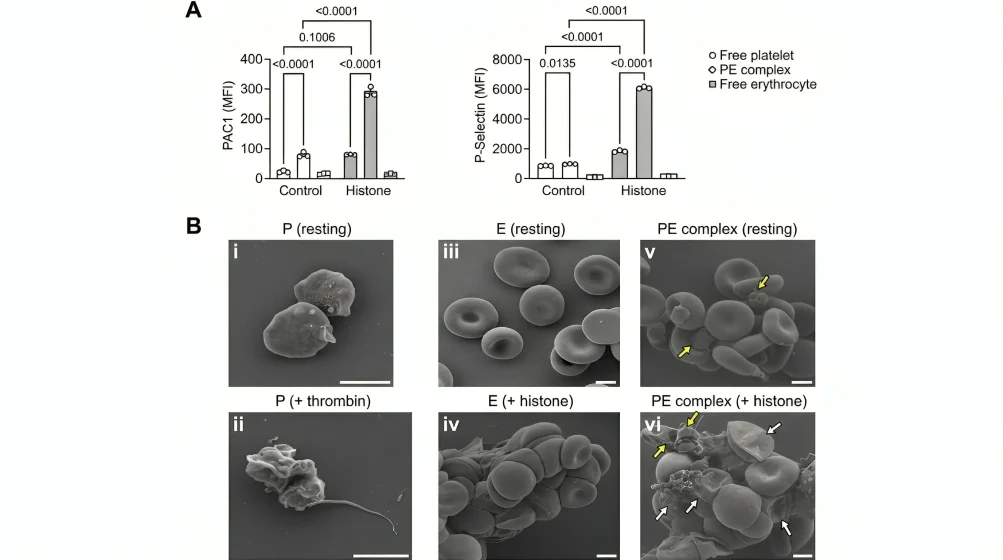
Treatment of isolated human erythrocytes and platelets with histones resulted in an approximate 10-fold increase in complexes, to 8-13 percent against a control range of 0.5-2 percent, with a comparable rise in whole mouse blood.
Under these histone-treated conditions, complexed platelets expressed approximately three times the P-selectin and eight times the active αIIbβ3 signal of unbound platelets. Both SPAs suppressed complex formation without affecting baseline levels, MTS more completely than mCBS, and only when given before or alongside the histones; neither could dissociate complexes once formed.
Mice given intravenous histones became thrombocytopenic while complex levels held steady rather than falling, suggesting a shrinking platelet pool sustained the same output, although the in vivo increase did not reach significance.”
Title: Platelet-erythrocyte complex production is exacerbated by histones and protected by small polyanion histone neutralizing compounds
Authors: Vichari Sirimanne, Jiwon Lee, Melanie Rug, Christopher R. Parish, Farzaneh Kordbacheh, Brendan J. McMorran
Stay updated on all scientific advances with Hemostasis Today.
-
Nov 13, 2026, 03:21Abdul Muqtadir Abbasi: Iron Deficiency Beyond Anemia and the Importance of Finding the Cause
-
Nov 13, 2026, 03:05Marc Carrier: Aspirin vs Anticoagulants for VTE Prevention After Joint Replacement
-
Nov 13, 2026, 02:28Julia Sjöberg: ROCK1 Inhibition and Red Blood Cell Recovery After Chemotherapy
-
Nov 13, 2026, 02:07Tonie Reincke: Understanding Deep Vein Thrombosis and Vascular Health
-
Nov 13, 2026, 01:52Akshita Singh: The Remarkable Process of Blood Clotting
-
Nov 12, 2026, 22:52Milka Koupenova: The Role of Platelet RIG-I in Regulating Thrombotic Responses
-
Nov 12, 2026, 22:50Arun V J: Why Has India Still Not Achieved 100% Voluntary Blood Donation?
-
Nov 12, 2026, 22:49Sickle Cell Disease Deserves to Be Prioritised in Ghana – ISCC
-
Nov 12, 2026, 22:47Samir Kumar Beura: Delighted to Serve as a Topic Editor for a Research Topic in Frontiers in Neuroscience