


Reza Shojaei: The Plasma Risk Governments Are Ignoring
Reza Shojaei, Chief Operating Officer at Canadian Plasma Resources, shared on LinkedIn:
Plasma Is the World’s Most Critical Medicine. It Also Has the World’s Most Fragile Supply Chain.
70% of global plasma comes from one country. Manufacturing takes up to 12 months. A pandemic simultaneously cut supply to 14 nations. And geopolitical tensions have never been higher. It is time to treat plasma the way we treat semiconductors.
In Issue 46, we examined the WHO’s latest global blood report and challenged its position on unpaid plasma donation. This week, we pull the lens wider, from donor policy to geopolitical strategy.
The world relies on a single country for the majority of its plasma supply.
The manufacturing pipeline from collection to finished medicine takes up to a year. When disruption strikes, whether from a pandemic, a geopolitical shock, or a domestic policy shift, there is no rapid substitute and no strategic reserve.
Patients simply go without.
This is not a theoretical risk. It has already happened. And in a world defined by rising geopolitical uncertainty, it will happen again, unless the sector, governments, and boards treat plasma supply with the strategic seriousness it deserves.
The Concentration Problem: One Country, 70% of the World’s Plasma
Let us begin with the most important number in this newsletter: 70%. That is the approximate share of the world’s plasma used to fractionate into life-saving medicines that comes from a single country: the United States (Belmonte et al., 2025; Ramesh & McIntosh, 2025).
The next largest contributors, Germany, Hungary, Austria, and the Czech Republic, collectively account for most of the remainder, and all allow compensated plasma donation.
The rest of the world, operating primarily on voluntary, unpaid models, contributes roughly 20% of the global fractionation-grade plasma supply.
To put this in comparative terms: the world relies on the United States for plasma in roughly the same way it relied on a handful of countries for semiconductor chips before the COVID-era supply crisis, and with similarly catastrophic consequences when the supply is disrupted.
The difference is that governments have now recognized semiconductors as a strategic asset and legislated accordingly. Most have not yet done the same for plasma.
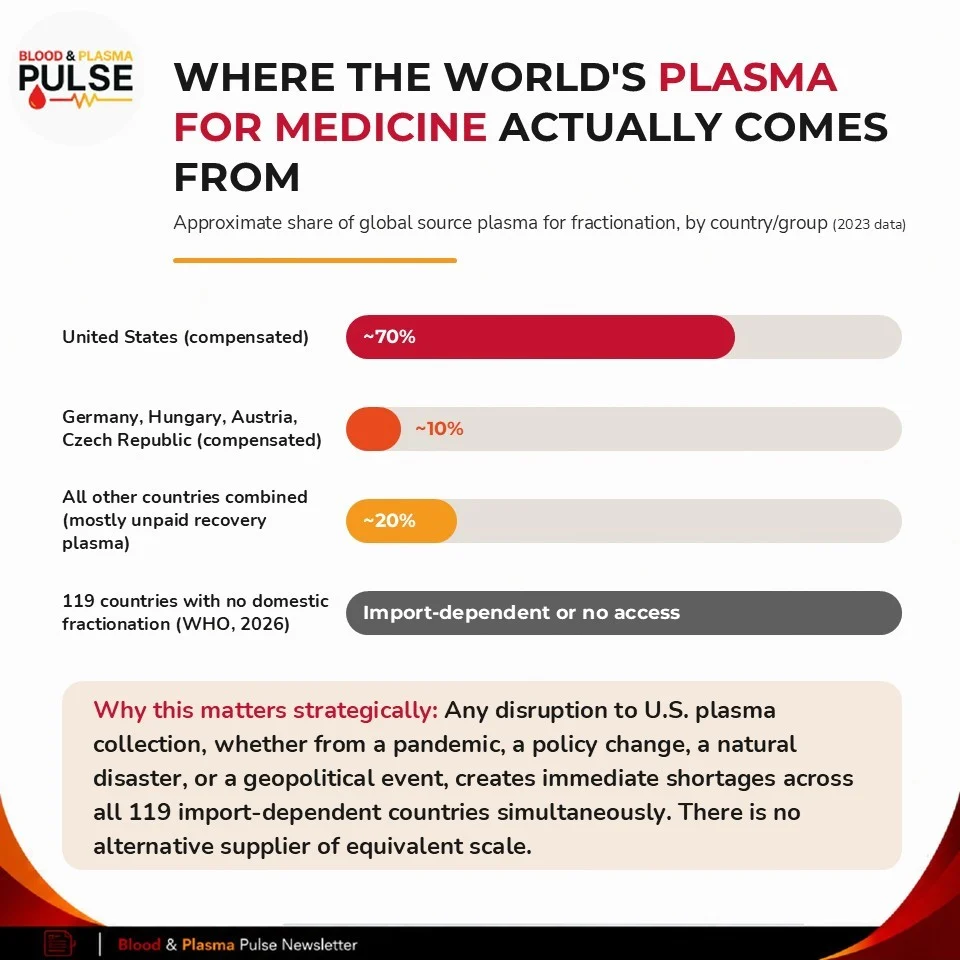
Figure 1. Global source plasma concentration by country/group. Sources: Belmonte et al. (2025), Vox Sanguinis; Ramesh & McIntosh (2025), Annals of Blood; WHO (2026a).
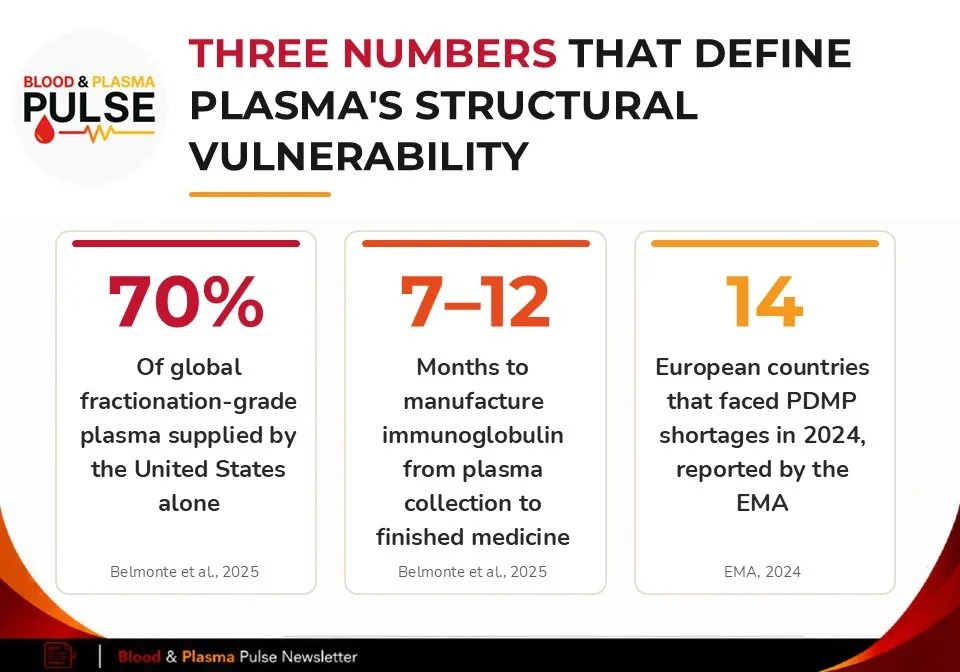
Figure 2. Three numbers that define the structural vulnerability of the global plasma supply chain. Sources: Belmonte et al. (2025); EMA (2024).
The Manufacturing Time Trap: Why Plasma Cannot Respond to a Crisis in Real Time
If plasma supply is disrupted, how quickly can the world respond? The answer is deeply uncomfortable: not quickly at all.
The manufacturing pipeline for plasma-derived medicinal products, particularly immunoglobulins, is extraordinarily long.
From the moment plasma is collected from a donor to the moment a finished immunoglobulin product is available for a patient, 7 to 12 months typically elapse (Belmonte et al., 2025).
By comparison, biological medicines made through recombinant manufacturing take 2 to 3 months. Small-molecule drugs are faster still.
This lag is not a manufacturing inefficiency that can be engineered away.
It reflects the genuine complexity of pooling plasma from thousands of donors, applying multiple pathogen reduction steps, fractionating proteins through multi-stage purification processes, conducting quality testing at each stage, and completing the full regulatory release cycle before the product can be shipped and administered to a patient.
The practical implication is stark: today’s plasma collection is effectively next year’s medicine.
A 10% drop in U.S. plasma collection volumes in 2026 will translate into a patient-level shortage in 2027.
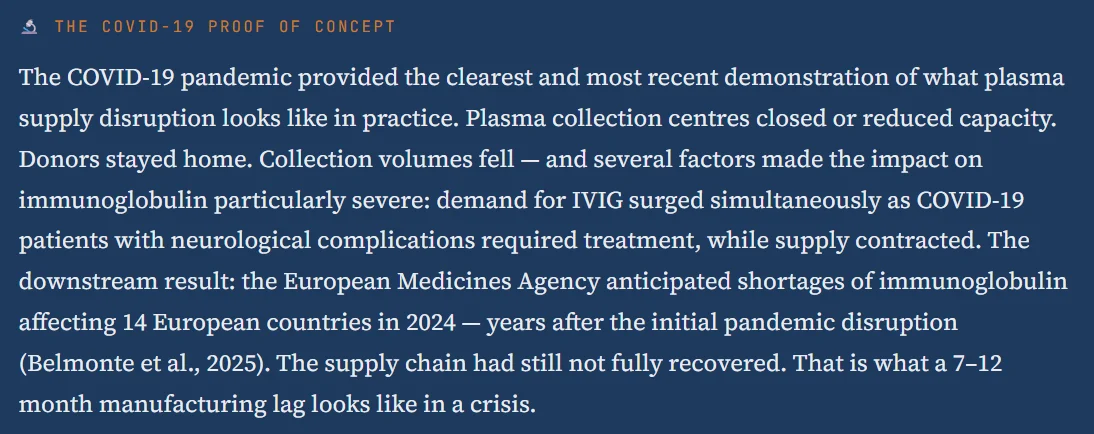
A pandemic that disrupts collection for six months creates a medicine shortage that persists for well over a year after collection resumes.
There is no emergency switch to flip.
There is no strategic stockpile of equivalent scale. And there is no alternative manufacturer with equivalent capacity on standby.
The Geopolitical Vulnerability Matrix: What Could Actually Disrupt the Supply?
Geopolitical risk analysis is standard practice for oil, gas, rare earth minerals, and semiconductors. It is not yet standard practice for plasma. It should be. Here is a structured assessment of the disruption scenarios that plasma-dependent nations and organizations should be modelling right now.
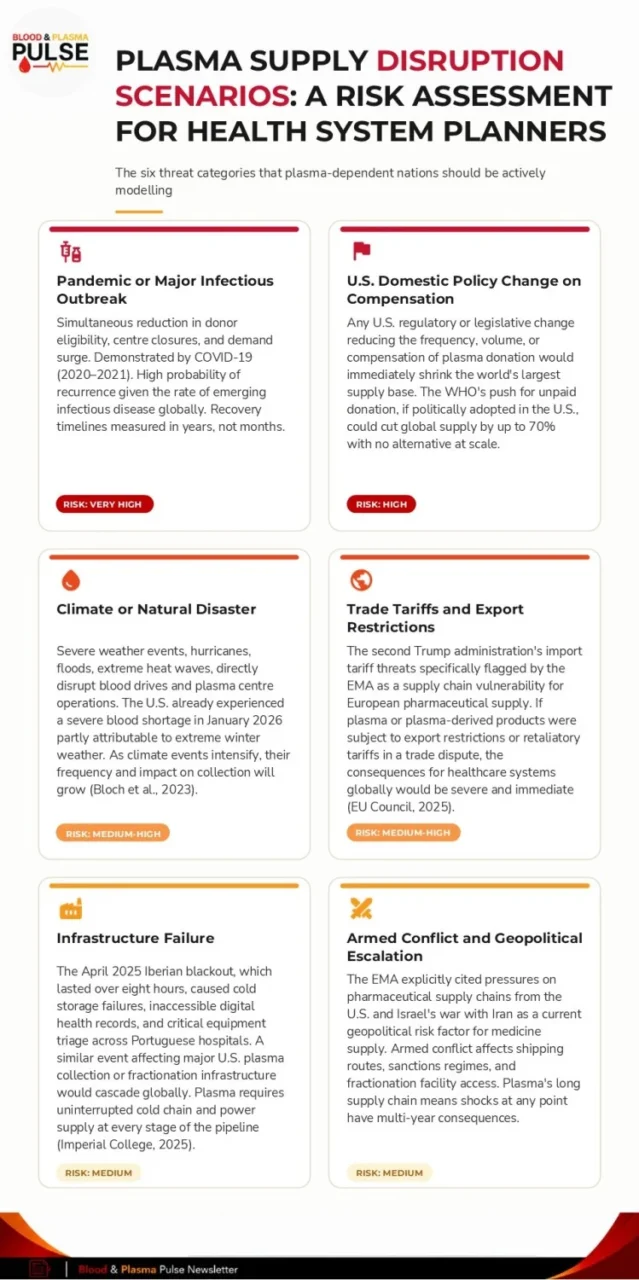
Figure 3. Plasma supply disruption risk matrix across six threat categories. Sources: Belmonte et al. (2025); EU Council (2025); Bloch et al. (2023); Pharmaceutical Technology (2026); Imperial College (2025).
The Policy Response: Europe Moves First, But Incompletely
To its credit, Europe is not waiting passively. On May 12, 2026, just six weeks ago, the European Parliament and European Council reached a provisional agreement on the landmark Critical Medicines Act (CMA), one of the most significant industrial policy measures in the European pharmaceutical sector in decades (Pharmaceutical Technology, 2026; EU Council, 2026).
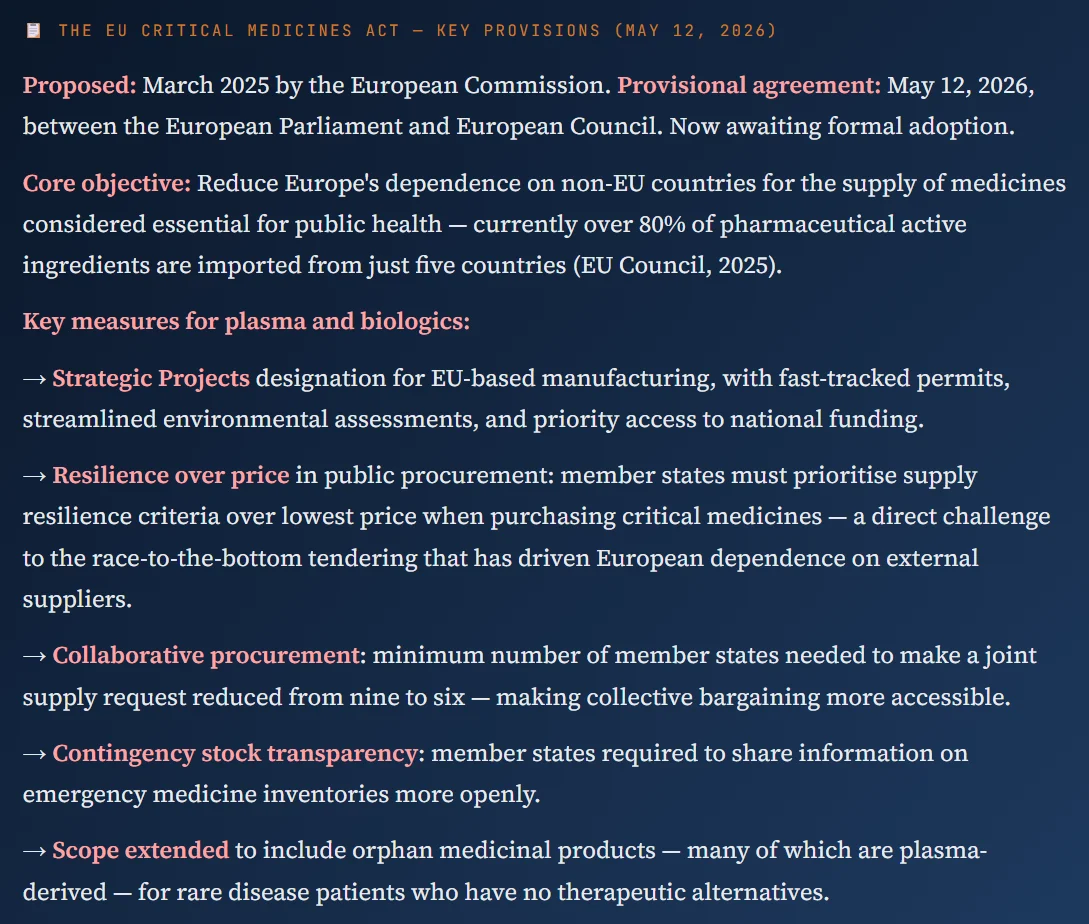
The CMA is important and welcome.
But for the plasma sector specifically, it has a significant limitation: it does not address plasma collection volumes or donation compensation models.
You can build new fractionation capacity in Europe, and the CMA provides tools to do that.
But if the plasma that feeds those facilities still comes predominantly from the United States, strategic autonomy remains an illusion.
The CMA’s rapporteur, MEP Tomislav Sokol, stated:
‘This agreement introduces new measures to prevent shortages of critical medicinal products across the EU, while enhancing Europe’s strategic autonomy in pharmaceutical manufacturing and in supply chains’ (Pharmaceutical Technology, 2026). That is a necessary step.
It is not sufficient on its own.
Critics warn that the EU’s push for resilience could inadvertently drain global supply, drive up prices for essential drugs, and undercut Africa’s emerging pharmaceutical industry, turning a European health security measure into a global access problem. Health Policy Watch (January 2026)
The Tendering Problem: How Price-Driven Procurement Made This Crisis Worse
It would be too easy to blame geopolitics alone for `the fragility of plasma supply.
A significant portion of the problem is self-inflicted, through inadequate tendering practices that prioritize short-term cost savings over long-term supply security.
Immunoglobulin products are typically procured through national tender processes, in which health systems invite manufacturers to bid for supply contracts.
When the primary or sole evaluation criterion is price, the market inevitably concentrates supply among the lowest-cost producers, and those producers, in turn, rationalize their risk by concentrating manufacturing.
The result is a system optimized for cost efficiency and catastrophically under-optimized for resilience (Belmonte et al., 2025).
Real-world examples are not hard to find.
In the United Kingdom, suboptimal tendering practices, setting prices too low and underforecasting demand, contributed directly to IVIG shortages that disrupted patient care (Belmonte et al., 2025).
In Romania, similar tendering failures created sustained supply disruptions (Belmonte et al., 2025). These are not anomalies.
They are the predictable consequence of applying lowest-cost procurement logic to a product with a 7–12 month manufacturing lead time, a single dominant global supplier, and no substitute for patients who depend on it.
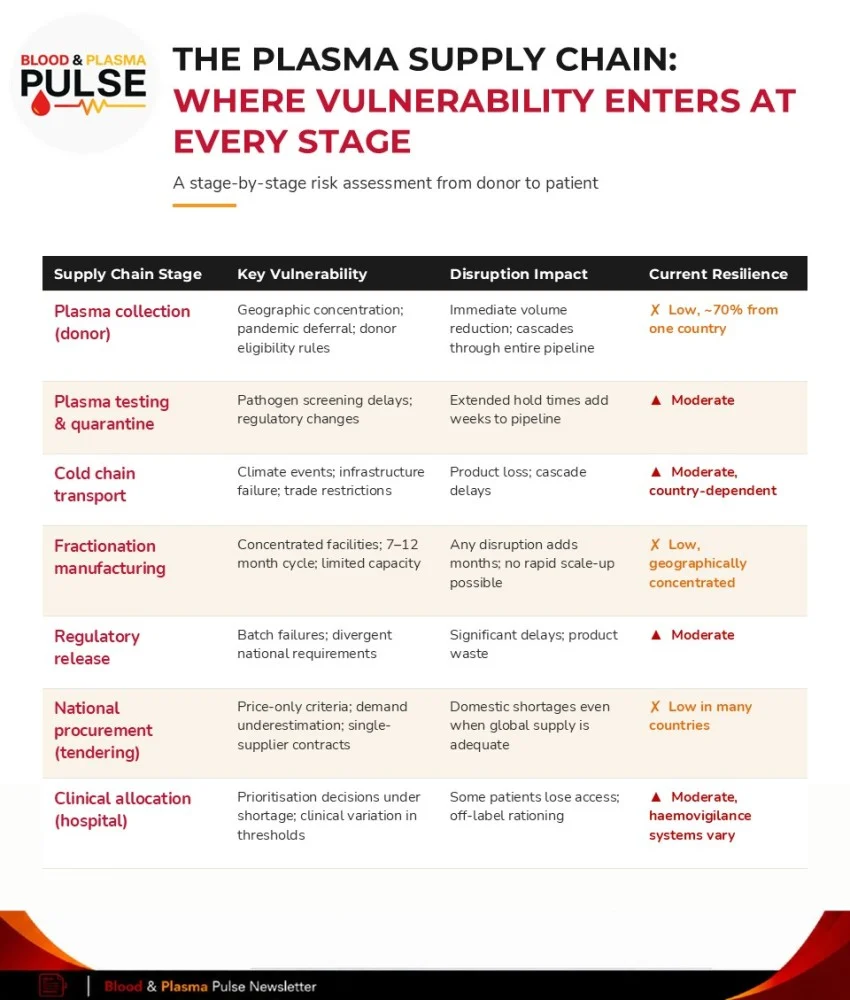
Figure 4. The plasma supply chain vulnerability map, stage by stage. Sources: Belmonte et al. (2025); Bonsdorff et al. (2024); Bloch et al. (2023); EU Council (2025).
What Strategic Autonomy in Plasma Actually Requires
The semiconductor analogy is instructive because it shows what governments are willing to do when they recognize a strategic supply dependency.
The U.S. CHIPS Act, the EU Chips Act, and equivalent legislation across Asia collectively mobilized hundreds of billions of dollars to diversify chip manufacturing, because policymakers understood that a concentrated, fragile supply chain for a critical technology was a national security risk, not merely a market inefficiency.
Plasma deserves the same analysis.
And when that analysis is applied rigorously, five interventions emerge as genuinely capable of building resilience, not as aspirational goals, but as evidence-supported policy levers that have already been proven to work in at least one jurisdiction.
- Expand compensated plasma collection in non-U.S. markets: The evidence from Alberta, Canada, where three commercial centres opened after the province’s ban on compensation was repealed, moving the province toward near-100% plasma self-sufficiency, demonstrates that compensated collection models can rapidly and meaningfully diversify the global supply base. Governments that continue to prohibit compensation while importing American plasma are not choosing altruism; they are choosing dependency (Niskanen Center, 2023). True strategic autonomy requires domestic collection capacity, and achieving that at scale in most countries requires donor compensation.
- Build domestic or regional fractionation capacity: The EU Critical Medicines Act provides the policy framework for this in Europe. But fractionation facilities take years to build and require a sustained plasma supply to operate economically. Investment in fractionation without parallel investment in domestic plasma collection creates infrastructure that imports its raw material, solving one vulnerability while preserving another. Both must be addressed together (European Commission, 2025; Pharmaceutical Technology, 2026).
- Reform procurement criteria to price resilience into tender evaluation: The CMA’s ‘resilience over price’ provision is the right direction. Health systems must stop creating demand incentives for supply concentration. Tenders should reward suppliers with diversified collection networks, regional manufacturing, and a demonstrated capacity to maintain supply during disruptions, even if those products cost more during baseline periods. The premium is an insurance premium, not an inefficiency (Belmonte et al., 2025).
- Establish strategic reserves and rolling inventory requirements: Most countries have strategic oil reserves as a matter of national security. Almost none have equivalent reserves for plasma-derived medicines. Given the 7–12 month manufacturing cycle, a strategic PDMP reserve of even three to six months’ supply would provide meaningful buffering against disruption, and the cost of maintaining that reserve is trivially small compared to the healthcare and economic cost of shortage (Belmonte et al., 2025; Bonsdorff et al., 2024).
- Enable contract fractionation for recovered plasma from LMICs: As noted in Issue 46, approximately 27% of globally fractionated plasma is recovered from whole-blood donations rather than from dedicated apheresis. Much of the plasma recoverable from whole blood donations in low- and middle-income countries is currently wasted because there is no fractionation pathway to receive it. Enabling regulatory-compliant contract fractionation for this plasma would simultaneously improve PDMP access in LMICs and reduce global concentration risk, without requiring any change in donation compensation policy (WHO, 2026a; Ramesh & McIntosh, 2025).
What This Means for Healthcare Leaders and Board Directors
The framing of this newsletter as a geopolitical risk story is deliberate because that is precisely the frame that healthcare boards and senior leaders need to apply. Plasma supply vulnerability is not a procurement department problem or a quality management challenge.
It is a strategic governance question that belongs at the highest level of decision-making in any organization that depends on, produces, collects, or advocates for plasma-derived medicines.
For blood collection organizations, the question is: what is our collection resilience strategy, and how does it reduce global concentration risk rather than perpetuating it? For fractionators and plasma product manufacturers, the questions are: how geographically diversified is our collection footprint, and what scenario has disrupted our supply in the last five years? For health ministries and national health agencies, the question is: do our tendering practices, inventory requirements, and donor policy frameworks create or reduce national supply risk? And for healthcare board directors across all of these organizations, the question is the simplest and most important: have we modelled this risk, and do we have a plan?
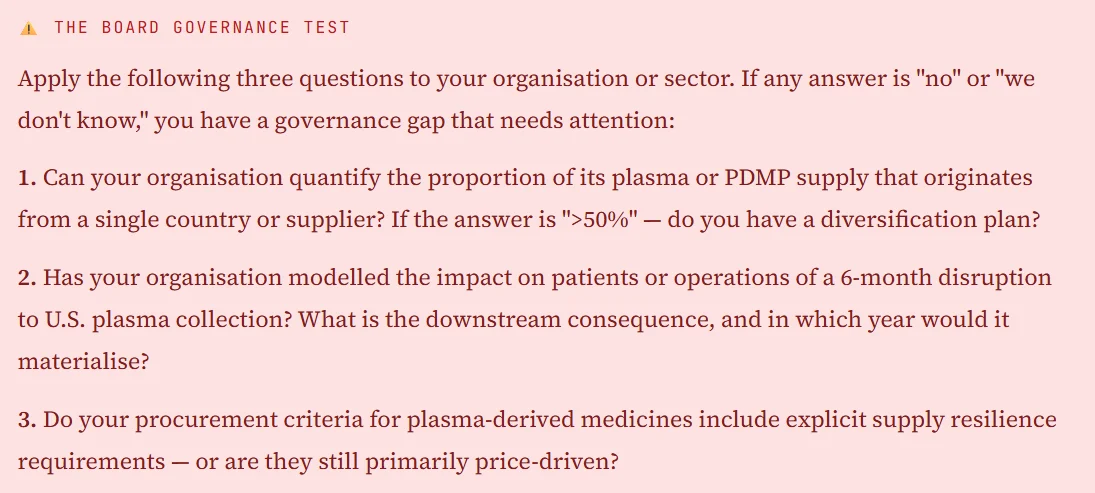
Plasma Is Too Important to Remain a Single Point of Failure
Plasma-derived medicines are not optional treatments. They are often the only treatment for patients with primary immune deficiency, haemophilia, hereditary angioedema, and dozens of other serious conditions.
They are on the WHO’s Essential Medicines List precisely because their absence is not a clinical inconvenience; it is a clinical emergency.
The global plasma supply chain, as currently configured, is a single point of failure dressed up as a functioning system.
It works well in stable conditions. It fails, as COVID-19 demonstrated, when conditions become unstable.
And the conditions of 2026: rising geopolitical tensions, climate disruption, trade volatility, and pandemic risk, are precisely the conditions in which it will be tested again.
The EU Critical Medicines Act is a meaningful step. The growing body of peer-reviewed evidence on PDMP supply sustainability is providing the analytical foundation for policy action. But the political will to treat plasma supply with the strategic urgency it deserves, to build fractionation capacity, diversify the collection footprint, reform procurement frameworks, and establish the strategic reserves that resilience actually requires, is still catching up to the scale of the risk.
The semiconductor crisis changed the way governments think about technology supply chains. We must not wait for the next plasma shortage to change how governments and the healthcare boards that guide organizations navigating this landscape think about biological supply chains.
When the world ran out of semiconductors, governments mobilised hundreds of billions to rebuild supply chains. When plasma runs short, patients with primary immune deficiency simply go without their medicine. The stakes are at least as high. The urgency has not yet matched them.
References
- Belmonte, M., Albiero, A., Callewaert, F., Patris, J., & Whittal, A. (2025). Understanding supply sustainability of plasma-derived medicinal products: Drivers and consequences of shortages.Vox Sanguinis, 120(8), 754–764.
- Bloch, E. M., Tobian, A. A. R., Alavi, A., Bilaloglu, S., Becker, R., et al. (2023). Managing blood supplies during natural disasters, humanitarian emergencies and pandemics: Lessons learned from COVID-19.Vox Sanguinis, 118(7), 535–546.
- Bonsdorff, C. H., et al. (2024). Securing commitment and control for the supply of plasma derivatives for public health systems II: A survey of national pathways.Vox Sanguinis, 119(11), 1213–1223.https://doi.org/10.1111/vox.13759
- Council of the European Union. (2025, December 2). Critical Medicines Act: Council agrees its position on new rules to tackle shortages.
- Council of the European Union. (2026, May 12). Critical Medicines Act: Council and Parliament reach provisional deal.
- European Commission. (2025, March 11).Proposal for a Critical Medicines Act.
- European Medicines Agency (EMA). (2024). EMA report on medicine shortages affecting 14 European countries. EMA Steering Group on Shortages and Safety of Medicinal Products (MSSG).
- Health Policy Watch. (2026, January 22). EU Parliament backs Critical Medicines Act, sparking supply concerns in Africa.
- Imperial College London / NOVA Medical School. (2025). When the lights went out: Impacts of the April 2025 Iberian blackout on the Portuguese National Health Service sovereignty, A reflection on national defence, health sovereignty, risk, and infrastructural dependency.PMC. PMC12283781.
- Niskanen Center. (2023, June 26).The case for commercial compensated plasma collections.
- Pharmaceutical Technology. (2026, June 19). The Critical Medicines Act’s impact on pharmaceutical manufacturing and supply resilience in Europe.Pharmaceutical Technology.
- Ramesh, N., & McIntosh, D. (2025). How do we solve the shortage of plasma-derived medicines in low- and middle-income countries (LMIC)?Annals of Blood, 10.
- World Health Organization (WHO). (2026a, June 12). Safe blood supply improves as voluntary donations exceed 85%, but many people still lack access[News release].
- World Health Organization (WHO). (2026b).Blood safety and availability[Fact sheet].
Stay updated on all scientific advances with Hemostasis Today.
-
Sep 23, 2026, 16:04Monia Ezzalfani: Advancing Patient-Centered Care in Hemophilia A and B
-
Sep 23, 2026, 15:49Bilge Başak: How Activated PRP Modulates Osteoarthritic Chondrocyte Function
-
Sep 23, 2026, 14:50Mbonjo Bitsie Dora: Strengthening Sickle Cell Care Through Education, Awareness and Innovation
-
Sep 23, 2026, 13:58The New B12 Diagnostic Algorithm: From Serum Cobalamin to Functional Deficiency
-
Sep 23, 2026, 13:56Noha Soror: Preparing for Hematology and Medical Oncology Board Certification
-
Sep 23, 2026, 13:46Ugochi Ogu: What Can Platelet Proteomics Reveal about Pain and Neurocognitive Vulnerability in Sickle Cell Disease?
-
Sep 23, 2026, 13:42Melissa Hollo: Connecting Obesity and Anemia for Earlier Maternal Risk Intervention
-
Sep 23, 2026, 13:16Beverley Hunt: Advances in Haemostatic Management of Postpartum Haemorrhage
-
Sep 23, 2026, 13:13Ioanna Mela: Recruiting a Research Associate on DNA nanotechnology