


Tetiana Lapikova-Bryhinska and Simon Kraler on the Role of JCAD in Post-ACS Adverse Events Prediction
Tetiana Lapikova-Bryhinska, Molecular Biology Researcher at UZH, reposted from Simon Kraler on LinkedIn:
”Exciting News!
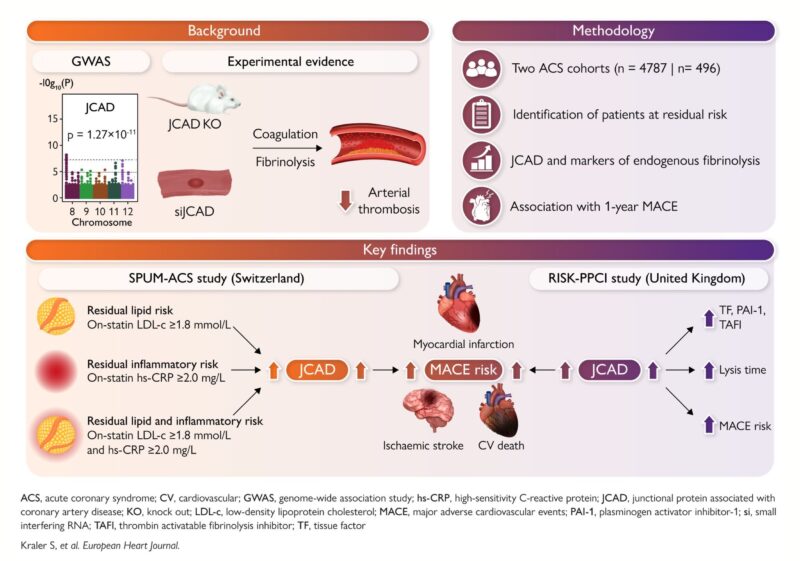
I am honored to have been a co-author on our recently published study in the European Heart Journal, which explores the role of JCAD in predicting major adverse cardiovascular events following acute coronary syndrome (ACS).
A big thank you to Simon Kraler, Thomas F. Lüscher, Giovanni G Camici, Alexander Akhmedov, and other colleagues for their collaboration and support throughout this important research.
I’m excited to share our findings and look forward to future advancements in cardiology, as well as the potential of JCAD as a therapeutic target.
This publication, released just in time for Christmas, feels like a wonderful gift as we enter the New Year!
Read the full paper here”
Quoting Simon Kraler‘s post:
”Residual risk: is it time to move 𝐛𝐞𝐲𝐨𝐧𝐝 𝐋𝐃𝐋-𝐜 𝐚𝐧𝐝 𝐢𝐧𝐟𝐥𝐚𝐦𝐦𝐚𝐭𝐢𝐨𝐧?
Despite guideline-directed lipid lowering and anti-inflammatory therapy, patients with a recent ACS remain at 𝐯𝐞𝐫𝐲 𝐡𝐢𝐠𝐡 𝐢𝐬𝐜𝐡𝐚𝐞𝐦𝐢𝐜 𝐫𝐢𝐬𝐤.
Based on GWAS and mechanistic data, we hypothesized that JCAD (‘𝐉unctional Protein Associated with 𝐂oronary 𝐀rtery 𝐃isease’) on chromosome 10 might represent the missing link.
In our newly published European Heart Journal study, JCAD independently predicted 1-𝐲𝐞𝐚𝐫 𝐌𝐀𝐂𝐄 in patients with residual lipid risk, inflammatory risk, or both – notably 𝐢𝐧𝐝𝐞𝐩𝐞𝐧𝐝𝐞𝐧𝐭 𝐨𝐟 𝐋𝐃𝐋-𝐜 𝐚𝐧𝐝 𝐡𝐬-𝐂𝐑𝐏.
High JCAD equals impaired 𝐞𝐧𝐝𝐨𝐠𝐞𝐧𝐨𝐮𝐬 𝐟𝐢𝐛𝐫𝐢𝐧𝐨𝐥𝐲𝐬𝐢𝐬 and high MACE risk, with similar results obtained during external validation.
JCAD may represent a 𝐧𝐨𝐯𝐞𝐥 𝐭𝐡𝐞𝐫𝐚𝐩𝐞𝐮𝐭𝐢𝐜 𝐭𝐚𝐫𝐠𝐞𝐭 to address residual risk after a recent ACS.
Full paper.
Special thanks to the colleagues and friends at University of Genoa, King’s College London, University of Zurich, CHUV | Lausanne university hospital, Universitätsspital Zürich, HUG – Hopitaux Universitaires de Genève and Insel Gruppe.
Thank you Thomas F. Lüscher, Luca Liberale, Giovanni G Camici, Diana Gorog Lorenz Räber, Davide Di Vece, Yifan Wang, Francesco Bruno and all!”
Read the full article here.
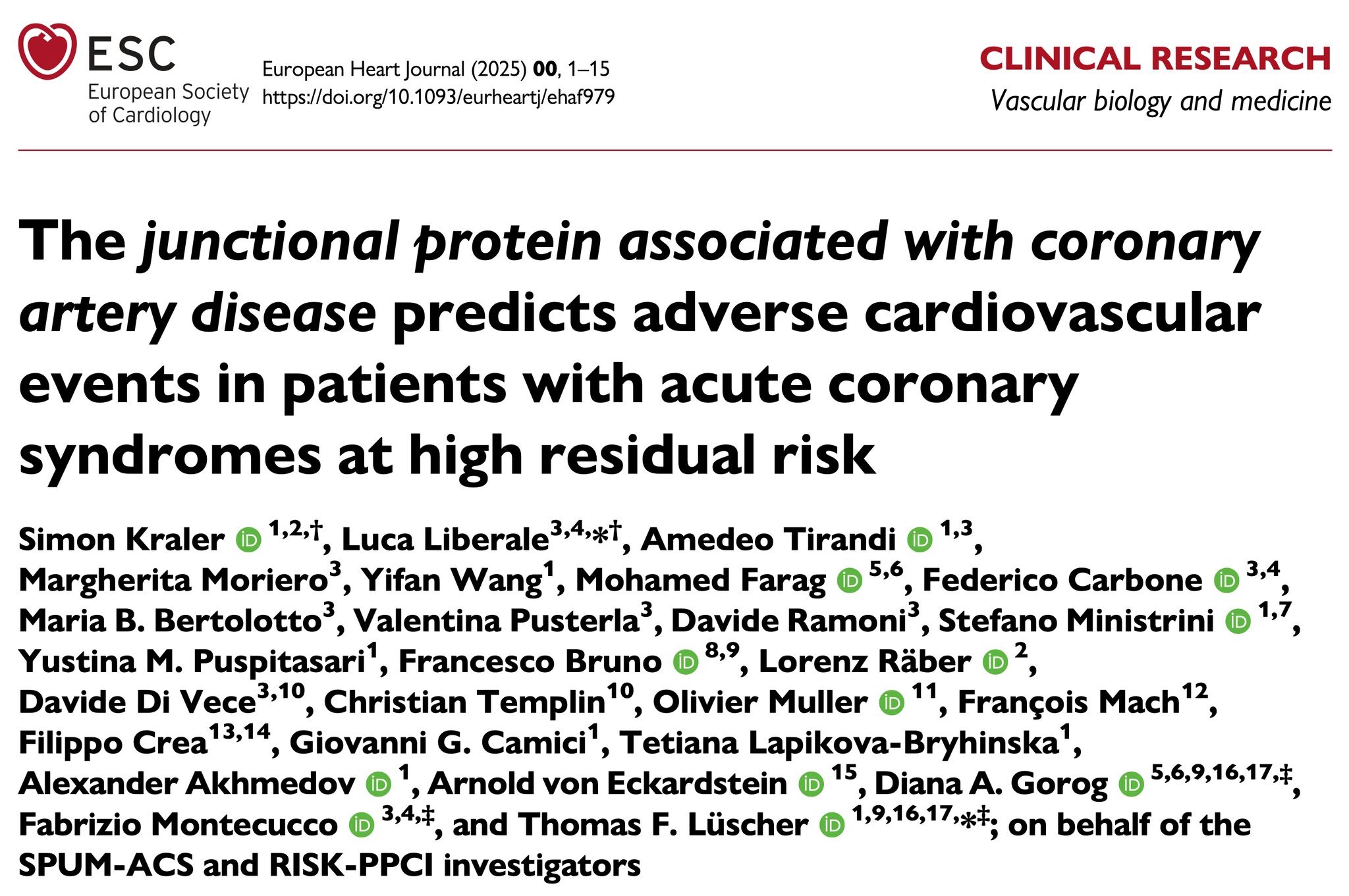
Article: The junctional protein associated with coronary artery disease predicts adverse cardiovascular events in patients with acute coronary syndromes at high residual risk
Authors: Simon Kraler , Luca Liberale , Amedeo Tirandi , Margherita Moriero , Yifan Wang , Mohamed Farag , Federico Carbone , Maria B Bertolotto , Valentina Pusterla , Davide Ramoni , Stefano Ministrini , Yustina M Puspitasari , Francesco Bruno , Lorenz Räber , Davide Di Vece , Christian Templin , Olivier Muller , François Mach , Filippo Crea , Giovanni G Camici , Tetiana Lapikova-Bryhinska , Alexander Akhmedov , Arnold von Eckardstein , Diana A Gorog , Fabrizio Montecucco , Thomas F Lüscher
Stay updated on all scientific advances with Hemostasis Today.
-
Oct 20, 2026, 15:04Laura S.: Could Speaking Up Prevent Maternal Deaths from Thrombosis?
-
Oct 20, 2026, 14:44Pete Stibbs: VTE in Professional Athletes – When Fitness Is Not Enough
-
Oct 20, 2026, 14:39Jan Hartmann: How Hemophilia Care Has Advanced Over the Past Decade
-
Oct 20, 2026, 14:27Amna Jamalallail: SCD and Thalassemia in Jeddah – A Public Health Perspective
-
Oct 20, 2026, 14:14Advancing Thalassaemia and Sickle Cell Care Through Nordic Collaboration – TIF
-
Oct 20, 2026, 14:01Ashkan Forouzani։ Warfarin or DOACs in Protein C and S Deficiency?
-
Oct 20, 2026, 13:20The Global Blood Crisis – Are We Solving the Wrong Problem?
-
Oct 20, 2026, 06:45Grant Garcia: Why Does a Blood Clot Diagnosis Immediately End an Athlete’s Season?
-
Oct 20, 2026, 06:35Parag Tamhankar: Landmark Study Reveals Genetic Spectrum and Targeted Therapies for ALPS in the Indian Population