


Thierry Burnouf: Turning Raw Plasma Into Life-Saving Medicines Requires Manufacturing and Regulatory Reform
Thierry Burnouf, Vice-Dean, Distinguished Professor, Biomedical Engineering at Taipei Medical University, shared a post on LinkedIn about a recent article he and his colleague co-authored, published in ISBT, adding:
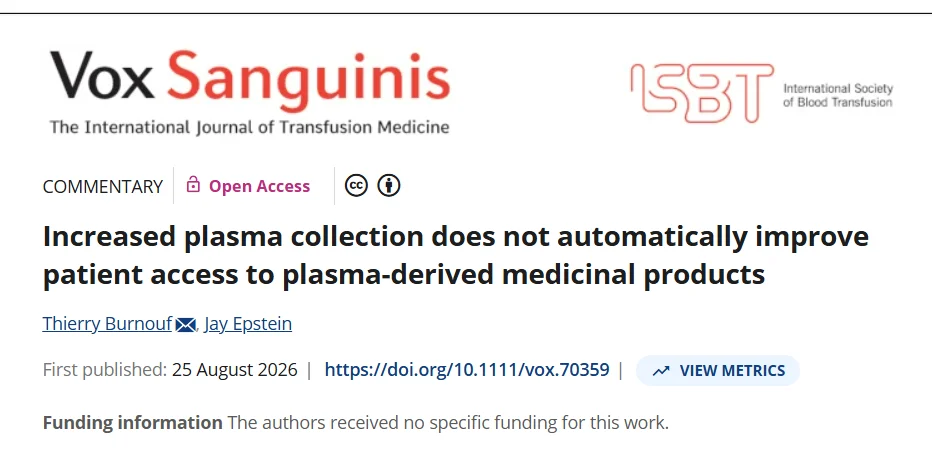
“Our new Commentary in Vox Sanguinis: ‘Increased plasma collection does not automatically improve patient access to plasma-derived medicinal products.’
There is increasing and justified worldwide attention to expanding plasma collection for fractionation. Plasma is the essential starting material for plasma-derived medicinal products (PDMPs).
But increasing plasma collection is only one part of the pathway.
Turning collected plasma into immunoglobulins, albumin, coagulation factors, and other essential medicines requires appropriate fractionation technologies, robust and validated manufacturing processes, regulatory capacity, sustainable financing, and arrangements to ensure the resulting products are accessible to patients.
This is particularly important in countries where fractionation capacity remains limited. Efforts to increase the volume and quality of plasma available for fractionation should therefore be accompanied by efforts to develop safe, robust, and cost-effective technological pathways for transforming this plasma into needed therapeutic proteins.
Now is the time to act: increasing plasma collection must go hand in hand with developing the technological and manufacturing capacity required to turn plasma into safe, accessible PDMPs.
This will require effective collaboration between blood establishments, health authorities, regulators, technology providers, industry and other stakeholders.
Well-designed public – private partnerships can play an important role in translating plasma collection efforts into sustainable access to PDMPs.
The objective should ultimately not be measured only in litres of plasma collected, but in the availability of safe and affordable plasma-derived medicines for the patients who need them.”
Title: Increased plasma collection does not automatically improve patient access to plasma-derived medicinal products
Authors: Thierry Burnouf, Jay Epstein
Stay updated on all scientific advances with Hemostasis Today.
-
Oct 13, 2026, 02:01Nour Al-Mozain: Is It Really Anti-D? – Unraveling Auto-Anti-LW in the Transfusion Laboratory
-
Oct 13, 2026, 01:51Berenice Villegas: The Role of Morphologic Evaluation in Body Fluid Differential Analysis
-
Oct 13, 2026, 01:44Debadrita Ray: Evaluating vWF and VITRO Score for Detecting CSPH in cACLD Patients
-
Oct 13, 2026, 01:34Nagesh Ramesh: Donating Blood for International Plasma Awareness Week
-
Oct 12, 2026, 21:51Sam Botchey: Orthobiologics Are Advancing but the Evidence Must Keep Pace
-
Oct 12, 2026, 21:50Serum Vitamin D, Platelet Function, and Bleeding in Primary ITP – Platelets Journal
-
Oct 12, 2026, 21:30Nika Samadzadeh Tabrizi: Looking Forward to the PACeS Trial on Anticoagulation for POAF
-
Oct 12, 2026, 21:28Michael Megaly: Does Coronary Ectasia Affect Outcomes in Acute Coronary Syndromes?
-
Oct 12, 2026, 21:25Vitor Borin P. de Souza: Think Twice Before Anticoagulating an Isolated Subsegmental PE