

New Machine Learning Models Improve Prediction of Thrombosis and Bleeding in Cancer – JTH
Journal of Thrombosis and Haemostasis (JTH) shared on LinkedIn about a recent article by Danielle Carole Roy et al, adding:
”Development of models for predicting the 7-month risk of venous thromboembolism and clinically relevant bleeding in ambulatory patients with cancer (AVERT trial analysis)
Using data from 514 ambulatory cancer patients in the AVERT trial, machine-learning models combining biomarkers and genetics predicted both venous thromboembolism (AUC 0.92) and clinically relevant bleeding (AUC 0.90).
VTE risk tracked with factor V Leiden and certain cancers, while bleeding risk tracked with cardiac and inflammatory markers.
The sample stayed modest.
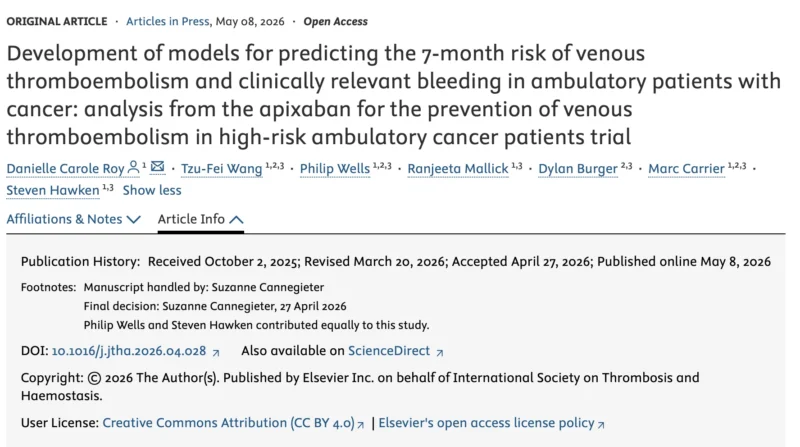
Title: Development of models for predicting the 7-month risk of venous thromboembolism and clinically relevant bleeding in ambulatory patients with cancer: analysis from the apixaban for the prevention of venous thromboembolism in high-risk ambulatory cancer patients trial
Authors: Danielle Carole Roy, Tzu-Fei Wang, Philip Wells, Ranjeeta Mallick, Dylan Burger, Marc Carrier, Steven Hawken
Stay updated on all scientific advances with Hemostasis Today.
-
Oct 9, 2026, 10:40What New U.S. Data Reveal About GT – Glanzmann’s Research Foundation
-
Oct 9, 2026, 10:32Anjali Pandey: The Morphologic Clues to MDS With del(5q)
-
Oct 9, 2026, 10:13Reza Shojaei: 5 Leadership Responsibilities for a Sustainable Plasma Ecosystem
-
Oct 9, 2026, 08:38Johannes Gratz: Perioperative Care in Factor VII Deficiency – Treating the Patient, Not the Number
-
Oct 9, 2026, 08:28Ghanim Fajish: Vascular Cells May Retain a Prothrombotic Memory of Oxidative Stress
-
Oct 9, 2026, 07:43Mehmet Cilingiroglu: The First Diagnosis of Coronary Thrombosis in a Living Patient
-
Oct 9, 2026, 07:21Federico Ravaioli: 40 kPa Spleen Stiffness May Help Avoid Endoscopy in Chronic PVT
-
Oct 9, 2026, 07:00Danny Reardon: Closing the Global Awareness Gap on Blood Clots
-
Oct 9, 2026, 00:54Mary Catherine Moffett: Advancing Advocacy Together – Highlights from the Sanofi Bleeding Disorders Summit