


Pip Nicolson: Understanding VITT From COVID-19 Vaccines
Pip Nicolson, Associate Clinical Professor in Cardiovascular Medicine (Haematology) at University of Birmingham, shared an insightful thread on X:
“Pleased to be able to share the VITT consortium’s comprehensive final report which sheds light on rare blood clotting syndrome linked to COVID-19 vaccines.
Main Findings:
- The development of antibodies to a small protein released by platelets called Platelet Factor 4 (PF4), which is a key feature of VITT, was probably due to an interaction between the negatively charged “hexon” proteins in the adenoviral vaccine and the positively charged PF4.
- Antibodies to the PF4 protein are uncommon in healthy individuals, vaccinated individuals, and those infected with COVID-19. By contrast, the levels are very high in patients with VITT.
- Whole genome sequencing revealed no significant genetic variants predisposing individuals to VITT, though further RNA sequencing studies are ongoing.
- A strong immune response is seen in patients with VITT – the formation of neutrophil extracellular traps (these are like sticky spider webs formed by white blood cells) and inflammatory reactions, collectively contributed to clot formation.
- The consortium recommends establishing a national reference laboratory registry to improve diagnosis and tracking of Thrombotic Thrombocytopenia Syndrome.
- The findings suggest that future adenoviral vector-based vaccines could be modified to reduce interactions with PF4 and minimise the risk of immune-related complications.
Funded by: NIHR (National Institute of Health and Care Research)
Many Contributors: Prof Cheng-Hock Toh CBE, Richard Buka, Sam Montague, British Society of Haematology, President of British Pharmacological Society Professor Sir Munir Pirmohamed, The Birmingham Platelet Group, Cardiovascular Sciences University of Birmingham, University of Liverpool, Cambridge University”
Read the full VITT Consortium report here.
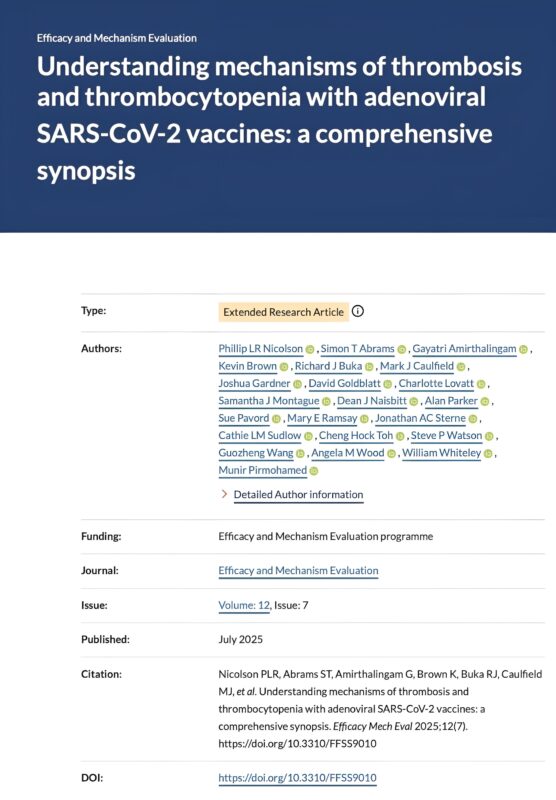
Article: Understanding mechanisms of thrombosis and thrombocytopenia with adenoviral SARS-CoV-2 vaccines: a comprehensive synopsis
Authors: Phillip LR Nicolson, Simon T Abrams, Gayatri Amirthalingam, Kevin Brown, Richard J Buka, Mark J Caulfield, Joshua Gardner, David Goldblatt, Charlotte Lovatt, Samantha J Montague, Dean J Naisbitt, Alan Parker, Sue Pavord, Mary E Ramsay, Jonathan AC Sterne, Cathie LM Sudlow, Cheng Hock Toh, Steve P Watson, Guozheng Wang, Angela M Wood, William Whiteley, Munir Pirmohamed
Stay updated on the latest scientific advances in the field of thrombotic disorders with Hemostasis Today.
-
Oct 4, 2026, 05:39Alicja Urbaniak: Targeting CD148 for Novel Antithrombotic Therapy
-
Oct 4, 2026, 05:27Nirali Thakkar: Influenza and Myocardial Infarction An Unexpected Cardiovascular Connection
-
Oct 4, 2026, 05:03Hisham Fahmi: Thromboprophylaxis in Children With ALL A Risk Adapted Approach
-
Oct 4, 2026, 05:00Mary Cushman: Erin Michos Highlights Rising Heart Disease Mortality Among Younger Women in the US
-
Oct 4, 2026, 04:48Liv Tybjærg Nordestgaard: Is Fasting Necessary Before Blood Sampling?
-
Oct 4, 2026, 04:31Sonal Sonu: Gen Z doesn’t just set trends – Gen Z saves lives
-
Oct 4, 2026, 04:22Registration Opens for 2027 Highlights of ASH – American Society of Hematology
-
Oct 4, 2026, 04:06Konstantinos Stavroulakis: Vessel Preparation in Lower Limb Revascularization
-
Oct 4, 2026, 03:34Liselotte Hyveled: Exploring Opportunities to Improve Hemophilia and Sickle Cell Care in Ghana