


Wolfgang Miesbach on Fernando Corrales-Medina’s Team’s Latest Cross-Sectional Study on Haemophilia
Wolfgang Miesbach, Professor of Medicine at Frankfurt University Hospital, shared on LinkedIn:
”Cardiovascular risk in haemophilia begins very early.
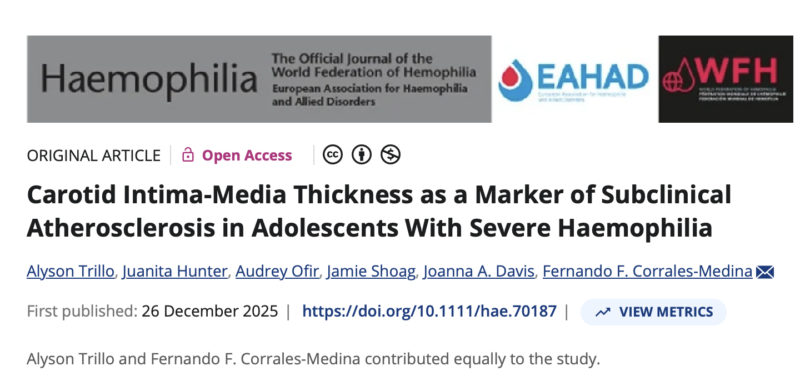
Fernando Corrales-Medina and colleagues have published an important cross-sectional study in Haemophilia evaluating carotid intima–media thickness (cIMT) as a marker of subclinical atherosclerosis in adolescent males with severe haemophilia A or B, all on prophylaxis.
Using bilateral carotid ultrasound, they compared 22 adolescents with severe haemophilia to 16 age‑matched healthy controls:
- Higher cIMT in haemophilia
Right-sided cIMT was significantly increased in adolescents with severe haemophilia compared with controls, despite similar age, BMI, waist circumference, and blood pressure. - Early vascular remodelling
Age- and height-adjusted cIMT percentiles were higher in the haemophilia cohort, suggesting that arterial changes may already begin in adolescence. - Beyond traditional risk factors
HDL cholesterol was lower in the haemophilia group, but cIMT did not correlate with conventional cardiovascular risk factors, highlighting that haemophilia-specific factors and lifelong treatment conditions may also contribute to vascular risk.
For a community that has rightly focused for decades on bleeding outcomes, this work is a strong reminder that comprehensive haemophilia care should systematically integrate cardiovascular risk assessment—starting in paediatric and adolescent age.
Non-invasive tools such as cIMT may become valuable adjuncts to long-term follow-up strategies in this emerging at-risk population.”
Read the full article here.
Article: Carotid Intima-Media Thickness as a Marker of Subclinical Atherosclerosis in Adolescents With Severe Haemophilia
Authors: Alyson Trillo, Juanita Hunter, Audrey Ofir, Jamie Shoag, Joanna A. Davis, Fernando Corrales-Medina
Stay updated on all scientific advances with Hemostasis Today.
-
Oct 16, 2026, 18:12Adil Nawaz: Extended Dual Antiplatelet Therapy After Coronary Stenting
-
Oct 16, 2026, 17:50Elad Asher։ STORM-PE Shows Functional Benefits of Thrombectomy
-
Oct 16, 2026, 17:32Shruthi Narayan: STORM-PE and STRIKE-PE Studies Advance Understanding of Recovery After Pulmonary Embolism
-
Oct 16, 2026, 17:22Wolfgang Miesbach։ What a Near-Perfect FISH Score Fails to See
-
Oct 16, 2026, 17:06Troels Wienecke: Connecting Myeloproliferative Disease and Ischemic Stroke
-
Oct 16, 2026, 17:03Only 5 Days Left to Submit Your Research for EAHAD 2027
-
Oct 16, 2026, 16:48Abdul Rahman: Reticulocyte Count and Bone Marrow Activity
-
Oct 16, 2026, 16:44DOAC Adherence in Stroke Patients With Atrial Fibrillation – International Journal of Stroke
-
Oct 16, 2026, 16:22Shannon Farmer: Driving Patient Blood Management Forward in Australia and New Zealand