


Werner Krammer: How Escitalopram Can Support Motor Recovery Post Cortical Sensori-Motor Stroke
Werner Krammer, Senior Physician at Zihlschlacht Rehabilitation Clinic, shared on LinkedIn about a recent article he and his colleagues co-authored, adding:
‘‘I am excited to share our latest research from the Support Center for Advanced Neuroimaging (SCAN) at the Inselspital, University Hospital Bern.
In our recent longitudinal study, we explored how Escitalopram can support motor recovery following cortical sensori-motor stroke.
Our findings suggest that the medication promotes significant recovery from hand paresis, offering a promising avenue for enhancing post-stroke rehabilitation.
A huge thank you to my colleagues and the entire team for their dedication to advancing neuro-rehabilitation.”
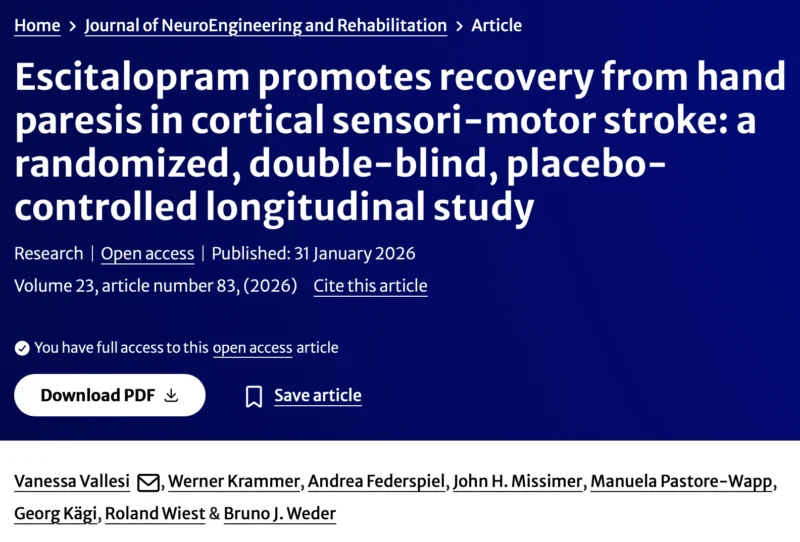
Title: Escitalopram promotes recovery from hand paresis in cortical sensori-motor stroke: a randomized, double-blind, placebo-controlled longitudinal study
Authors: Vanessa Vallesi, Werner Krammer, Andrea Federspiel, John H. Missimer, Manuela Pastore-Wapp, Georg Kägi, Roland Wiest, Bruno J. Weder
Read the Full Article on Journal of NeuroEngineering and Rehabilitation
Stay updated on all scientific advances with Hemostasis Today.
-
Sep 22, 2026, 09:18Shamee Shastry: How Transfusion Medicine Research Is Evolving in India
-
Sep 22, 2026, 09:11Tarique Shahzad Chachar: Why Warfarin Remains the Gold Standard for Mechanical Heart Valves
-
Sep 22, 2026, 09:04Bianca Rocca: Thromboinflammatory Injury in Ischemic Limb Necrosis During Severe Shock
-
Sep 22, 2026, 09:01Ash Paul: Comparing Left Atrial Appendage Occlusion and Oral Anticoagulation
-
Sep 22, 2026, 08:50Emily Horner: Lipoprotein(a) Links Oxidized Phospholipids to Platelet Hyperactivity
-
Sep 22, 2026, 08:42Sally Mandour: Bone Marrow Needle Gauge Explained
-
Sep 22, 2026, 08:39Alessandro Sionis: Navigating Anticoagulation in Mechanical Circulatory Support
-
Sep 22, 2026, 08:28Raghavendra Rao: The Latest Research on Varicose Veins
-
Sep 22, 2026, 08:23Aravind Palraj: Three Essential Tests in Antiphospholipid Syndrome