


William Wallace: Why Normal Bloodwork Doesn’t Always Mean Normal Iron Stores
William Wallace, Co-Founder and Chief Scientific Officer at Supplement Success Solutions, shared a post on LinkedIn:
“You can have iron deficiency for months while your bloodwork looks completely normal.
This isn’t a screening failure; it’s how the condition actually progresses.
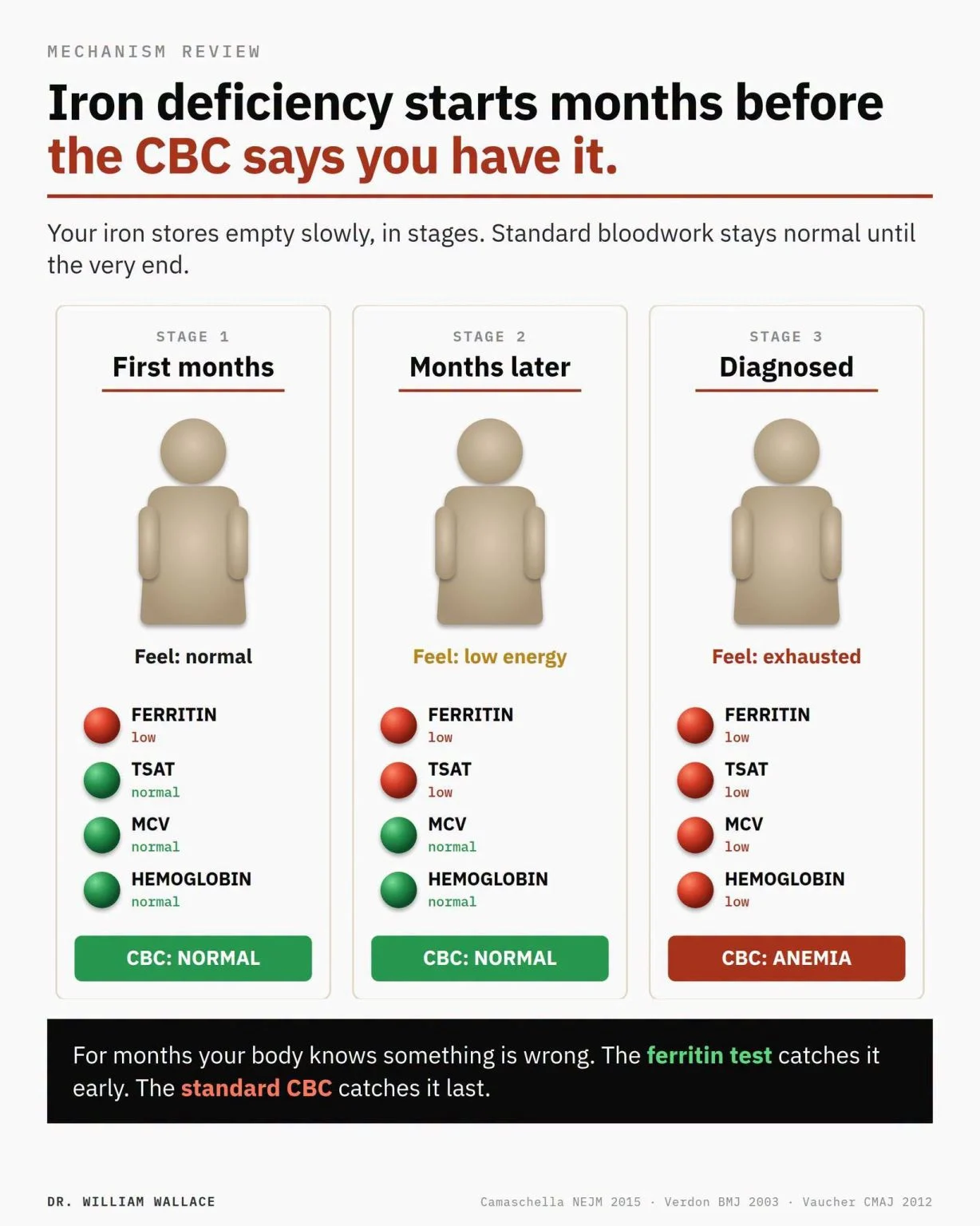
Iron leaves the body in stages. The first stage is your storage iron emptying out, measured by a blood marker called ferritin. Ferritin lives in cells throughout your liver, spleen, and bone marrow as a reservoir.
When iron intake doesn’t keep up with iron loss (menstrual blood, GI bleeding, pregnancy, restricted diets, donation), ferritin starts to drop. You can lose most of your stored iron and still feel fine because the iron in active circulation is being maintained.
A standard CBC at this point will look completely normal. Hemoglobin, MCV, red cell count, all unremarkable. The only test that would catch what’s happening is a separately ordered ferritin and iron panel.
The second stage is what hematologists call iron-deficient erythropoiesis. Your stores are empty, so the iron carrier protein in your blood (transferrin) starts running short on cargo. Transferrin saturation (TSAT) falls below 20 percent.
Your bone marrow is now making red blood cells with less iron available. Some people start to feel it here, some don’t.
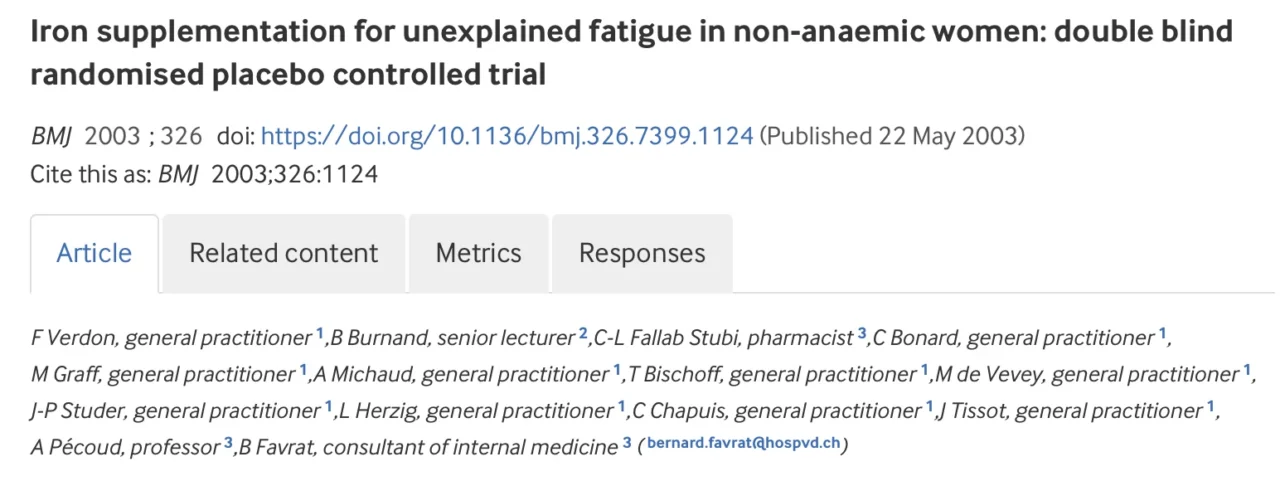
Verdon and colleagues at the University of Lausanne ran a randomized trial in 144 women with low ferritin but no anemia and showed that iron sulfate reduced their fatigue scores compared to placebo (BMJ 2003).
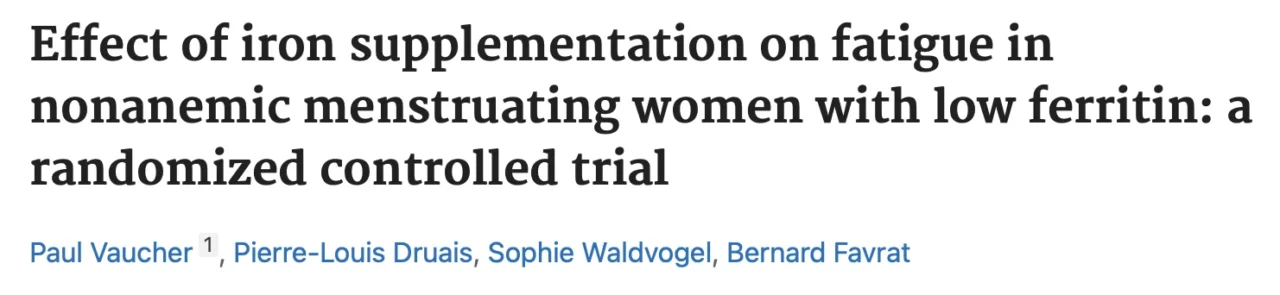
Vaucher later replicated this finding in 198 women over 12 weeks (CMAJ 2012). A 2024 analysis of nearly 10,000 blood donors complicated the picture by showing the fatigue association was strongest in men and weaker than commonly claimed in the general population.
So Stage 2 symptoms are real but variable. Your CBC is still normal.
The third stage is when hemoglobin finally drops. The bone marrow is running out of usable iron and starts producing smaller, less-loaded red cells. MCV falls. Hemoglobin falls.
Your CBC finally flags ‘anemia.’ By the time this happens, iron deficiency has been present for months, possibly longer.
The clinical implication is straightforward. If you have a reason to suspect iron deficiency (menstruation, heavy training, restricted diet, GI symptoms, chronic fatigue), don’t rely on a CBC alone. Ask for ferritin and transferrin saturation.
The CBC tells you when anemia has set in. Ferritin helps inform you as to whether iron deficiency has begun.”
Title: Iron-Deficiency Anemia
Author: Clara Camaschella, M.D.

Title: Iron supplementation for unexplained fatigue in non-anaemic women: double blind randomised placebo controlled trial
Authors: F Verdon, B Burnand, C-L Fallab Stubi, C Bonard, M Graff, A Michaud, T Bischoff, M de Vevey, J-P Studer, L Herzig, C Chapuis, J Tissot, A Pécoud, B Favrat
Title: Effect of iron supplementation on fatigue in nonanemic menstruating women with low ferritin: a randomized controlled trial
Authors: Paul Vaucher, Pierre-Louis Druais, Sophie Waldvogel, Bernard Favrat
Find more posts featuring William Wallace on Hemostasis Today.
-
Sep 26, 2026, 03:11Alice Mihai: One Blood Donation, Three Lives Touched
-
Sep 26, 2026, 03:01Jensa Morris: Anticoagulation in Thrombocytopenia and Cancer-Associated Thrombosis
-
Sep 26, 2026, 02:37Alireza Arzhangzadeh: Antithrombotic Strategies in Coronary Artery Aneurysm, Ectasia, and Slow Flow
-
Sep 26, 2026, 02:15Sherif Mahmoud: Updated Guideline for Antithrombotic-Associated Intracranial Hemorrhage
-
Sep 25, 2026, 20:01Anand Gupta: Timing of DOAC Initiation in Newly Diagnosed Atrial Fibrillation
-
Sep 25, 2026, 19:56Steven Fein: A History of Blood Clots Doesn’t Mean a Healthy Pregnancy Is Out of Reach
-
Sep 25, 2026, 19:54Pedro Perez: “Provoked” VTE May Not Always Mean the Risk Disappears When the Provoking Event Does
-
Sep 25, 2026, 19:53Kemal Karaagac: Calcitriol May Reduce Thrombotic Risk in MASLD
-
Sep 25, 2026, 19:52The SINGLE-AF Trial Anticoagulation for Intermediate Stroke Risk – NEJM