

Davide Stradella: Bleeding is an Unpleasant Complication in Endoscopy
Davide Stradella, Consultant Physician (Gastroenterology and Digestive Endoscopy) at Mauriziano Hospital, Turin, shared a post on LinkedIn:
“We need to ensure safety for our patients in every day practice and operative endoscopy.
Bleeding is a unpleasant complication in endoscopy.
We need to know MoA and correct time for withdrawal of principal antiplatelets/anticoagulant
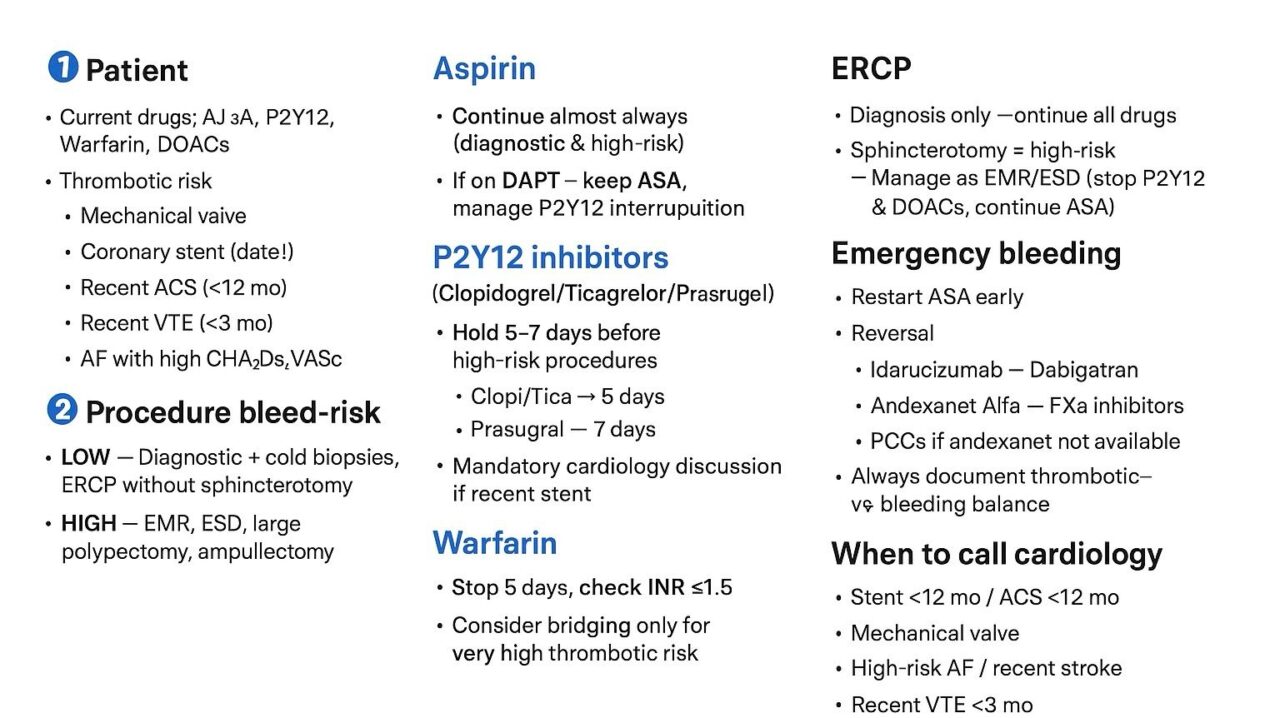
Here’s a Antiplatelets & anticoagulants in endoscopy — practical update for daily practice based on principal guidelines and review.
Balancing bleeding vs thrombotic risk is central to safe endoscopy. Short summary:
• Diagnostic procedures (EGD/colonoscopy without biopsy, ERCP without sphincterotomy): usually do not stop aspirin/warfarin/DOACs — omit morning DOAC dose for low-risk cases.
• High-risk procedures (EMR/ESD, polypectomy >1–2 cm, sphincterotomy): stop P2Y12 inhibitors 5–7 days (clopidogrel/ticagrelor ~5 days, prasugrel ~7), stop warfarin 5 days and ensure INR <1.5, and stop DOACs 48–72 h before (longer if renal impairment). Continue aspirin in most cases. Liaise with cardiology for recent coronary stent/DAPT.
• Urgent bleeding / life-threatening cases: use specific reversal agents where indicated (idarucizumab for dabigatran; andexanet alfa or PCCs for factor-Xa inhibitors) and coordinate with hematology/cardiology.
Short practical tip: document thrombotic risk (stent timing, mechanical valve, recent VTE/AF CHADS-VASc), classify procedure bleed-risk, and have plan for interruption/resumption and for urgent reversal.
1. BSG/ESGE guideline — Endoscopy in patients on antiplatelet or anticoagulant therapy (update 2021; addendum 2024). (full guideline PDF).
2. Veitch AM et al., Gut / Endoscopy (BSG/ESGE summary 2021).
3. ACG/CAG clinical guideline on periprocedural antithrombotic management (2022).
4. International Digestive Endoscopy Network (IDEN) consensus on antithrombotics in endoscopy (2024).
5. Reviews on anticoagulant reversal and peri-endoscopic management (2021–2024).”
Stay informed with Hemostasis Today.
-
Oct 12, 2026, 10:36PAI-1 Inhibition as a New Strategy for Enhancing Fibrinolysis and Clot Resolution
-
Oct 12, 2026, 07:39Emmanuel J Favaloro: 100 Years of von Willebrand Disease and the Importance of Local Diagnosis and Management
-
Oct 12, 2026, 07:39Post-Stroke Fatigue Trajectories – 38% Recovered at 12 Months, While 16% Developed New Fatigue – International Journal of Stroke
-
Oct 12, 2026, 07:28Beth Sara: IBMS Specialist Portfolio Achievement and a New Role in Transfusion Practice
-
Oct 12, 2026, 07:28Abdul Mannan: PCC vs. aPCC – The Small ‘a’ That Changes Emergency Management
-
Oct 12, 2026, 07:20Mokhtar Tazik: Improving Access to Plasma Derived Medicines Through Awareness, Interest and Accessibility
-
Oct 12, 2026, 07:08Larissa Chastain: Partnering to Transform Anticoagulation Management Through INR Self-Testing
-
Oct 12, 2026, 06:57Saiful Islam: Laboratory Spot Check – Microcytic Anemias and The Thalassemia Spectrum
-
Oct 12, 2026, 06:45Nick Lenamon: Stroke Awareness at Any Age Recognizing the Signs and Acting FAST