


Marieke Ogay on Pregnancy, Thrombophilia and Loss
Marieke Ogay, Bachelor in Midwifery at Erasmushogeschool Brusse, shared on LinkedIn:
”Pregnancy, thrombophilia and loss: what can this teach us about truly individualized care?
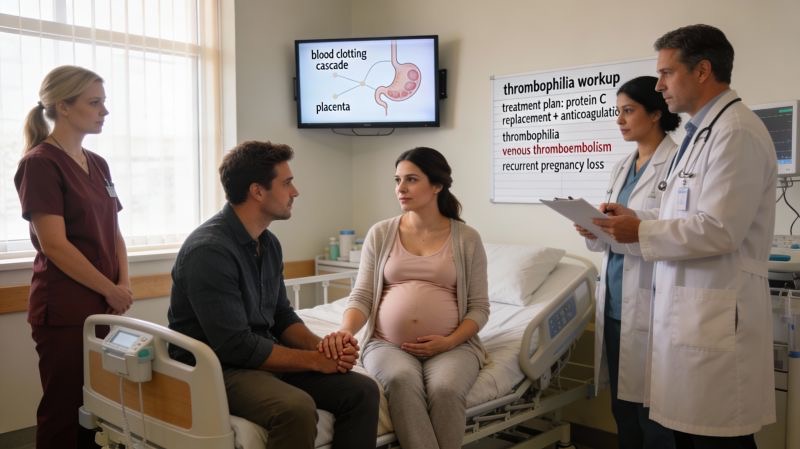
A short but striking case report in the British Journal of Haematology describes a 27‑year‑old woman with type 1 protein C deficiency, a history of DVT, pulmonary embolism and five consecutive miscarriages after her first birth.
Because she developed severe skin reactions to all forms of heparin and even a heparinoid, standard thromboprophylaxis during pregnancy was not an option.
For her seventh pregnancy, the team tried a different strategy: regular infusions of protein C concentrate in the first and third trimesters, with carefully managed warfarin during the second trimester and early postpartum period.
This time, there were no thromboembolic or major haemorrhagic events, and she delivered a healthy baby by caesarean at 38 weeks.
Why does this matter for those of us working in pregnancy care?
It highlights how heritable thrombophilias such as protein C deficiency markedly increase the risk of venous thromboembolism and both early and late fetal loss.
It illustrates the power—and the ethical responsibility—of tailoring therapy when “standard” pathways (like heparin prophylaxis) are contraindicated or not tolerated.
It reminds us that behind each protocol sits an individual physiology, history and set of constraints; sometimes, only creative, multidisciplinary thinking can bridge that gap.
Even though this is just a single case, it opens the door to considering protein C replacement as a potential strategy for highly selected women with familial protein C deficiency, recurrent pregnancy loss and limited treatment options.
As clinicians and birth workers, the challenge is to keep balancing safety, evidence and humanity—especially in rare, high‑risk scenarios where the guideline ends and real‑life complexity begins.
Source: Richards EM, Makris M, Preston FE. “The successful use of protein C concentrate during pregnancy in a patient with type 1 protein C deficiency, previous thrombosis and recurrent fetal loss.” British Journal of Haematology, 1997”
Stay updated with Hemostasis Today.
-
Oct 10, 2026, 17:58Archo Farzana Batool: Exploring Medical Writing Through an Article on Iron Deficiency Anemia
-
Oct 10, 2026, 17:53Assessing Frailty in Adults With Hemophilia – JTH
-
Oct 10, 2026, 17:52Fatma Sadeghi: Reducing Maternal Health Inequalities Through Nursing Advocacy
-
Oct 10, 2026, 17:50Grzegorz Hensler: How Apheresis Transformed Blood Cell Separation and Collection
-
Oct 10, 2026, 17:47Hemant K Sharma: Japan’s Universal Artificial Blood Research – A Potential Breakthrough in Transfusion Medicine
-
Oct 10, 2026, 17:40John Strouse: Learning About Bleeding Disorders and Sickle Cell Disease at FWGBD
-
Oct 10, 2026, 17:34Mae Caime: Speaking at the Annual Women’s Retreat for the Hemophilia Community in Florida
-
Oct 10, 2026, 17:30Chokri Ben Lamine: PNH beyond the Textbook Triad
-
Oct 10, 2026, 17:29Ruah Alyamany: Thrombosis and Anticoagulation in Hematological Malignancies at SOHO KSA 2026