


Khurram Nasir on Where The Cholesterol Guidelines Are Headed
Khurram Nasir, Co-Director Houston Methodist-Rice University Digital Health Institute (HM-Rice DHI) at Houston Methodist, shared on LinkedIn:
”Where are cholesterol guidelines headed, and what must the clinical and prevention community do to keep up?
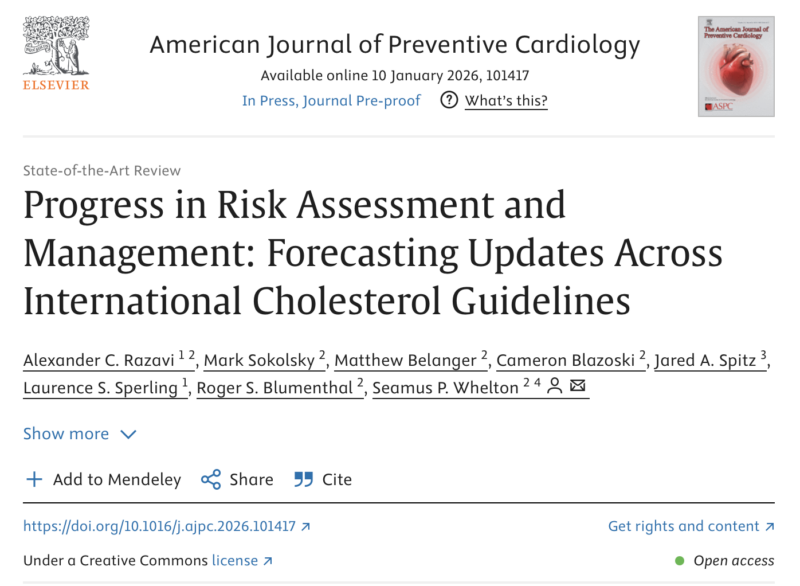
This excellent review just published American Journal of Preventive Cardiology by Alexander Razavi and colleagues maps out key updates across international cholesterol guidelines, while forecasting the next set of shifts that will shape lipid management globally.
The summary figure is especially helpful, distilling developments across risk assessment models, treatment strategies, and LDL-C targets into a structured and practical reference.
The five domains outlined
1. Risk Assessment
The shift to the PREVENT model, with more contemporary calibration and lower estimated risk for the same clinical profiles, will likely support earlier intervention in broader populations. However, an open question remains: Is this model meaningfully better than the PCE in influencing decision-making and improving outcomes at the individual level?
2. Subclinical Atherosclerosis Imaging
CAC scoring is no longer optional. Beyond its well-known role in reclassification, newer data show its potential to enhance adherence, risk communication, and treatment intensification. It should be more routinely incorporated, particularly in intermediate-risk individuals and as a tool to guide escalation in higher-risk groups.
3. Combination Lipid-Lowering Therapy
The traditional escalation model is increasingly misaligned with modern prevention goals. Trials like RACING and CLEAR Outcomes reinforce the value of early combination therapy, not only to reach LDL-C targets, but also to address clinical inertia and optimize adherence. Inclisiran may offer additional value, especially where adherence or access remains a barrier.
4. LDL-C Targets
Among patients with established ASCVD or high atherosclerotic burden, the safety and efficacy of achieving very low LDL-C levels is now supported by long-term trial data. Despite this, many patients remain above guideline-recommended thresholds. Narrowing this gap will require a shift in routine practice toward multi-agent therapy and tighter treatment monitoring.
5. Lipoprotein(a)
Universal Lp(a) testing is increasingly endorsed by major societies. Until dedicated therapies are available, prioritizing individuals with elevated Lp(a) for more intensive LDL-C lowering may represent a practical near-term strategy, especially in younger patients with family history or unexplained residual risk. Whether direct Lp(a) lowering leads to substantial outcome benefits remains to be determined.
This review offers a clear, structured lens into how the science and policy around lipid management are evolving.
The next phase will depend not only on updating guidelines, but on translating them into practical, scalable strategies.”
Read the full article here.
Article: Progress in Risk Assessment and Management: Forecasting Updates Across International Cholesterol Guidelines
Authors: Alexander C. Razavi, Mark Sokolsky, Matthew Belanger, Cameron Blazoski, Jared A. Spitz, Laurence S. Sperling, Roger S. Blumenthal, Seamus P. Whelton
Stay updated on all scientific advances with Hemostasis Today.
-
Oct 21, 2026, 10:33Karen Schreiber: Beyond Clinical Outcomes – The Voices of Women with APS
-
Oct 21, 2026, 10:11Tau Braun: Clots Through the Copper-Zinc Model
-
Oct 21, 2026, 09:55Cristina Figueroa Villalba: Celebrating Excellence in Transfusion Medicine
-
Oct 21, 2026, 09:43Ahmad Gharehbaghian: How Can Blood Supplies Be Sustained During a Crisis?
-
Oct 21, 2026, 09:30Adrián Dante De Angelis: Research That Opens New Possibilities for Recurrent iTTP
-
Oct 21, 2026, 09:13Jarod Horobin: Blood 2026 – Connecting Science and People
-
Oct 21, 2026, 08:35Raeeda Gheewala: VTE in Athletes – Risks Beyond the Playing Field
-
Oct 21, 2026, 08:29Andreas Kronbichler: The Changing Landscape of CV Risk in ANCA-Associated Vasculitis
-
Oct 21, 2026, 08:21Pham Quy: Taking Stroke Awareness Beyond Hospitals and Into the Community