


Martin Haluzík on Compariosn of Cardiovascular Outcomes Between Semaglutide and Dulaglutide Therapies
Martin Haluzík, Professor of Medicine at Institute for Clinical and Experimental Medicine, shared on LinkedIn:
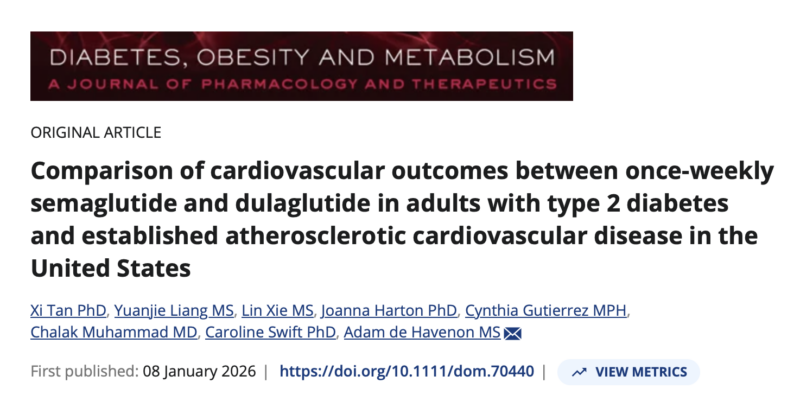
”Comparison of cardiovascular outcomes between once-weekly semaglutide and dulaglutide in adults with type 2 diabetes and established atherosclerotic cardiovascular disease in the United States
Interesting retrospective cohort study just published in Diabetes, Obesity and Metabolism by Xi Tan and colleagues.
This study aims to compare the risk of major adverse cardiovascular events (MACE) among United States individuals with type 2 diabetes (T2D) and atherosclerotic cardiovascular disease (ASCVD) treated with once-weekly semaglutide vs. dulaglutide.
This was a retrospective cohort study using Optum’s de-identified Clinformatics Data Mart (Optum CDM) from 1 January 2007 through 30 September 2024.
New initiators of semaglutide or dulaglutide ≥18 years with both T2D and ASCVD were included.
The index date was the first date of a prescription claim for semaglutide or dulaglutide within the index medication identification period (1 January 2018 through 31 March 2024).
The primary outcome was 3-point MACE (stroke, myocardial infarction [MI], cardiovascular [CV]-related death). Entropy balancing was applied to balance baseline characteristics. Weighted incidence rates per 1000 person-years and doubly robust Cox proportional hazard ratios were reported.
There were 75 243 enrolees included (semaglutide, 42 007; dulaglutide, 33 236). The mean age was 68.2 and 69.3 years (unweighted) in the semaglutide and dulaglutide cohorts, respectively. After balancing, standardized mean differences were <0.1 for all variables.
The incidence rates of the primary outcome, 3-point MACE, were 25.7 and 33.0 in the semaglutide and dulaglutide cohorts, respectively. Compared with the dulaglutide cohort, the semaglutide cohort had a 22% lower risk of 3-point MACE (hazard ratio, 0.78 [95% CI, 0.70–0.87]; p < 0.001).
Among United States Medicare Optum CDM enrolees with T2D and ASCVD, semaglutide was associated with reduced risks of CV outcomes compared with dulaglutide.
Very intersting data
- There is no direct randomized comparison between semaglutide and any other GLP-1 RA looking into CV outcomes
- Recently published SURPASS-CVOT trial A primary end-point event occurred in 801 patients (12.2%) comparing tirzepatide vs. dulaglutide in T2DM patients showed MACE hazard ratioof 0.92; 95.3% confidence interval, 0.83 to 1.01; P=0.003 for noninferiority; P=0.09 for superiority)
- The current study comparing semaglutide vs. dulaglutide is a retrospective analysis with all limitations that has to be taken into account.
- It can only give us a hint, not a final answer but it is an interesting addition to the data that have already been published”
Read the full article here.
Article: Comparison of cardiovascular outcomes between once-weekly semaglutide and dulaglutide in adults with type 2 diabetes and established atherosclerotic cardiovascular disease in the United States
Authors: Xi Tan, Yuanjie Liang, Lin Xie, Joanna Harton, Cynthia Gutierrez, Chalak Muhammad, Caroline Swift, Adam de Havenon
Stay updated on all scientific advances with Hemostasis Today.
-
Oct 10, 2026, 17:58Archo Farzana Batool: Exploring Medical Writing Through an Article on Iron Deficiency Anemia
-
Oct 10, 2026, 17:53Assessing Frailty in Adults With Hemophilia – JTH
-
Oct 10, 2026, 17:52Fatma Sadeghi: Reducing Maternal Health Inequalities Through Nursing Advocacy
-
Oct 10, 2026, 17:50Grzegorz Hensler: How Apheresis Transformed Blood Cell Separation and Collection
-
Oct 10, 2026, 17:47Hemant K Sharma: Japan’s Universal Artificial Blood Research – A Potential Breakthrough in Transfusion Medicine
-
Oct 10, 2026, 17:40John Strouse: Learning About Bleeding Disorders and Sickle Cell Disease at FWGBD
-
Oct 10, 2026, 17:34Mae Caime: Speaking at the Annual Women’s Retreat for the Hemophilia Community in Florida
-
Oct 10, 2026, 17:30Chokri Ben Lamine: PNH beyond the Textbook Triad
-
Oct 10, 2026, 17:29Ruah Alyamany: Thrombosis and Anticoagulation in Hematological Malignancies at SOHO KSA 2026