


Murad Ali: An Important Marker of Active Clot Formation and Fibrinolysis
Murad Ali, Medical Laboratory Technologist Alfalah Lab, shared on LinkedIn:
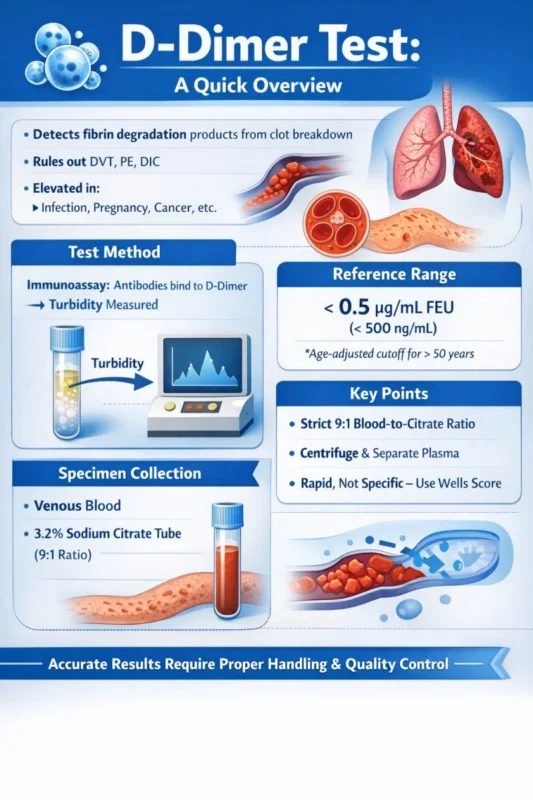
”The D-Dimer test is a coagulation assay used to detect fibrin degradation products formed when cross-linked fibrin clots are broken down by plasmin, making it an important marker of active clot formation and fibrinolysis.
It is widely used to help rule out deep vein thrombosis, pulmonary embolism, and disseminated intravascular coagulation, and is also elevated in conditions such as infection, inflammation, malignancy, pregnancy, trauma, liver disease, and advanced age; therefore, it has high sensitivity but low specificity and must be interpreted alongside clinical assessment tools like the Wells score.
The test is commonly performed using immunoturbidimetric or latex-enhanced immunoassay methods in which monoclonal antibodies bind to D-Dimer fragments, producing turbidity measured photometrically, with results typically reported as less than 0.5 µg/mL FEU (or 500 ng/mL FEU) as normal, though age-adjusted cutoffs may be applied in patients over 50 years.
The required specimen is venous blood collected in a 3.2% sodium citrate tube with a strict 9:1 blood-to-anticoagulant ratio, followed by centrifugation to obtain platelet-poor plasma; samples should be properly filled, gently mixed, centrifuged promptly, and analyzed within a few hours or stored appropriately to maintain stability.
Accurate results depend on correct pre-analytical handling, proper calibration, daily quality control, and adherence to manufacturer guidelines, as underfilled tubes, hemolysis, or improper processing can affect reliability.”
Stay updated with Hemostasis Today.
-
Nov 25, 2026, 08:57Ndembe Djeni Erwan: Sickle Cell Disease Awareness and Stigma Among Medical Students in Cameroon
-
Nov 25, 2026, 08:27Rana Zareef: Early Right Ventricular Remodeling in Pediatric Sickle Cell Disease
-
Nov 25, 2026, 08:08Jae Hyun Byun: Single-Cell Insights Into Carotid Atherosclerosis and Stroke Risk
-
Nov 25, 2026, 07:02Nicola Ammirabile: New Evidence in Structural Heart Interventions at PCR London Valves 2026
-
Nov 25, 2026, 05:58Paris Margaritis: Are LSECs the Panacea for FVIII Gene Therapy?
-
Nov 25, 2026, 05:53Rahul Kaushik: Challenging the “One-and-Done” Rule in AAV Gene Therapy
-
Nov 25, 2026, 05:45Michela Milani: WFH New Technology and Gene Therapy Workshop 2026
-
Nov 25, 2026, 05:37Ross Baker: How a WA Health Innovation is Changing Women’s Blood Health
-
Nov 25, 2026, 02:17Ahmad G. Alzahrani: Why Iron Is Low Despite High Ferritin in Inflammatory Anemia?