

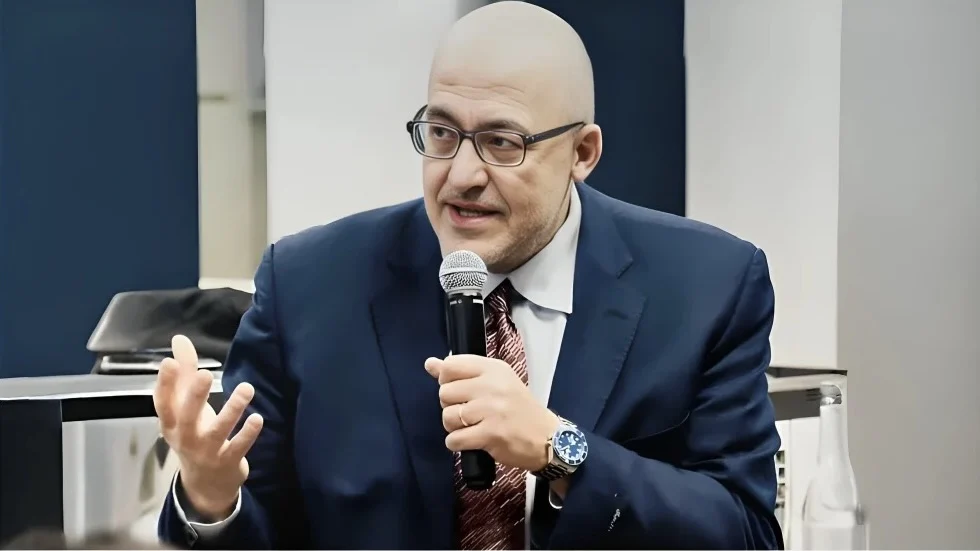
Filippo Cademartiri: Can AI Reduce Diagnostic Errors in Low-Resource Settings?
Filippo Cademartiri, Consultant Advanced Cardiovascular Imaging at UPMC Salvator Mundi International Hospital, shared on LinkedIn about a recent article by Ihsan Ayyub Qazi et al, published in Nature Health:
”Can AI reduce diagnostic errors in low-resource settings?
A randomized trial says: yes — if physicians are trained first.
Diagnostic errors are a major cause of preventable harm, especially in low- and middle-income countries (LMICs).
This rigorous randomized controlled trial in Pakistan tested whether large language model (LLM) access improves physician diagnostic reasoning — but only after structured AI-literacy training .
Study Design
60 licensed physicians
All completed a 20-hour AI-literacy curriculum
Randomized to:
- LLM (GPT-4o) + conventional resources
- Conventional resources only
6 structured clinical vignettes
Primary outcome: expert-graded diagnostic reasoning score
The Results Are Striking
LLM group: 71.4%
Control group: 42.6%
+27.5 percentage point improvement (P < 0.001)
No increase in time per case
Even more interesting:
LLM alone scored 82.9%
But in 31% of cases, physicians + LLM outperformed the LLM alone
That’s not replacement. That’s complementarity.
Key Insights
- The largest gains were seen in less experienced physicians
- Prior LLM familiarity did not guarantee better performance
- Structured AI training likely explains why this trial differs from earlier negative studies
Important Caveats
Vignette-based, not real patients
Single country
Only GPT-4o tested
Cannot isolate training vs access effects
Why This Matters
This is one of the first RCTs showing that AI plus trained clinicians significantly improves diagnostic reasoning in a resource-limited setting — without slowing workflow.
The lesson is clear:
- AI alone is powerful.
- Untrained AI use is risky.
- But trained human–AI collaboration may be transformative.
In global health, that’s not hype.
That’s potentially lifesaving.”
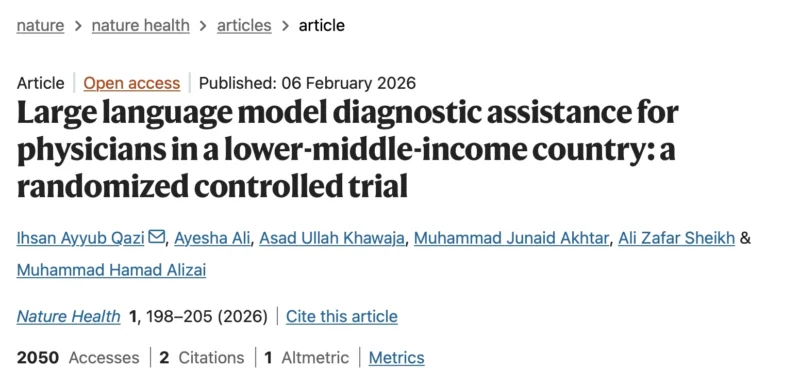
Title: Large language model diagnostic assistance for physicians in a lower-middle-income country: a randomized controlled trial
Authors: Ihsan Ayyub Qazi, Ayesha Ali, Asad Ullah Khawaja, Muhammad Junaid Akhtar, Ali Zafar Sheikh, Muhammad Hamad Alizai
Read the Full Article on Nature Health
Stay updated on all scientific advances with Hemostasis Today.
-
Oct 10, 2026, 17:58Archo Farzana Batool: Exploring Medical Writing Through an Article on Iron Deficiency Anemia
-
Oct 10, 2026, 17:53Assessing Frailty in Adults With Hemophilia – JTH
-
Oct 10, 2026, 17:52Fatma Sadeghi: Reducing Maternal Health Inequalities Through Nursing Advocacy
-
Oct 10, 2026, 17:50Grzegorz Hensler: How Apheresis Transformed Blood Cell Separation and Collection
-
Oct 10, 2026, 17:47Hemant K Sharma: Japan’s Universal Artificial Blood Research – A Potential Breakthrough in Transfusion Medicine
-
Oct 10, 2026, 17:40John Strouse: Learning About Bleeding Disorders and Sickle Cell Disease at FWGBD
-
Oct 10, 2026, 17:34Mae Caime: Speaking at the Annual Women’s Retreat for the Hemophilia Community in Florida
-
Oct 10, 2026, 17:30Chokri Ben Lamine: PNH beyond the Textbook Triad
-
Oct 10, 2026, 17:29Ruah Alyamany: Thrombosis and Anticoagulation in Hematological Malignancies at SOHO KSA 2026