


Stuart Diamond: ApoB as a Key Marker of Cardiovascular Risk
Stuart Diamond, Scientific Director at Global Integral Beauty, Medical Doctor at Geneva College of Longevity Science, and Co-Founder at Equilux – Unlock Your Biology, shared a post on LinkedIn:
“For decades, cardiovascular risk has been assessed primarily through LDL-cholesterol.
But modern lipid science increasingly points to a more fundamental driver of atherosclerosis:
Apolipoprotein B (ApoB).
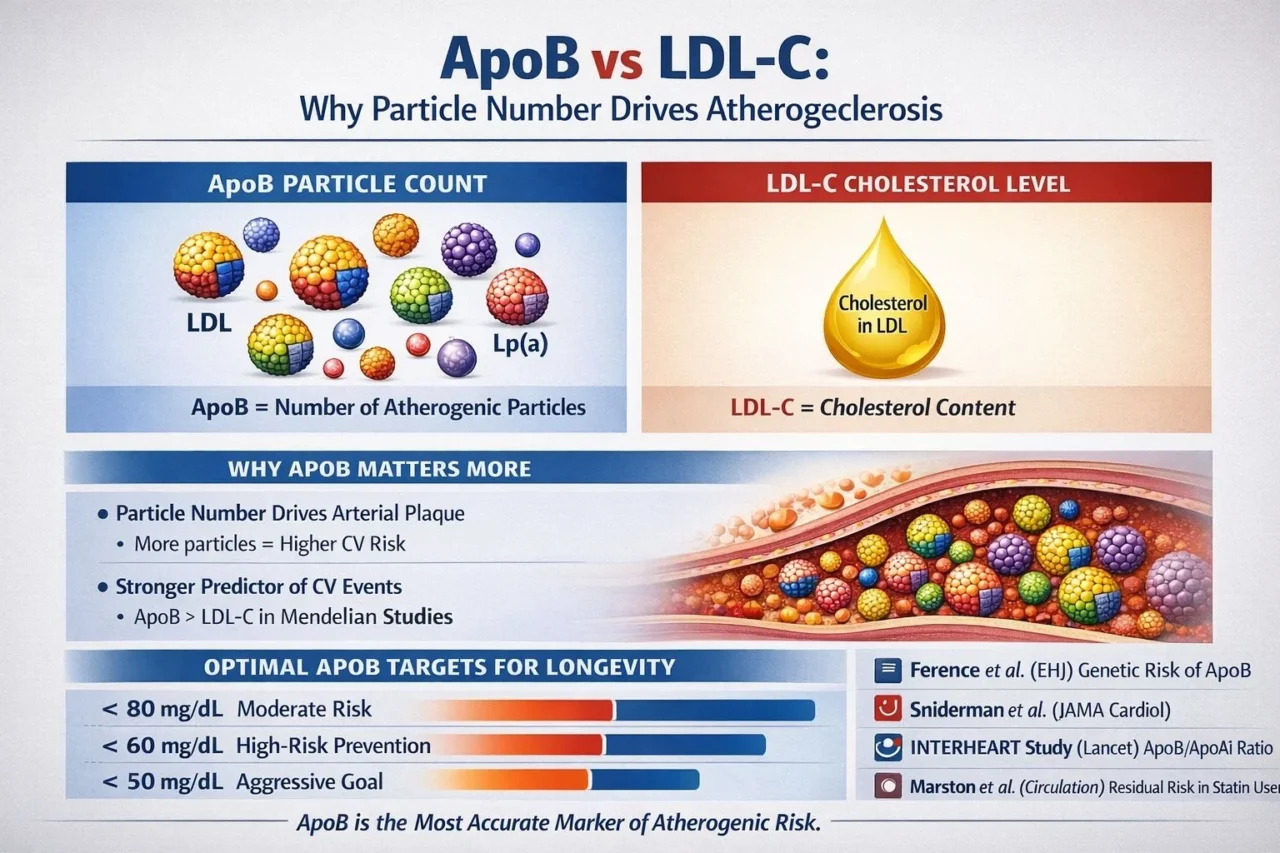
Every atherogenic lipoprotein particle – LDL, VLDL remnants, IDL, and Lp(a) – carries one ApoB molecule.
This means ApoB reflects the number of particles capable of penetrating the arterial wall and initiating plaque formation.
Two individuals can have identical LDL- C levels, yet one may have significantly more circulating atherogenic particles.
In simple terms:
- LDL-C measures cholesterol content.
- ApoB measures particle number.
Evidence continues to support this.
- Ference BA et al., European Heart Journal (2017) — genetic analyses showing cardiovascular risk proportional to cumulative exposure to ApoB lipoproteins.
- Sniderman AD et al., JAMA Cardiology (2019) — ApoB more accurately reflects atherogenic particle burden than LDL-C.
- Yusuf S et al., Lancet — INTERHEART study linking ApoB/ApoA1 ratio to myocardial infarction risk globally.
From a biological perspective the mechanism is straightforward.
Atherosclerosis begins when ApoB-containing lipoproteins cross the endothelium and become retained in the arterial intima, triggering inflammation and plaque formation.
The greater the number of circulating ApoB particles, the greater the probability of this process occurring.
Cardiovascular disease still remains the leading cause of mortality worldwide, often developing silently for decades.
Monitoring ApoB allows clinicians to detect and address risk earlier and more precisely.
Preventive targets commonly used in cardiology practices include:
- ApoB less than 80 mg/dL – moderate risk
- ApoB less than 60 mg/dL – high-risk prevention
- ApoB less than 50 mg/dL – aggressive prevention
Achieving these levels often requires lifestyle optimization and targeted therapy including statins, ezetimibe, PCSK9 inhibitors, or bempedoic acid.
What is becoming increasingly clear:
Atherosclerosis is fundamentally a disease of cumulative exposure to ApoB-containing particles.
Reducing that exposure earlier in life may be one of the most powerful ways to extend cardiovascular health and healthspan.”
Stay updated with Hemostasis Today.
-
Sep 25, 2026, 12:53Bastu Odoka: What Happened to Blood Donation?
-
Sep 25, 2026, 12:43Thomas Dayspring: Reshaping the Biology of Atherosclerotic Plaques with New Therapies
-
Sep 25, 2026, 12:14Garima Sharma: Community Clinical Linkages for Better Postpartum Cardiovascular Care
-
Sep 25, 2026, 10:49Shefina S: From Presenting to Hosting at TRANSCON 2026
-
Sep 25, 2026, 10:37Michelle Leona Cecil: Hemophilia Advocacy and the Power of Community
-
Sep 25, 2026, 10:13Michael Baria: Platelet Concentration and PRP Outcomes in Partial Rotator Cuff Tears
-
Sep 25, 2026, 09:49Haley Coleman: Volunteering to Support Hemophilia Awareness
-
Sep 25, 2026, 08:55Hitarth Mehta: BHMS Students Gain Practical Exposure to Haemophilia Diagnosis
-
Sep 25, 2026, 07:25Varun Capoor: How Therapeutic Apheresis and Transfusion Medicine Can Complement Clinical Management in SCD