


Sumedha Dash: What Happens Before a Blood Bag Reaches the Patient?
Sumedha Dash, Transfusion Medicine specialist at Institute of Medical Sciences and Sum Hospital, shared a post on LinkedIn:
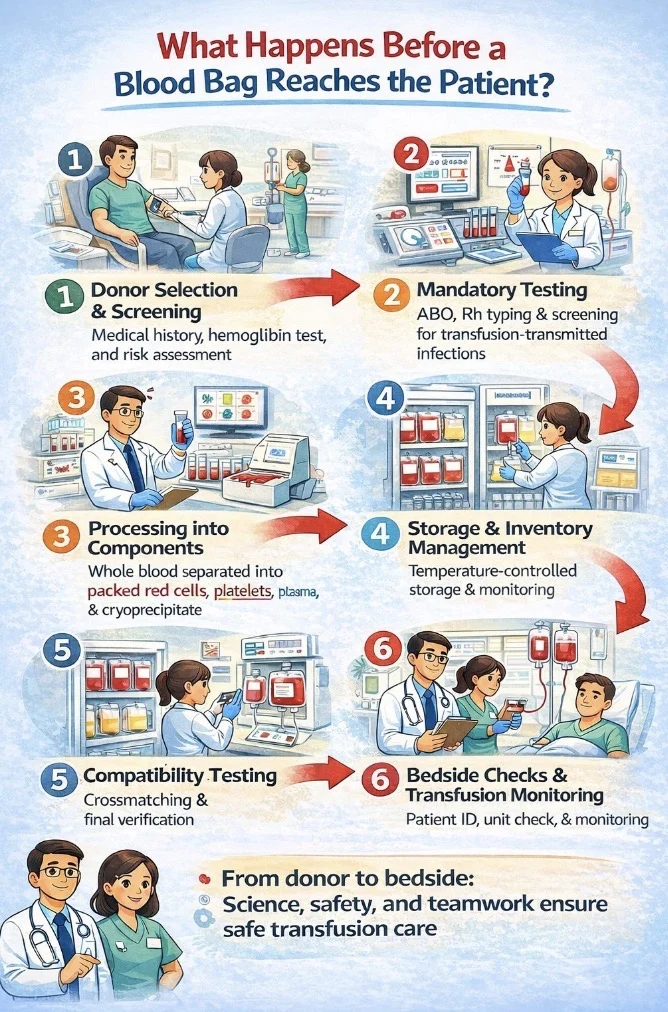
“What Happens Before a Blood Bag Reaches the Patient?
A blood transfusion may take minutes at the bedside-but the journey of that blood begins long before it reaches the patient.
- Step 1: Donor selection and screening
Every donor is carefully evaluated through medical history, hemoglobin testing, and risk assessment to ensure donor and recipient safety. - Step 2: Mandatory testing
Each unit undergoes rigorous testing for ABO and Rh typing, antibody screening, and transfusion-transmitted infections such as HIV, hepatitis B and C, syphilis, and malaria-before it is ever released. - Step 3: Processing into components
Whole blood is separated into packed red cells, platelets, plasma, and cryoprecipitate, allowing one donation to benefit multiple patients through targeted therapy. - Step 4: Storage and inventory management
Blood components are stored under strict temperature-controlled conditions, with continuous monitoring to maintain potency and safety. Quality control. - Step 5: Compatibility testing
Before issue, each unit undergoes crossmatching and final verification to ensure compatibility with the intended recipient. - Step 6: Bedside checks and transfusion monitoring Even at the bedside, safety continues-with patient identification, unit verification, and close monitoring for transfusion reactions.
At IMS and SUM Hospital, Transfusion Medicine department, blood components are stored using dedicated, component-specific storage systems, ensuring strict temperature control and regulatory compliance. Red cell units are stored separately from plasma, platelets, and cryoprecipitate, with plasma maintained in independent deep freezers to preserve clotting factor activity.
This structured approach strengthens transfusion safety, inventory management, and rapid availability of the right component for the right patient.
What reaches the patient is not just a blood bag-it is the outcome of science, systems, vigilance, and teamwork, all designed to deliver safe and effective transfusion care.”
Stay updated with Hemostasis Today.
-
Sep 18, 2026, 06:48Gopal Patidar: Honoured to Contribute to the ASFA 2026 Guidelines for Therapeutic Apheresis
-
Sep 18, 2026, 05:48Julie Taylor: Navigating Tech Glitches to Deliver Engaging BBTS Presentation
-
Sep 18, 2026, 05:42Emma Copperwaite: BBTS Conference Presentation Highlights Power of Peer Support and Pushing Past Fear
-
Sep 18, 2026, 05:34Suhasini Sil: RGSSH Joins Mega Blood Donation Camp at Thyagaraj Stadium
-
Sep 18, 2026, 05:25Lisa Laun: Spleen Clears Activated Platelets to Limit Thrombosis and Inflammation
-
Sep 18, 2026, 05:16Louise St. Germain Bannon: ISTH Advocates for Enhanced Patient Safety in Blood Disorder Care
-
Sep 18, 2026, 05:08Vikas Veer: Exploring Sickle Cell Anemia at the Molecular Level
-
Sep 18, 2026, 01:35Matthew Hazell: From Platelet Refractoriness to Protecting Transplanted Organs
-
Sep 18, 2026, 01:23Apple Joy A. Valenzuela: Exploring How Neutrophil Develops from the Myeloblast to the Mature Segmented Neutrophil