


Tareq Abadl: How One Blood Donation Saves Three Lives
Tareq Abadl, Medical Laboratory Specialist and Director of the Blood Bank at Dr. Abdelkader Al-Mutawakkil Hospital, shared a post on LinkedIn:
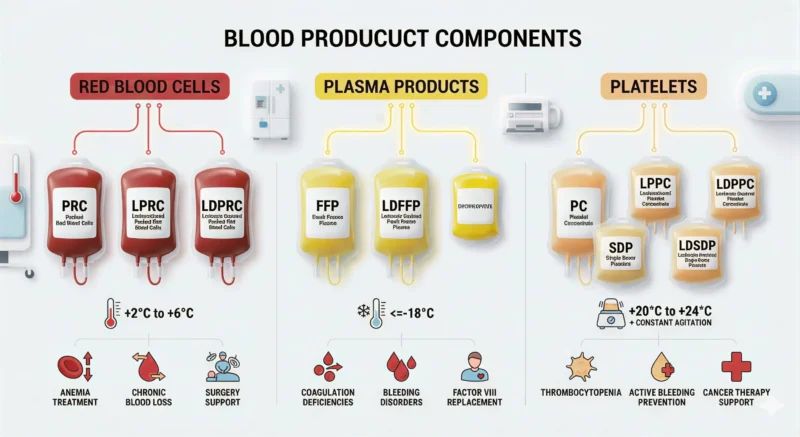
”Did you know that a single blood bag stored in the blood bank is actually separated into precise components, and each part has its own protocol for processing, storage, transport, and clinical use?
Let’s break it down in full detail:
Red Blood Cells (PRC, LPRC, LDPRC):
- PRC (Packed Red Cells):
A concentrated bag of red blood cells only. Stored at 1–6°C, with a shelf life of 35–42 days depending on the preservative solution. - LPRC:
Red cells with most white blood cells removed to reduce complications like fever or antibody formation. - LDPRC:
Almost completely free of white blood cells. Crucial for patients receiving frequent transfusions or those with immune deficiencies.
Clinical Use:
Boosting hemoglobin, compensating for blood loss, and saving patients undergoing major surgeries or internal bleeding.
Plasma (FFP, LDFFP, Cryoprecipitate):
FFP (Fresh Frozen Plasma):
Rapidly frozen at -30°C to preserve clotting factors. Shelf life can reach up to one year.
LDFFP:
Plasma with white blood cells removed to minimize immune reactions.
Cryoprecipitate:
A concentrate rich in clotting factors like fibrinogen and Factor VIII. Vital for hemophilia patients or severe bleeding cases.
Clinical Use:
Replacing clotting factors, treating liver disease, and managing complex bleeding scenarios.
Platelets (PC, LPPC, LDPPC, SDP, LDSDP):
- PC (Platelet Concentrate):
Platelets collected from a single donor. Stored at room temperature with continuous agitation to stay active. Shelf life is only 5 days. - LPPC / LDPPC:
Platelets with reduced or removed white blood cells to lower the risk of transfusion reactions. - SDP (Single Donor Platelets):
Platelets collected via apheresis from one donor, providing a higher dose. - LDSDP:
Same as SDP but with white blood cells removed.
Clinical Use:
Supporting cancer or chemotherapy patients, treating severe platelet deficiency, and controlling post-surgical bleeding.
Bonus Insight:
- Each component has strict storage and transport conditions. If these are broken, the product may lose its effectiveness.
- One donated blood bag can save three different patients: one needing red cells, one needing plasma, and one needing platelets.”
Stay updated with Hemostasis Today.
-
Sep 25, 2026, 10:49Shefina S: From Presenting to Hosting at TRANSCON 2026
-
Sep 25, 2026, 10:37Michelle Leona Cecil: Hemophilia Advocacy and the Power of Community
-
Sep 25, 2026, 10:13Michael Baria: Platelet Concentration and PRP Outcomes in Partial Rotator Cuff Tears
-
Sep 25, 2026, 09:49Haley Coleman: Volunteering to Support Hemophilia Awareness
-
Sep 25, 2026, 08:55Hitarth Mehta: BHMS Students Gain Practical Exposure to Haemophilia Diagnosis
-
Sep 25, 2026, 07:25Varun Capoor: How Therapeutic Apheresis and Transfusion Medicine Can Complement Clinical Management in SCD
-
Sep 25, 2026, 07:14Manshi Kesharwani: SAK-GQDs Modulate Thrombus Burden and Endothelial Function in Deep Vein Thrombosis
-
Sep 25, 2026, 06:20Farjah Hassan Algahtani: How Can We Better Identify Patients at Risk of Blood Clots after Metabolic and Bariatric Surgery?
-
Sep 25, 2026, 05:59Carla Lewis: Kids Conquering Sickle Disease Joins Nemours Children’s Hospital for 2nd Annual Awareness Event