


Rare Diseases, Plasma-Derived Medicines and the Elephant in the Room – Part 2
World Rare Disease Day last month of course gave due emphasis to the importance of Plasma-Derived Medicines (PDMPs). Where they are available, their value to patients suffering from rare diseases and conditions is lifesaving and life changing. Warm thanks have also been deservedly extended to the many plasma donors, in many parts of the World, who make PDMPs possible. Disappointingly however, the day’s reflections and discussions have, on the whole, rather failed to address the one aspect of rare disease care most in need of attention – the sad inadequacy of appropriate medicines supplies, worldwide.
Relph, the Reality Elephant, is still in the room – and still humbly requesting answers to some fundamental questions.
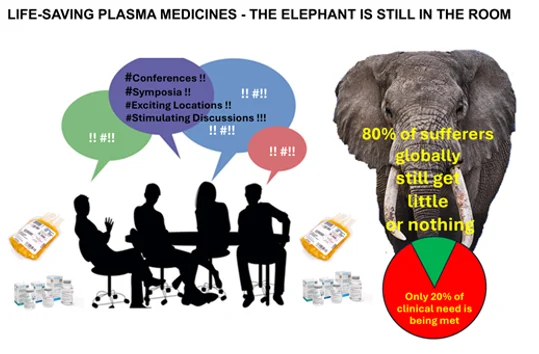
The protracted suffering and premature mortality that global PDMP shortages cause with every day that passes must surely merit far more attention – and far more determined efforts at corrective action. With an estimated 300 million people in this World still suffering without the benefit of adequate treatment, the key focus between now and the activities of World Rare Disease Day ‘27 must surely be on increased efforts to help those people, to reduce their protracted suffering, and deliver significant achievements in terms of reduced rare disease mortality.
So far, so obvious ….. but how?
The answer to that question may be less obvious to many. It is very easy to over-complicate and is often misrepresented; but it is in fact quite straightforward. There are, of course, multiple other factors that contribute to these difficulties, but the main cause is a severe global shortage of the required raw material – human plasma.
Taking Immunoglobulin (Ig) as an example, tables 1 and 2 offer a closer look at current levels of inequity, globally.
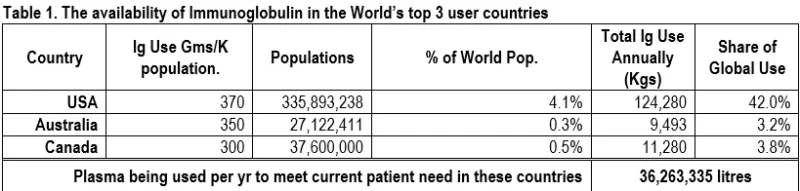
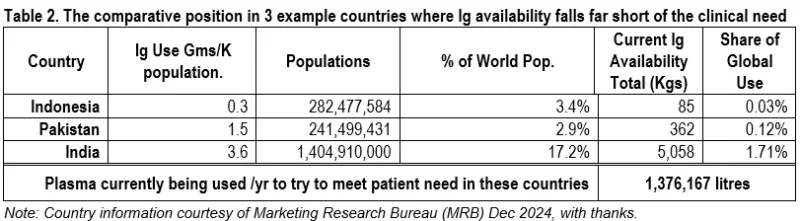
So, at the top end, three rich countries with a combined population of less than 5% of the global total have the use of 50% of the total global supply of Immunoglobulin; while three less fortunate countries, representing more than 20% of the global population, also needing Immunoglobulin, only benefit from less than 2% of what’s available. This is hardly surprising, given that the USA alone is contributing some 75% of the current total global plasma supply; and only relatively tiny amounts of plasma are being collected from donors anywhere in the poorer parts of the World. However, though unsurprising, the situation is surely also unacceptable.
In an attempt to focus the challenge, the table below sets out a vision in which the three example nations achieve a level of Immunoglobulin supply that matches the average Ig availability in the top ten Ig user countries, globally 170 gms of Ig per thousand population. Given the wide range of levels of Ig use, even in High Income Countries, and the significant differences of opinion that have been recorded in relation to the optimal national availability of this precious medicine, it doesn’t seem appropriate yet to advocate for all countries to achieve the 300gm+ levels of the USA, Australia and Canada. However, the average of the clinical consensus in the top ten countries feels like a sensible place to start – as an immediate development aspiration (cf Table 3).
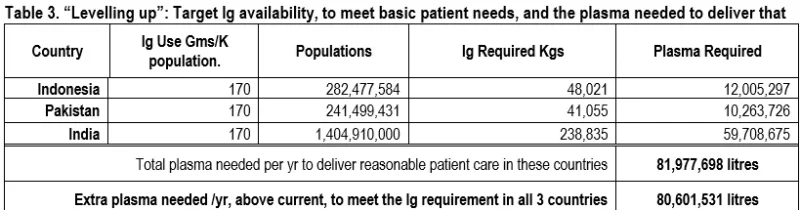
Yes …. in these three nations alone, an extra 80 million litres of plasma will be needed each year if appropriate treatment is to be provided for rare disease sufferers in need of Immunoglobulin. After the rousing celebrations of Rare Disease Day ‘26, this must surely be a sobering thought – and, surely, a loud call to action.
The overall global situation is summarised in Table 4, showing the current position and the situation as it would be if all nations were to achieve the target Ig availability of at least 170 gms per thousand population per year:

So – nearly a quarter of a billion extra litres of plasma are needed, every year, if we are to properly combat the rare diseases that afflict this World. The morbidity they cause inflicts prolonged and repetitive patient suffering on a harrowing road to eventual premature death. In addition to the inhumanity of this situation, it also has a damaging impact on Healthcare costs. It’s elimination must surely be a top priority for all concerned.
Plasma is, of course, universally plentiful. Poorer countries have as much potential access to it as others do. That only five rich countries are currently achieving a sufficient plasma supply shouldn’t be allowed to deter poorer nations from trying. For the sake of patients, globally, the collection of sufficient plasma must surely be a top priority for all countries – along with arranging its processing into the vital medicines that patients need.
Encouragingly, following the example of pioneers USA, Germany, Austria, Hungary and Czechia, now Ukraine, Uzbekistan, Egypt and others are making progress down the same road. These incipient trickles of progress must surely now become a rising flood.
Readers comments on this will be warmly welcomed. Relph, the Reality Elephant, and the rare disease sufferers he cares about, are very much looking forward to hearing your views – and your plans for action!
Written by David McIntosh, Founder and Chair at United Plasma Action.
Stay updated with Hemostasis Today.
-
Sep 30, 2026, 10:55Rana Al Hrout: Diagnostic Approach to Hypochromic Microcytic Anemia
-
Sep 30, 2026, 01:52Javed Anees: DADA2 – When a Young Stroke Is More Than a Stroke
-
Sep 30, 2026, 01:51How a Venous Thrombus Becomes Revascularized – ISTH
-
Sep 29, 2026, 22:45Victor Agunyego: Paracetamol – The Most Common Drug We Underestimate
-
Sep 29, 2026, 22:42Nova Sinclair: Advancing the Future of Hematology – Meet Our 2027 Organizing Committee
-
Sep 29, 2026, 22:41Lorenz Räber: Intracoronary Imaging in PCI – Why, When, How, and Which Modality?
-
Sep 29, 2026, 22:31Selma Turkovic: Pleased to Deliver the Opening Presentation at Kingston Hospital
-
Sep 29, 2026, 22:31Miguel Teran: Ultrasound and Simulation in Arterial Blood Sampling
-
Sep 29, 2026, 22:28Mohammad Refaei: Navigating Your Career in Hematology From Training to Practice