

Akinchan Bhardwaj: Differences in Bleeding Outcomes Among DOACs
Akinchan Bhardwaj, Consultant Interventional Cardiologist at Kauvery Hospital, shared a post on LinkedIn about a recent article by Lana A. Castellucci published in NEJM, adding:
“Two of the most commonly used anticoagulants in the world… but are they really equivalent?
For years, clinicians have treated apixaban and rivaroxaban as largely interchangeable for venous thromboembolism.
A new randomized trial published in NEJM challenges that assumption.
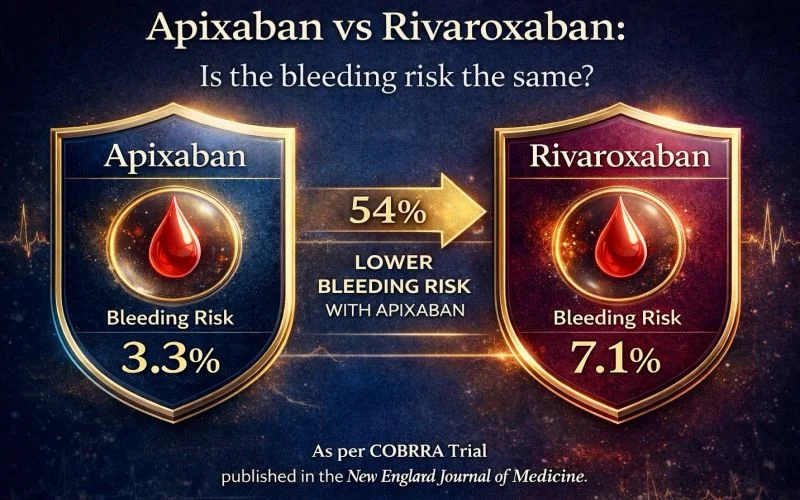
In the COBRRA trial, more than 2700 patients with acute VTE were randomized to apixaban or rivaroxaban. Striking results!
Clinically relevant bleeding
- Apixaban: 3.3%
- Rivaroxaban: 7.1%
That is about a 54% relative reduction in bleeding risk.
Importantly, this difference appeared within the first 3 months, the highest-risk phase of anticoagulation therapy.
Why this matters clinically?
- Anticoagulation decisions are rarely about efficacy alone.
- They are about balancing thrombosis prevention with bleeding risk.
- If two agents prevent clots similarly but one carries substantially less bleeding, that changes real-world prescribing decisions.
For clinicians managing:
- Pulmonary embolism
- Proximal DVT
- Early anticoagulation after diagnosis
These data may influence which DOAC becomes the default choice.
Bigger picture:
We often assume drugs within the same class behave the same.
But trial-level comparisons show us that pharmacology still matters.
Small differences in mechanism, dosing schedules, and pharmacokinetics can translate into meaningful differences for patients.
Curious how others are thinking about this.
Would this change your first-line DOAC choice in acute VTE?”
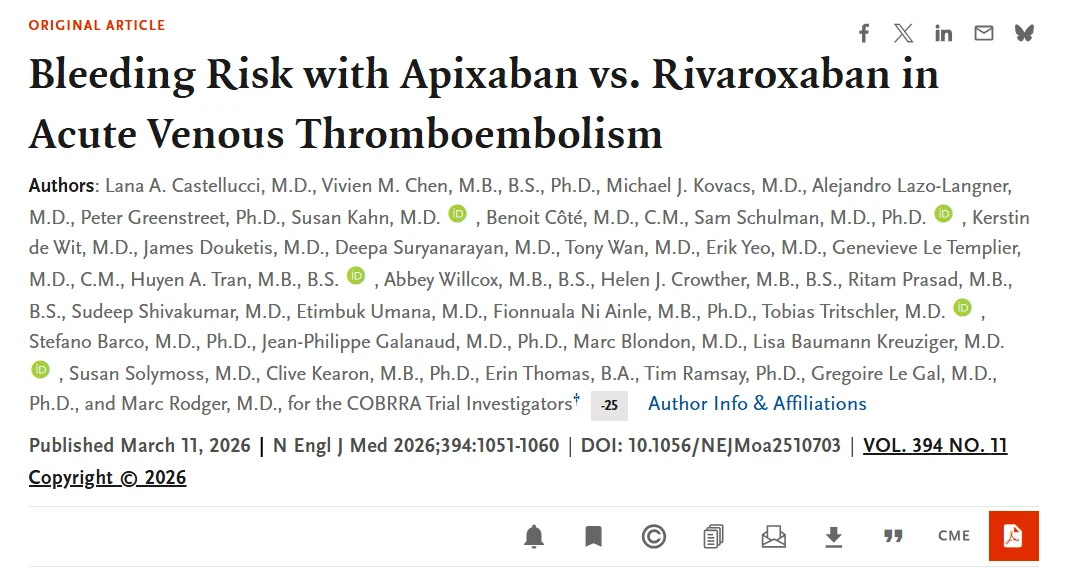
Title: Bleeding Risk with Apixaban vs. Rivaroxaban in Acute Venous Thromboembolism
Authors: Lana A. Castellucci, Vivien M. Chen, Michael J. Kovacs, Alejandro Lazo-Langner, Peter Greenstreet, Susan Kahn, Benoit Côté, Sam Schulman, Kerstin de Wit, James Douketis, Deepa Suryanarayan, Tony Wan, Erik Yeo, Genevieve Le Templier, Huyen A. Tran, Abbey Willcox, Helen J. Crowther, Ritam Prasad, Sudeep Shivakumar, Etimbuk Umana, Fionnuala Ni Ainle, Tobias Tritschler, Stefano Barco, Jean-Philippe Galanaud, Marc Blondon, Lisa Baumann Kreuziger, Susan Solymoss, Clive Kearon, Erin Thomas, Tim Ramsay, Gregoire Le Gal, Marc Rodger
Read the Full Article on NEJM
More posts featuring Akinchan Bhardwaj on Hemostasis Today.
-
Sep 25, 2026, 10:49Shefina S: From Presenting to Hosting at TRANSCON 2026
-
Sep 25, 2026, 10:37Michelle Leona Cecil: Hemophilia Advocacy and the Power of Community
-
Sep 25, 2026, 10:13Michael Baria: Platelet Concentration and PRP Outcomes in Partial Rotator Cuff Tears
-
Sep 25, 2026, 09:49Haley Coleman: Volunteering to Support Hemophilia Awareness
-
Sep 25, 2026, 08:55Hitarth Mehta: BHMS Students Gain Practical Exposure to Haemophilia Diagnosis
-
Sep 25, 2026, 07:25Varun Capoor: How Therapeutic Apheresis and Transfusion Medicine Can Complement Clinical Management in SCD
-
Sep 25, 2026, 07:14Manshi Kesharwani: SAK-GQDs Modulate Thrombus Burden and Endothelial Function in Deep Vein Thrombosis
-
Sep 25, 2026, 06:20Farjah Hassan Algahtani: How Can We Better Identify Patients at Risk of Blood Clots after Metabolic and Bariatric Surgery?
-
Sep 25, 2026, 05:59Carla Lewis: Kids Conquering Sickle Disease Joins Nemours Children’s Hospital for 2nd Annual Awareness Event