

AI Generated
Apr 12, 2026, 12:56
Chokri Ben Lamine: Clinical Dosing and Special Populations Guide for Apixaban
Chokri Ben Lamine, Adult Hematology and SCT Assistant Consultant at Oncology Center of Excellence at King Faisal Specialist Hospital and Research Center, shared a post on X:
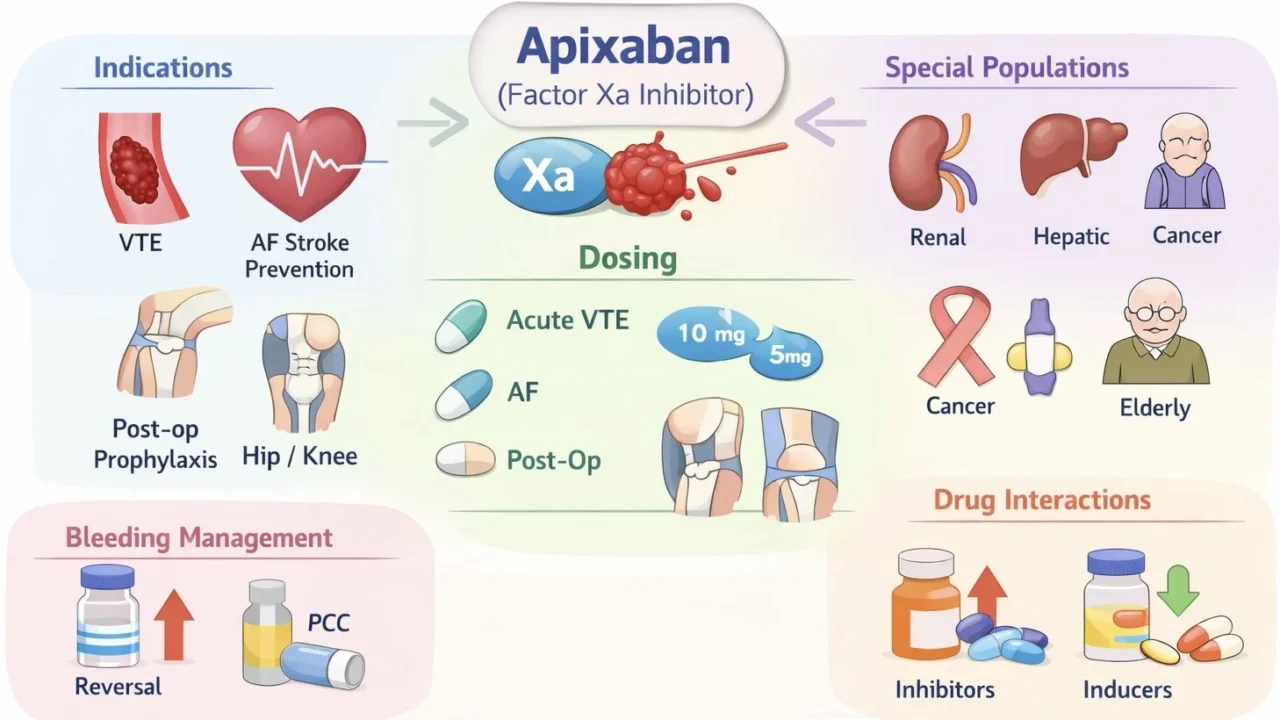
“Apixaban Pearls (Indications, Dosing plus, and Special Populations)
Mechanism
- Leads to Direct Factor Xa inhibitor leads to decrease thrombin generation
Indications
- VTE treatment (DVT/PE)
- Extended VTE prophylaxis
- Stroke prevention in AF (NVAF)
- Post-op prophylaxis (hip/knee)
Dosing (Adults)
Acute VTE
- 10 mg twice daily for 7 days
- Then 5 mg twice daily
Extended VTE
- 2.5 mg twice daily after at least 6 months of treatment
AF stroke prevention
- 5 mg twice daily
Dose reduction AF
- 2.5 mg twice daily if ≥2 of the following are present:
- Age ≥80 years
- Body weight ≤60 kg
- Serum creatinine ≥133 µmol/L (≈1.5 mg/dL)
Post-operative prophylaxis
- Hip replacement: 2.5 mg twice daily for 35 days
- Knee replacement: 2.5 mg twice daily for 12 days
Special Populations
Renal impairment
- Creatinine clearance ≥30 mL/min: standard dosing
- Creatinine clearance 15–29 mL/min: use with caution (dose reduction in atrial fibrillation)
- Creatinine clearance <15 mL/min or dialysis: limited evidence; avoid use (prefer warfarin)
Hepatic disease
- Mild (Child–Pugh A): use without dose adjustment
- Moderate (Child–Pugh B): use with caution
- Severe (Child–Pugh C): not recommended / contraindicated
Cancer-associated VTE
- Preferred option: DOAC in many patients (vs LMWH, depending on bleeding risk and cancer type)
- Avoid: if active gastrointestinal or genitourinary lesions due to increased bleeding risk
Obesity
- BMI >40 kg/m² or weight >120 kg: use with caution
- Consider drug level monitoring (anti–Xa activity) or alternative anticoagulation (LMWH or warfarin)
Elderly
- Increased bleeding risk
- Assess carefully for dose reduction criteria and comorbidities
Pregnancy
- Not recommended
- Use low-molecular-weight heparin (LMWH)
Breastfeeding
- Not recommended (insufficient safety data)
Antiphospholipid syndrome (APS)
- Not recommended, particularly in triple-positive APS
- Prefer warfarin
Drug interactions
- Strong CYP3A4/P-gp inhibitors (e.g., azoles, clarithromycin): increased bleeding risk
- Strong inducers (e.g., rifampin, carbamazepine): reduced efficacy
Bleeding management
- Specific reversal agent: andexanet alfa (if available)
- If unavailable: prothrombin complex concentrate (PCC)
Key pearl
- Apixaban has one of the safest bleeding profiles among direct oral anticoagulants in many hematology patients.”
Find more posts featuring Chokri Ben Lamine on Hemostasis Today.
-
Oct 12, 2026, 10:36PAI-1 Inhibition as a New Strategy for Enhancing Fibrinolysis and Clot Resolution
-
Oct 12, 2026, 07:39Emmanuel J Favaloro: 100 Years of von Willebrand Disease and the Importance of Local Diagnosis and Management
-
Oct 12, 2026, 07:39Post-Stroke Fatigue Trajectories – 38% Recovered at 12 Months, While 16% Developed New Fatigue – International Journal of Stroke
-
Oct 12, 2026, 07:28Beth Sara: IBMS Specialist Portfolio Achievement and a New Role in Transfusion Practice
-
Oct 12, 2026, 07:28Abdul Mannan: PCC vs. aPCC – The Small ‘a’ That Changes Emergency Management
-
Oct 12, 2026, 07:20Mokhtar Tazik: Improving Access to Plasma Derived Medicines Through Awareness, Interest and Accessibility
-
Oct 12, 2026, 07:08Larissa Chastain: Partnering to Transform Anticoagulation Management Through INR Self-Testing
-
Oct 12, 2026, 06:57Saiful Islam: Laboratory Spot Check – Microcytic Anemias and The Thalassemia Spectrum
-
Oct 12, 2026, 06:45Nick Lenamon: Stroke Awareness at Any Age Recognizing the Signs and Acting FAST