


Hossam Qassem: When To Start Anticoagulation After Cerebral Aneurysm Clipping
Hossam Qassem, ICU Clinical pharmacist at Mabaret AlAsafra Group for Medical Services and Clinical Pharmacist and Infectious Diseases Specialist at Alex Knee Center, shared a post on LinkedIn:
”Your patient had a ruptured cerebral aneurysm – clipped 48 hours ago.
Now they’re in atrial fibrillation. Do you anticoagulate?
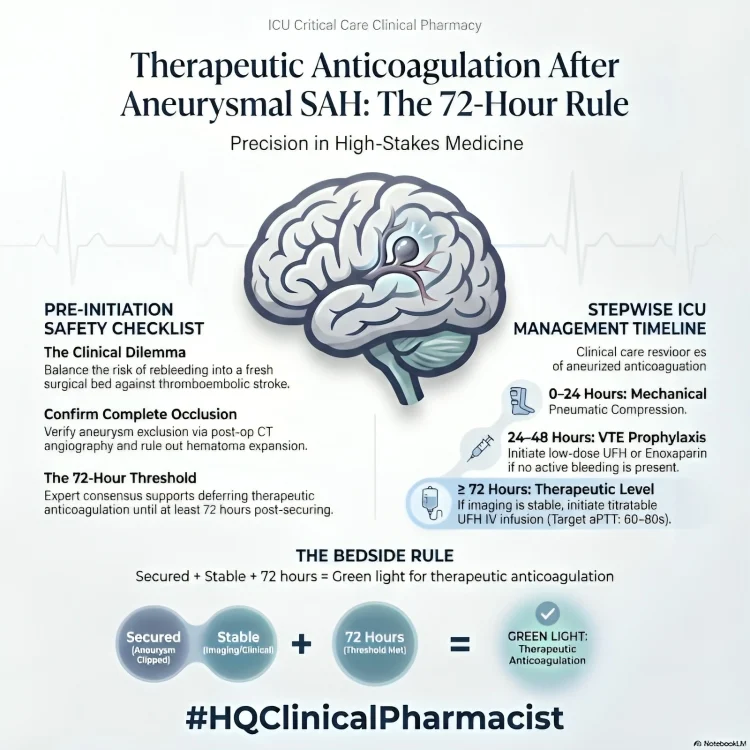
Day 150 – Therapeutic Anticoagulation After Aneurysmal SAH: Timing After Surgical Clipping
Why this matters
Delaying anticoagulation risks cardioembolic stroke, DVT, and PE.
Starting too early risks rebleeding into a fresh surgical bed.
This timing decision carries life-or-death consequences – and there is no universal consensus.
The clinical dilemma
Clot protection vs. thromboembolic prevention.
Reflex thinking says: ‘Brain bleed means hold all anticoagulation.’
Reality: A secured, clipped aneurysm is not the same as an active hemorrhage.
Recognition: when this decision arises
- Post-clipping AF with high embolic risk (CHA₂DS₂-VASc ≥ 2)
- Confirmed deep vein thrombosis or PE in the post-op window
- Mechanical heart valve – cannot defer
- Easy to miss: Delayed cerebral ischemia (DCI) can mimic stroke – confirm etiology before anticoagulating
Diagnosis
- Confirm aneurysm securing: post-op CT angiography showing complete clip occlusion
- Assess rebleeding risk window: highest in first 24-72 hrs post-clipping
- CT head: rule out surgical bed hematoma expansion before initiating
- Per Neurocritical Care Society consensus: anticoagulation timing must be individualized based on hemorrhage stability plus procedural success
No major guideline mandates a fixed restart date – but:
Most expert consensus supports deferring therapeutic anticoagulation at least 72 hours after securing, if hemostasis is confirmed.
Stepwise ICU managment
First-line (72 hrs post-clipping, stable imaging):
- Mechanical prophylaxis: pneumatic compression – start immediately post-op
- Pharmacologic VTE prophylaxis: low-dose UFH or enoxaparin 40 mg SC daily – initiate at 24-48 hrs if no active bleeding
Escalation (therapeutic need confirmed – AF, DVT, PE):
- If clipping is confirmed complete and CT is stable at 72 hours, initiate therapeutic anticoagulation
- UFH IV infusion preferred initially (reversible, titratable)
- Target aPTT: 60–80 seconds; adjust per institutional nomogram
- Transition to DOAC or warfarin at 5–7 days if neurologically stable
Rescue (mechanical valve – cannot delay):
- Restart UFH within 24–48 hrs post-clipping with neurosurgical agreement
- Bridge with UFH; avoid direct oral anticoagulants in mechanical valves
Do not anticoagulate before confirming complete aneurysm exclusion
Do not assume clipping equals zero rebleed risk in the first 24 hours
Do not use low-molecular-weight heparin when rapid reversal may be needed (renal dosing also unreliable post-SAH AKI)
Do not ignore vasospasm window (day 4-14) – anticoagulation during DCI adds hemorrhagic transformation risk
Bedside Rule:
‘Secured, stable, and 72 hours equal green light for therapeutic anticoagulation, but always with neurosurgery in the loop.’ ”
Stay updated with Hemostasis Today․
-
Oct 21, 2026, 00:58Anees Ur Rahman: Completing a Two-Week Clinical Rotation at Haemophilia Treatment Centre Rawalpindi
-
Oct 21, 2026, 00:56Caitlyn Mooney: Pulmonary Embolism in Athletes, Recognition and Return to Sport
-
Oct 21, 2026, 00:54Hani Karrar: Pleased to Share Our Review on Emicizumab in Hemophilia A Management
-
Oct 21, 2026, 00:53Akshay Sharma: HSCT Leads to Sustained Improvements in Sickle Cell Cardiomyopathy for Up to 3 Years
-
Oct 21, 2026, 00:51Prateek Meena: The F. A. T. R. N. Mnemonic for Recognizing TTP
-
Oct 20, 2026, 23:51Registration Is Open for WFH CCS 2027 – World Federation of Hemophilia
-
Oct 20, 2026, 23:44Edward Lee Carter: AF in Nursing Homes – When Stroke Risk Scores Tell Only Part of the Story
-
Oct 20, 2026, 22:59Building Effective Patient Advocacy Through Collaboration Between Patients and Clinicians – EHC
-
Oct 20, 2026, 21:22Intezar Mehdi: When Prolonged Bleeding May Indicate an Underlying Bleeding Disorder