


Kalyan Roy: Swirling as a Simple Indicator of Platelet Quality
Kalyan Roy, Transfusion Medicine Specialist at Square Hospitals LTD, shared a post on LinkedIn:
”What if a simple visual check could reliably indicate platelet quality – without complex testing?
Ensuring the quality and viability of platelet concentrates (PCs) remains a fundamental pillar of modern transfusion medicine, directly influencing patient safety and clinical outcomes.
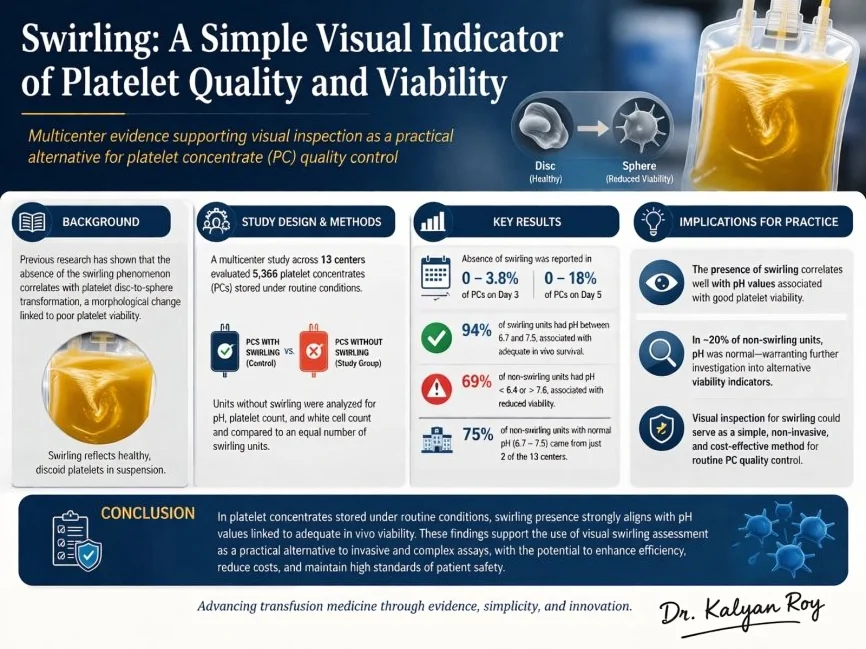
A large multicenter study across 13 centers, evaluating over 5,000 platelet units, highlights a valuable and practical insight: the visual assessment of ‘swirling’ can serve as a reliable, real-time indicator of platelet quality.
Key Observations from the Study
- Strong correlation with optimal pH
Swirling was consistently associated with pH levels between 6.7–7.5, a range linked to effective in vivo platelet survival. - Indicator of compromised platelet integrity
Approximately 69% of units lacking swirling showed pH values outside the acceptable physiological range (<6.4 or >7.6), suggesting reduced viability. - Unexplained subset requiring further research
Nearly 20% of non-swirling units had normal pH values, indicating additional underlying factors influencing platelet quality.
Why This Matters
Swirling reflects the preservation of the platelet’s discoid morphology, essential for optimal hemostatic function.
Its absence often signals transformation into a spherical form-historically associated with diminished viability and clinical performance.
Implications for Clinical Practice
- Enables rapid, bedside-compatible evaluation
- Offers a non-invasive and cost-effective alternative to complex laboratory assays
- Improves operational efficiency in transfusion services
- Maintains high standards of patient safety with minimal resource burden
In an era where healthcare systems must balance efficiency with excellence, adopting validated, low-cost tools like swirling assessment can significantly enhance routine platelet quality monitoring.”
Other posts featuring Kalyan Roy on Hemostasis Today.
-
Oct 21, 2026, 00:58Anees Ur Rahman: Completing a Two-Week Clinical Rotation at Haemophilia Treatment Centre Rawalpindi
-
Oct 21, 2026, 00:56Caitlyn Mooney: Pulmonary Embolism in Athletes, Recognition and Return to Sport
-
Oct 21, 2026, 00:54Hani Karrar: Pleased to Share Our Review on Emicizumab in Hemophilia A Management
-
Oct 21, 2026, 00:53Akshay Sharma: HSCT Leads to Sustained Improvements in Sickle Cell Cardiomyopathy for Up to 3 Years
-
Oct 21, 2026, 00:51Prateek Meena: The F. A. T. R. N. Mnemonic for Recognizing TTP
-
Oct 20, 2026, 23:51Registration Is Open for WFH CCS 2027 – World Federation of Hemophilia
-
Oct 20, 2026, 23:44Edward Lee Carter: AF in Nursing Homes – When Stroke Risk Scores Tell Only Part of the Story
-
Oct 20, 2026, 22:59Building Effective Patient Advocacy Through Collaboration Between Patients and Clinicians – EHC
-
Oct 20, 2026, 21:22Intezar Mehdi: When Prolonged Bleeding May Indicate an Underlying Bleeding Disorder