


Dr. Akhil/X
Jun 2, 2025, 07:10
Breaking Insights from Dr. Akhil: 2025 Global Platelet Transfusion Guidelines Unveiled – What’s In, What’s Out
A snapshot review of evidence-based thresholds and recommendations for platelet transfusion from Dr. Akhil on X:
Summary Breakdown – “Recommendations for Platelet Transfusion”
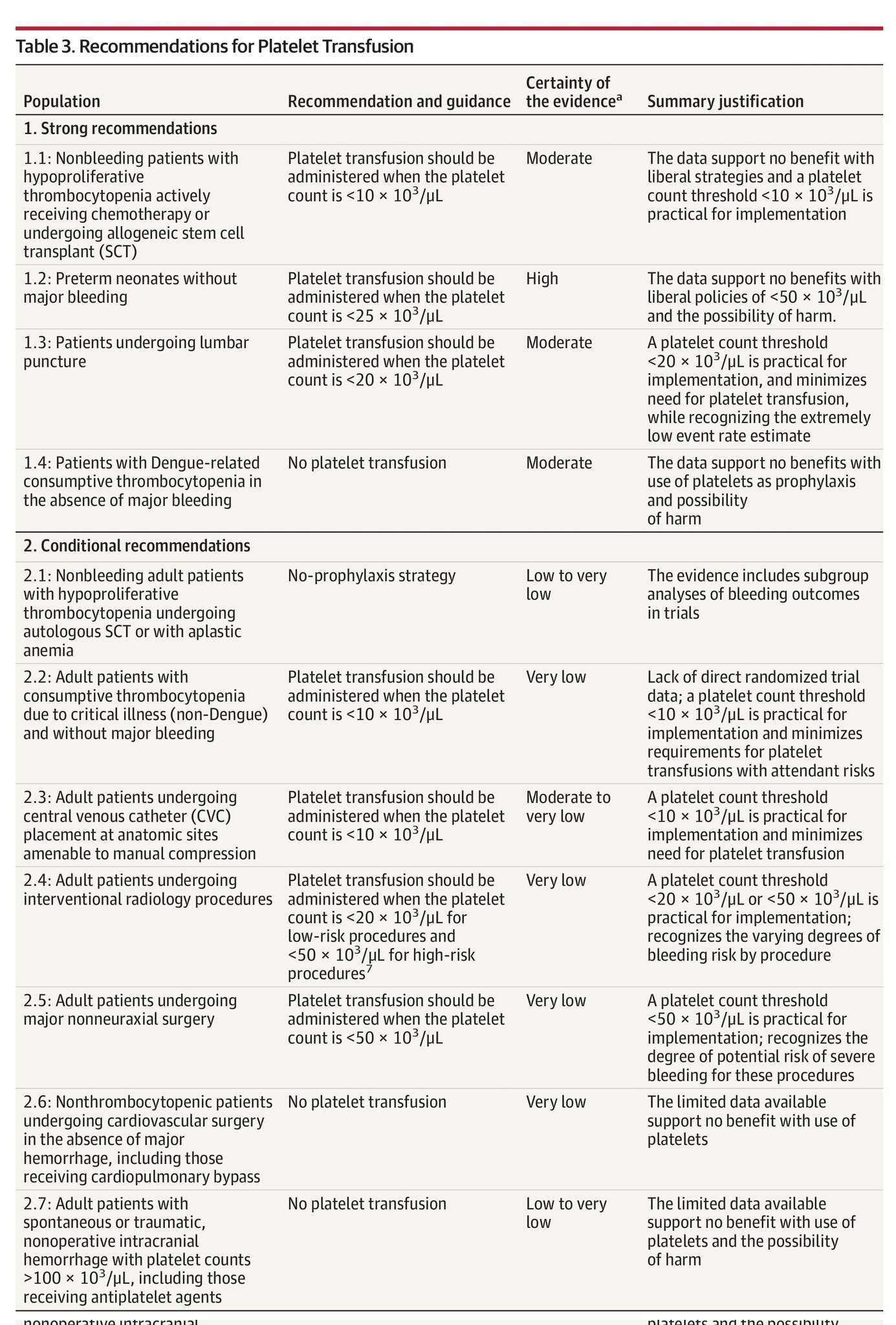
This table from the 2025 AABB and ICTMG clinical practice guidelines provides a tiered approach to platelet transfusion, based on population, clinical scenario, and quality of evidence
“Platelet Transfusion:- 2025 AABB and ICTMG International Clinical Practice Guidelines
Strong Recommendations
These are based on moderate to high certainty of evidence and clearly defined platelet thresholds.Population When to Transfuse Threshold Certainty
Nonbleeding patients with hypoproliferative thrombocytopenia (e.g., chemo, SCT) Transfuse <10 × 10³/μL: Moderate
Preterm neonates without bleeding Transfuse <25 × 10³/μL: High
Lumbar puncture Transfuse <20 × 10³/μL: Moderate
Dengue patients without major bleeding: No transfusion — Moderate
Key Message: Liberal transfusion policies (e.g., at 50 × 10³/μL) are no longer supported; stricter thresholds are both safer and evidence-based.Section 2: Conditional RecommendationsThese have low or very low certainty and apply to more nuanced clinical situations.Clinical Setting Transfusion Strategy Certainty
Adult nonbleeding patients (autologous SCT/aplastic anemia): No prophylaxis Low to very low
Critical illness (non-Dengue) without bleeding Transfuse if <10 × 10³/μL: Very low
Central venous catheter placement Transfuse if <10 × 10³/μL: Moderate to very low
Interventional radiology Transfuse if <20 × 10³/μL (low risk) or <50 × 10³/μL (high risk): Very low
Major non-neuraxial surgery Transfuse if <50 × 10³/μL: Very low
Nonthrombocytopenic cardiovascular surgery (no bleeding): No transfusion – Very low
Intracranial hemorrhage (>100 × 10³/μL) on antiplatelets: No transfusion- Low to very low
Clinical Takeaways:
Restrictive transfusion thresholds (<10–20 × 10³/μL) are widely favored, even for invasive procedures.
Platelet transfusion is not recommended in several settings where bleeding is not present, including:
Dengue-associated thrombocytopenia
Intracranial hemorrhage with normal/high platelet counts
Cardiovascular surgery without thrombocytopenia
High-risk interventions may require transfusion at slightly higher thresholds (e.g., <50 × 10³/μL), but this is based on low certainty evidence.”
2025 AABB and ICTMG International Clinical Practice Guidelines
You can find the details in Hemostasis Today.
-
Nov 8, 2026, 11:56Why Genetic Predisposition Does Not Always Lead to Thrombosis – Stork Genetics
-
Nov 8, 2026, 11:45Sher-Lu Pai: Investigating Intracardiac Thrombosis and Its Management in Liver Transplantation
-
Nov 8, 2026, 11:25Mehmet Cilingiroglu: Navigating Anticoagulation Choices in Acute Coronary Syndrome PCI
-
Nov 8, 2026, 07:16Gilberto de lima Lopes Junior: The Cardiovascular Consequences of Cancer in Younger Patients
-
Nov 8, 2026, 06:51Haney Mallemat: Key Principles and Pitfalls of LVAD Emergencies
-
Nov 8, 2026, 06:31Maria Omer: Clinical Recognition and Management of Cavernous Sinus Thrombosis
-
Nov 8, 2026, 06:16Natasha Jolakoski: University of New Mexico Hospital Promotes PGY-2 Thrombosis and Hemostasis Management Pharmacy Residency
-
Nov 8, 2026, 05:47Safaa Hilal: POCUS in the Evaluation of Perioperative Troponin Elevation
-
Nov 8, 2026, 05:34Eugene Bolotin: Thrombosis and Survival in Pancreatic Cancer