

Sip Wijchers: Is It Time to Use Ultrasound for Every AF Ablation Access?
Sip Wijchers, Cardiologist-electrophysiologist at Erasmus MC, shared a post on LinkedIn:
”We’ve optimized anticoagulation in AF ablation. But what about the puncture?
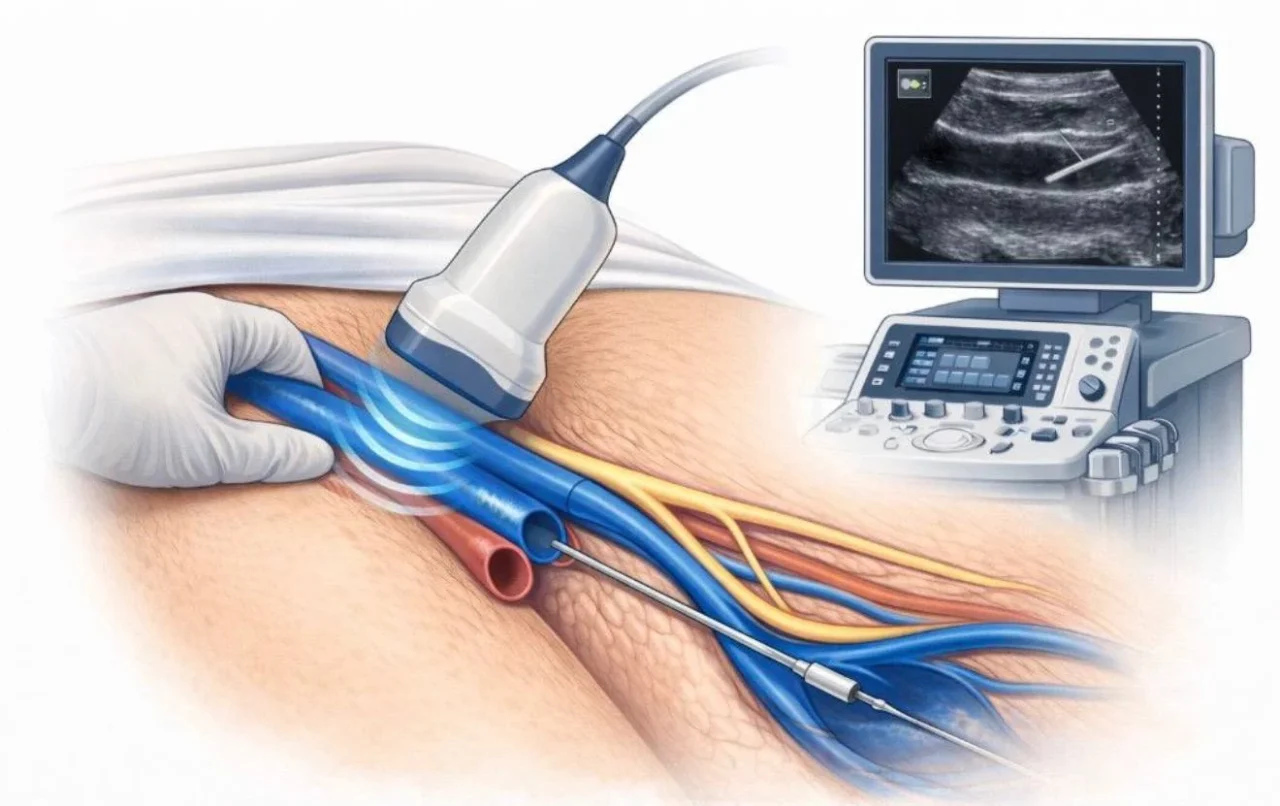
Vascular access complications remain the most common adverse event in AF ablation. And yet, many labs still rely on landmark-based femoral venous access.
The ULYSSES trial challenges that habit.
In 986 patients undergoing AF/LA tachycardia ablation, ultrasound-guided access reduced clinically relevant vascular complications from 3.3% to 0.6% (RR 0.19, p=0.002) (Schaack et al., 2026).
But the real signal may be elsewhere:
- Arterial puncture: 16% – 2%
- Failed venous access: 8.2% – 0.2%
- No increase in procedure time
This is not about marginal gains.
This is about predictability and safety at the very first step of the procedure.
And importantly, this aligns with decades of data across vascular access:
Ultrasound improves success and reduces complications in central lines, subclavian access, and femoral arterial puncture (Teja et al., 2024; Zawadka et al., 2023; Strauss et al., 2025).
So the real question is no longer does it help?
It’s:
Can we still justify not using it?
- Yes, the absolute risk reduction is modest.
- Yes, the trial was stopped early.
But when a low-cost, widely available tool reduces the most frequent complication of a high-volume procedure… the bar for “routine use” should be low.
Should ultrasound-guided femoral venous access now be the default in AF ablation?
Or is palpation still acceptable in experienced hands?
Curious how this is implemented in your lab.”
Stay updated with Hemostasis Today.
-
Sep 30, 2026, 01:52Javed Anees: DADA2 – When a Young Stroke Is More Than a Stroke
-
Sep 30, 2026, 01:51How a Venous Thrombus Becomes Revascularized – ISTH
-
Sep 29, 2026, 22:45Victor Agunyego: Paracetamol – The Most Common Drug We Underestimate
-
Sep 29, 2026, 22:42Nova Sinclair: Advancing the Future of Hematology – Meet Our 2027 Organizing Committee
-
Sep 29, 2026, 22:41Lorenz Räber: Intracoronary Imaging in PCI – Why, When, How, and Which Modality?
-
Sep 29, 2026, 22:31Selma Turkovic: Pleased to Deliver the Opening Presentation at Kingston Hospital
-
Sep 29, 2026, 22:31Miguel Teran: Ultrasound and Simulation in Arterial Blood Sampling
-
Sep 29, 2026, 22:28Mohammad Refaei: Navigating Your Career in Hematology From Training to Practice
-
Sep 29, 2026, 22:27Matteo Foschi: 10 Clinical Pearls for Antithrombotic Therapy in Secondary Stroke Prevention