


Akmez Latona: Clauss vs PT-Derived Fibrinogen in Relation to Viscoelastic Clot Strength
Akmez Latona, Specialist Emergency Physician at Queensland Health, reposted from RPTH Journal on LinkedIn:
”Coagulation profiles in Queensland Health report two fibrinogen measures: Clauss and PT-derived.
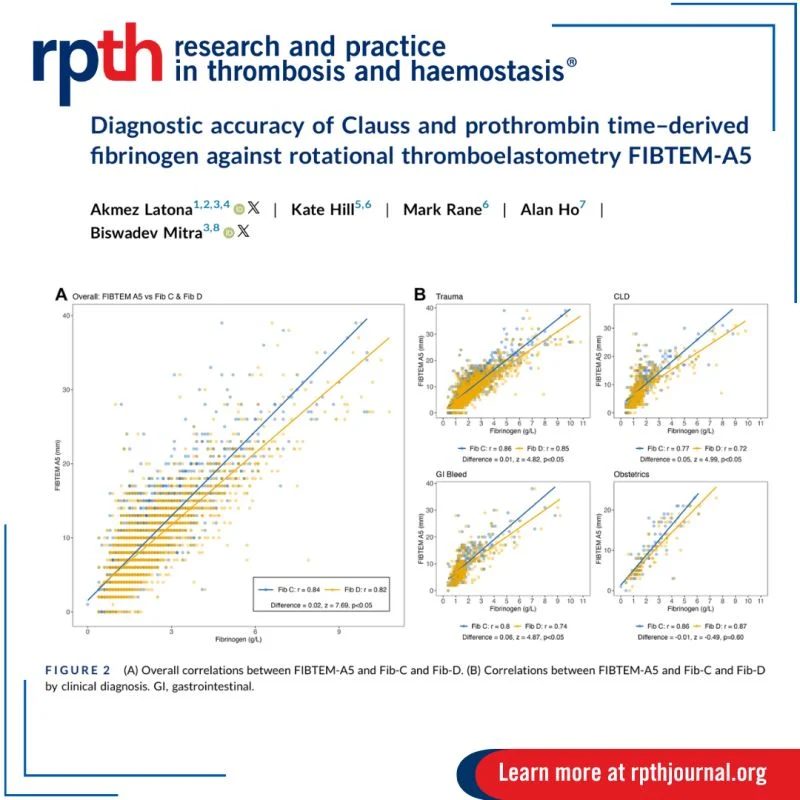
A novel aspect we introduced is the comparison of Clauss and PT-derived fibrinogen with viscoelastic clot firmness (ROTEM FIBTEM A5) across different domains of coagulopathy.
The findings show these tests are not interchangeable in context of low clot firmness and inform recommendations for fibrinogen reporting in critical bleeding within laboratory workflows.
Thank you Emergency Medicine Foundation – Australasia (EMF) for funding this study!”
RPTH Journal shared on LinkedIn about a recent article by Akmez Latona et al, adding:
”Fibrinogen testing in critical bleeding: Clauss or PT-derived, does it matter?
Two common assays are used to measure Fibrinogen: the Clauss method (Fib-C), considered the laboratory gold standard, and the prothrombin time-derived assay (Fib-D), a faster and cheaper alternative.
But are they interchangeable?
A new study in RPTH Journal compared both methods against viscoelastic clot firmness (ROTEM FIBTEM-A5) across all Queensland Health hospitals, using over 2,200 paired results from 2019 to 2025.
Key findings:
- Fib-C correlated more strongly with FIBTEM-A5 than Fib-D
- Fib-C showed higher accuracy for detecting critically low clot firmness
- Fib-D systematically overestimated fibrinogen levels compared with Fib-C – in trauma, chronic liver disease, and overall
The clinical implication is clear: in critical bleeding, Fib-C better reflects true clot firmness, and routine Fib-D reporting may be misleading rather than helpful.”
Title: Diagnostic accuracy of Clauss and prothrombin time–derived fibrinogen against rotational thromboelastometry FIBTEM-A5
Authors: Akmez Latona, Kate Hill, Mark Rane, Alan Ho, Biswadev Mitra
Stay updated on all scientific advances with Hemostasis Today.
-
Sep 25, 2026, 07:25Varun Capoor: How Therapeutic Apheresis and Transfusion Medicine Can Complement Clinical Management in SCD
-
Sep 25, 2026, 07:14Manshi Kesharwani: SAK-GQDs Modulate Thrombus Burden and Endothelial Function in Deep Vein Thrombosis
-
Sep 25, 2026, 06:20Farjah Hassan Algahtani: How Can We Better Identify Patients at Risk of Blood Clots after Metabolic and Bariatric Surgery?
-
Sep 25, 2026, 05:59Carla Lewis: Kids Conquering Sickle Disease Joins Nemours Children’s Hospital for 2nd Annual Awareness Event
-
Sep 25, 2026, 05:47Omid Seidizadeh: Evolutionary Constraint and Population Variation Across Coagulation Genes
-
Sep 25, 2026, 05:40Gerald Bertrand: Presenting UMi-NGS Non-Invasive Foetal HPA Genotyping at DGTI 2026
-
Sep 25, 2026, 05:33Urge Congress to support the Sickle Cell Disease Comprehensive Care Act – ASH
-
Sep 25, 2026, 05:24Isabelle Mahé: Reduced-Dose Apixaban in Extended CAT Treatment
-
Sep 25, 2026, 05:15Maria Cherska: High Cholesterol Isn’t Always Diet or Lifestyle – Sometimes It’s Genetic