


Yesehak Abraham: Enoxaparin Is The Quiet Hero in Clot Prevention
Yesehak Abraham, Social Media Manger at Sheromeda Gebya, Sales and Marketing Officer at Ze-el Pharmaceutical Import, shared a post on LinkedIn:
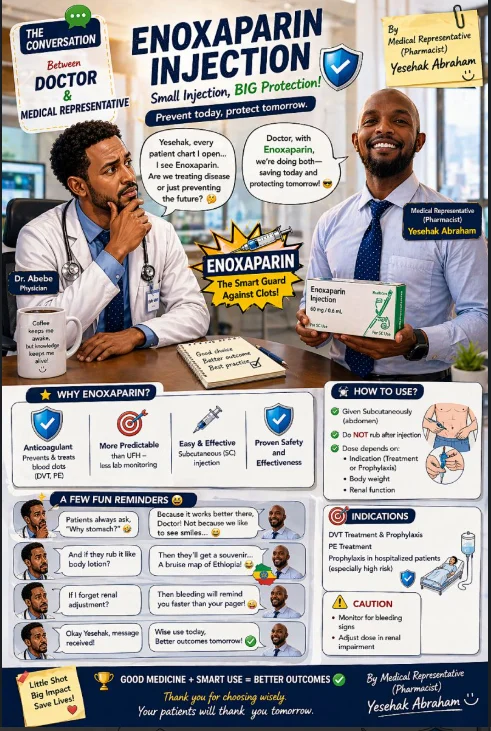
“Enoxaparin: The Quiet Hero in Blood Clot Prevention
Most people never think about blood clots… until they become a problem.
That’s where Enoxaparin steps in a small injection with a big clinical impact.
What it does :
It helps prevent dangerous clots by slowing down specific clotting factors (especially Factor Xa), keeping blood flow smooth and safe.
Where it’s commonly used:
- Post – surgery patients
- Bedridden or immobile patients
- Acute coronary syndromes
- DVT/PE prevention and treatment
Clinical reality:
Predictable. Effective. No routine monitoring in most cases.
But always respect renal function and bleeding risk.
‘Enoxaparin doesn’t dissolve clots… it just politely stops them from forming group chats in your bloodstream.’
Patient reminder:
- Small bruises can be normal
- Don’t massage injection sites
- Report unusual bleeding immediately
Final thought:
Sometimes the most powerful treatments are not dramatic – just precise, consistent, and quietly life – saving.”
Stay updated with Hemostasis Today.
-
Sep 30, 2026, 01:52Javed Anees: DADA2 – When a Young Stroke Is More Than a Stroke
-
Sep 30, 2026, 01:51How a Venous Thrombus Becomes Revascularized – ISTH
-
Sep 29, 2026, 22:45Victor Agunyego: Paracetamol – The Most Common Drug We Underestimate
-
Sep 29, 2026, 22:42Nova Sinclair: Advancing the Future of Hematology – Meet Our 2027 Organizing Committee
-
Sep 29, 2026, 22:41Lorenz Räber: Intracoronary Imaging in PCI – Why, When, How, and Which Modality?
-
Sep 29, 2026, 22:31Selma Turkovic: Pleased to Deliver the Opening Presentation at Kingston Hospital
-
Sep 29, 2026, 22:31Miguel Teran: Ultrasound and Simulation in Arterial Blood Sampling
-
Sep 29, 2026, 22:28Mohammad Refaei: Navigating Your Career in Hematology From Training to Practice
-
Sep 29, 2026, 22:27Matteo Foschi: 10 Clinical Pearls for Antithrombotic Therapy in Secondary Stroke Prevention