


Could Albuminuria Be an Overlooked Marker of Thrombotic Risk? – RPTH Journal
RPTH Journal shared a post on LinkedIn about a recent article by Xiu Hong Yang et al, adding:
”Could albuminuria be an overlooked marker of thrombotic risk?
We usually think of the urine albumin-to-creatinine ratio (UACR) as a kidney or cardiovascular marker.
But what if it also reflects systemic thrombotic vulnerability?
A new prospective RPTH study of 419,282 UK Biobank participants examined the relationship between albuminuria and future arterial thromboembolism (ATE) and pulmonary embolism (PE).
Here’s the key signal:
- Moderate albuminuria (UACR 3–30 mg/mmol) increased ATE risk
- Severe albuminuria (>30 mg/mmol) increased the risk of both ATE and c
- Risk intensified further with reduced kidney function or low serum albumin
What’s changing under the hood:
- Albuminuria reflects endothelial dysfunction and vascular injury
- Associated with platelet activation and hypercoagulability
- Linked to inflammatory pathways (CRP, VWF, ADAMTS13)
- Suggests a systemic prothrombotic state – not just kidney disease
(Figures 1–3 show dose-dependent increases in thrombotic risk with rising UACR)
Translation:
Albuminuria may not simply mark renal injury; it may identify patients with heightened endothelial and thrombotic dysfunction.
Big questions for the field:
- Should UACR be incorporated into thrombosis risk assessment?
- Is albuminuria a mediator of thrombosis – or a marker of systemic vascular injury?
- Could aggressive treatment of albuminuria reduce thromboembolic events?”
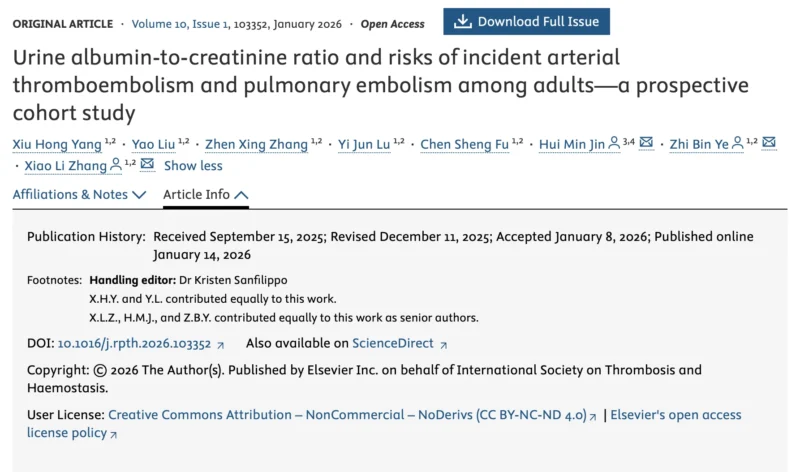
Title: Urine albumin-to-creatinine ratio and risks of incident arterial thromboembolism and pulmonary embolism among adults—a prospective cohort study
Authors: Xiu Hong Yang, Yao Liu, Zhen Xing Zhang, Yi Jun Lu, Chen Sheng Fu, Hui Min Jin, Zhi Bin Ye, Xiao Li Zhang
Stay updated on all scientific advances with Hemostasis Today.
-
Nov 8, 2026, 19:31Anna Kajaste-Rudnitski: Presenting AAV-Induced p53 Signalling in Human CNS Cells at ESGCT 26
-
Nov 8, 2026, 19:29David McIntosh: Cybersecurity Matters, but Blood Availability Remains the Bigger Challenge
-
Nov 8, 2026, 19:26Wenxue Ma: An Integrative Framework for Macrophage-Mediated Therapeutic Resistance in Cancer
-
Nov 8, 2026, 19:25Yildiz Yigit: Presenting a Polycythemia Vera Case at the MPN Subcommittee Session
-
Nov 8, 2026, 18:56Denis Oduor: Strengthening the Regulation and Delivery of Blood Transfusion and Transplantation Services
-
Nov 8, 2026, 18:28Raghavendra Rao: A Narrative Review on Chronic Venous Disease during Pregnancy
-
Nov 8, 2026, 17:57Dhiren Patel: PLD1-Derived Phospholipids Regulate NAD Kinase and ROS Production in Neutrophils
-
Nov 8, 2026, 17:48Andra T.: What Causes Antiphospholipid Syndrome? – Four Steps, not One Cause
-
Nov 8, 2026, 17:38Nasrin Samadi: Can a Normal Clotting Test Be Misleading?