


Ney Carter Borges: POAF and Long-Term Outcomes After Cardiac Surgery
Ney Carter Borges, Member Cardiologist of Global Physician Association at Cleveland Clinic Florida, shared a post on LinkedIn:
“Postoperative Atrial Fibrillation (POAF) After Cardiac Surgery.
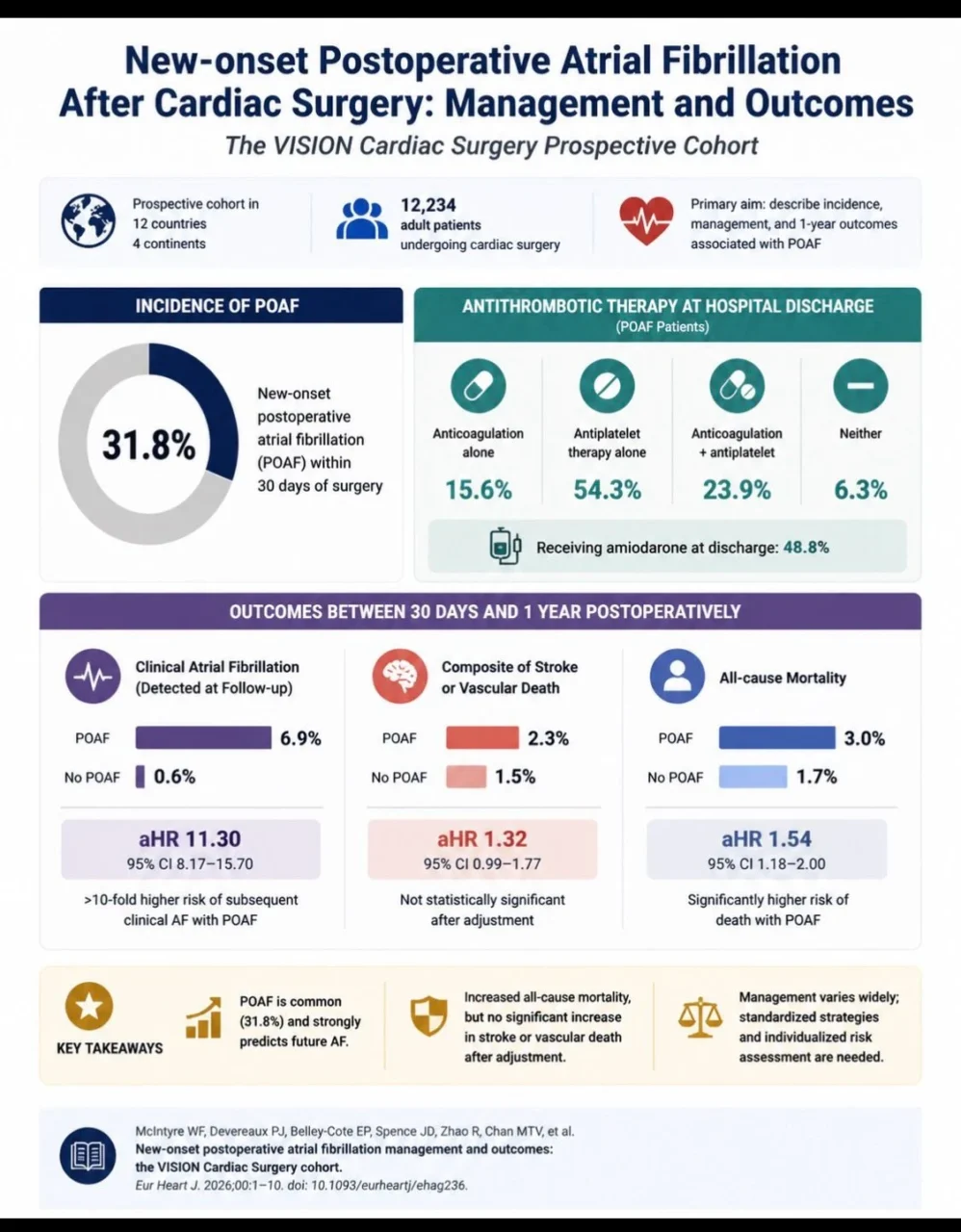
In a large prospective, multinational cohort (VISION Cardiac Surgery; n = 12,234), new-onset postoperative atrial fibrillation (POAF) occurred in 31.8 percent of patients within 30 days of surgery, confirming its status as the most frequent postoperative complication.
From a prognostic standpoint, POAF was strongly associated with subsequent atrial fibrillation: 6.9 percent versus 0.6 percent, corresponding to an adjusted hazard ratio (aHR) of 11.30 (95 percent CI 8.17–15.70), indicating a more than 10-fold increased risk.
Regarding hard outcomes between 30 days and 1 year:
- The composite of stroke or vascular death occurred in 2.3 percent versus 1.5 percent (aHR 1.32; 95percent CI 0.99–1.77), not reaching statistical significance after adjustment.
- All-cause mortality was significantly higher in POAF patients (3.0 percent versus 1.7 percent), with an aHR of 1.54 (95 percent CI 1.18–2.00).
Importantly, absolute stroke rates remained low (approximately 0.7 percent overall), suggesting that POAF may function more as a risk marker than a direct causal driver of thromboembolic events.
Therapeutic strategies were heterogeneous: only 39.4 percent of POAF patients received oral anticoagulation at discharge, while 48.8 percent were treated with amiodarone, reflecting substantial global variability in management.
Conclusion: POAF is common and clinically meaningful, conferring increased mortality and markedly higher AF recurrence, but with a modest and statistically uncertain impact on thromboembolic outcomes.
These findings highlight the need for individualized risk stratification and more standardized management strategies.”
Other posts featuring Ney Carter Borges on Hemostasis Today.
-
Sep 29, 2026, 13:12Wolfgang Miesbach: Teclistamab Targets the Source of Pathogenic Autoantibodies
-
Sep 29, 2026, 12:37Dan Milikovsky: Uncovering Cerebrovascular Injury in Sickle Cell Disease
-
Sep 29, 2026, 12:02Hajra Malik: Bridging Language Gaps in Hematology With AI
-
Sep 29, 2026, 11:57Joan Montaner: Can Blood Test Identify Intracerebral Hemorrhage Within Minutes?
-
Sep 29, 2026, 11:43From Years Without Answers to Life With Hemophilia Care – WFH
-
Sep 29, 2026, 11:32Sara Al Dallal: Transforming Hemophilia Care Across the Gulf
-
Sep 29, 2026, 11:21Richard Davis: Rapid Rescue in Massive Pulmonary Embolism
-
Sep 29, 2026, 11:14Nissan Brown: Every Step Counts for the Hemophilia Community
-
Sep 29, 2026, 11:03Zain Khalpey: SINGLE AF Adds New Evidence to the Anticoagulation Debate